
Learn what mobile phlebotomy is for routine blood work, how to prepare, what a doctor's order requires, and what mobile blood draw cost involves.
Concierge Lab Services for Busy Professionals: 2026 Guide
Table of Contents
- Why Busy Professionals Are Choosing Concierge Lab Services
- What Mobile Phlebotomy Services Actually Include
- How to Prepare for a Blood Test Before Your Appointment
- What Mobile Blood Draw Cost Looks Like and Who Pays
- Mobile Phlebotomy Insurance Coverage: What to Check
- Pros and Cons of Concierge Lab Services for Busy Professionals
- What Happens After Collection: Specimen Handling and Results
- Frequently Asked Questions
Last Updated: October 21, 2026
Why Busy Professionals Are Choosing Concierge Lab Services
Concierge lab services for busy professionals replace the trip to a draw site with a scheduled visit to your home or office. At Phlebotomy Experts, we built our practice on a simple observation: the blood draw takes minutes, but the trip around it can eat half a morning.
Consider what a standard lab visit actually costs you. You block your calendar, drive to a patient service center, hunt for parking, and check in. Then you wait, often behind a room full of walk-ins.
For anyone billing hours or managing a team, that lost time is the real expense. Concierge lab services exist to remove it.
The Real Time Cost of a Traditional Lab Visit
The hidden cost of a clinic visit is rarely the draw. It is the buffer time around it, padding before and after because you cannot predict the wait. That padding disappears when a licensed phlebotomist comes to you.
There is a second cost that gets less attention: repeat draws. A difficult vein or a nervous patient can turn one visit into two.
What Mobile Phlebotomy Services Actually Include
Mobile phlebotomy services bring the collection to your location: a licensed phlebotomist arrives with supplies, performs the venipuncture, and handles specimen transport to the laboratory you or your clinician choose.
Here is what a typical visit involves:
- Scheduling at your convenience, including early mornings before work or evenings at home
- A licensed phlebotomist arriving with sterile collection equipment and tubes matched to your test order
- Venipuncture performed at your kitchen table, office, or hotel room, with privacy and a calm pace
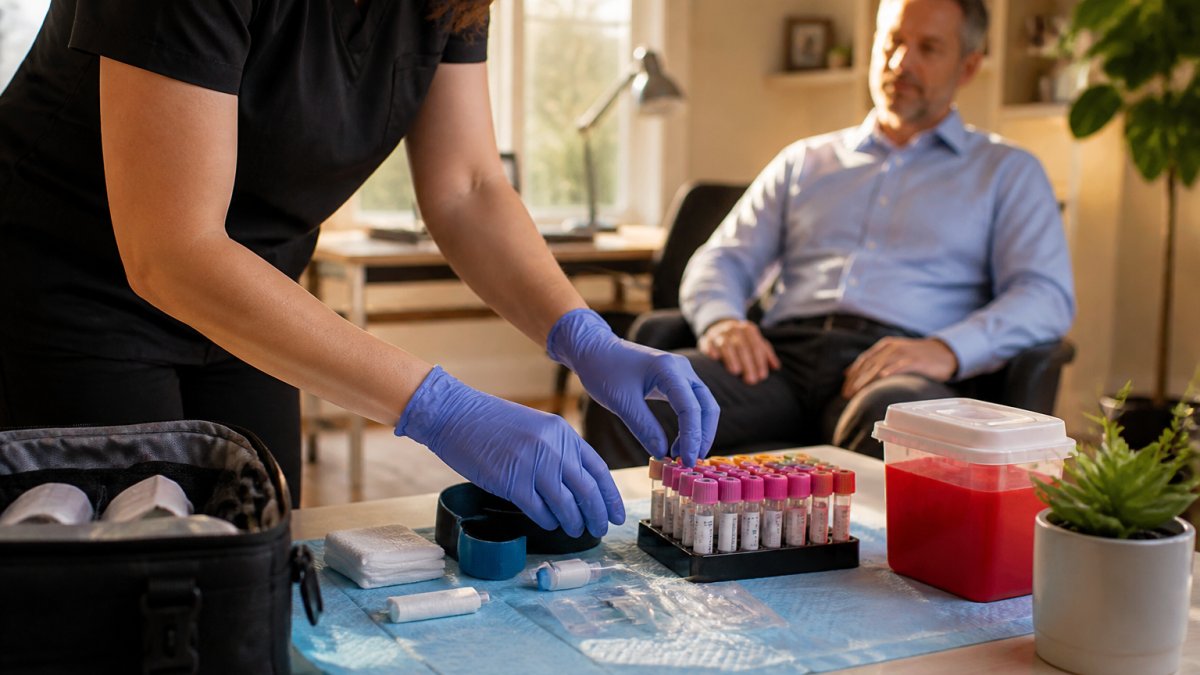
What most people do not realize is how much of the service is logistics. Proper specimen handling matters as much as a clean draw.
How to Prepare for a Blood Test Before Your Appointment
Preparation starts with your test order, not your appointment time. The most common reason a home draw has to be repeated is a preventable preparation error: the wrong fasting window, an unlabeled tube, or a collection area that makes a clean draw harder than it needs to be. The steps below turn preparation into a checklist.
Step 1: Confirm the Order and the Tests
Before you schedule anything, confirm three things with the ordering clinician:
- The exact test names on the order, not just “routine blood work.” Fasting rules, tube types, and handling requirements differ by test.
- Whether the order is current. Most laboratories will not accept an expired requisition, and some tests require a diagnosis code or medical necessity documentation.
- Whether the test is supported for home collection. A small number of tests require processing within minutes of collection or specialized handling a mobile visit cannot support. Confirm with the ordering clinician or performing laboratory before you book.
A mobile phlebotomist collects a test a clinician has already ordered. The service does not order tests, diagnose, or interpret results, that stays with your clinician and the laboratory.
Step 2: Lock In Fasting, Hydration, and Medication Timing
Fasting rules vary by panel. Some require nothing at all; others ask for a window without food, and a few are sensitive to what you drink. Follow the instructions attached to your specific order, not a general rule you found online.
- Fasting: Confirm the required window with your clinician or the performing laboratory. Do not guess, and do not extend a fast “to be safe”, an overly long fast can affect some results as much as a short one.
- Water: Drink normally unless told otherwise. Staying hydrated makes veins easier to find, which matters for difficult draws and shortens the visit.
- Medication: Ask your clinician about timing before skipping or delaying anything. Never change a medication schedule on your own.
Pro Tip
Schedule the draw for a time when you are naturally warm and hydrated. A brisk walk before the appointment and a glass of water can make a vein easier to access, which shortens the visit for everyone.
Schedule the draw for a time when you are naturally warm and hydrated. A brisk walk before the appointment and a glass of water can make a vein easier to access, which shortens the visit for everyone.
Step 3: Prepare the Collection Area
A home draw goes faster when the phlebotomist has a clean, well-lit space with room to set up. Before the visit:
- Clear a table or counter near an outlet if the phlebotomist needs light or equipment power.
- Provide a chair with armrests and enough space to extend your arm comfortably.
- Have your photo ID and insurance card (if applicable) within reach, plus the printed or digital test order.
Step 4: Confirm the Logistics the Day Before
A short confirmation the day before prevents most failed visits:
- Address and access details: gate codes, parking instructions, building security, and which entrance to use.
- Timing window: confirm the arrival window and how the phlebotomist will contact you on arrival.
- Identification requirements: ask what the phlebotomist will need to see, and have it ready.
Step 5: Know What to Expect During the Visit
A routine home draw typically takes minutes once the phlebotomist is set up. Expect them to verify your identity and order, confirm fasting status, select a vein, cleanse the site, collect tubes in the order the tests require, label each tube at the point of collection, and package the specimens for transport.
Good preparation protects the sample and can spare you a repeat visit, the difference between a five-minute visit and a lost morning.
What Mobile Blood Draw Cost Looks Like and Who Pays
Mobile blood draw cost usually has two parts: a collection fee for the visit itself and the laboratory’s charge for analyzing the sample. The collection fee pays for convenience; the lab charge depends on which tests your clinician ordered. Understanding how each part is billed prevents most surprise bills.
The Two Charges, Explained
- Collection fee (the mobile visit): This covers the phlebotomist’s time, travel, supplies, and specimen transport. It is typically a flat fee per visit, though some services quote per-draw or per-tube pricing. Because travel distance and scheduling window affect cost, the fee is usually confirmed at booking rather than published as a national rate.
- Laboratory charge (the analysis): This is billed by the laboratory that runs the tests, not by the mobile service. It depends on the specific tests, the laboratory’s fee schedule, and your insurance contract. The mobile service generally does not set or collect this charge.
Some services bundle the collection fee into one upfront payment; others bill it separately and let the laboratory bill insurance for the analysis. Ask which model applies before you book, because it changes what you pay at the time of service versus what arrives later.
How Insurance Usually Handles Each Part
Coverage for medically necessary laboratory testing is common, but coverage for the mobile collection fee varies by plan. Often the plan pays for the lab analysis under the laboratory benefit while treating the mobile visit fee as a convenience charge that is not covered or is applied to the deductible.
- Is the test covered? Coverage depends on medical necessity and your plan’s rules, not on where the draw happens.
- Is the collection fee covered? Ask your insurer directly. This is the line most often excluded, and it is the question to ask first.
- Is the laboratory in network? An in-network lab keeps your out-of-pocket cost predictable. If your clinician’s preferred lab is out of network, ask whether an in-network alternative can run the same tests.
Questions to Ask Before You Book
A short call to your insurer and a short exchange with the mobile service before booking saves arguments later. Ask in this order:
- To your insurer: Does my plan cover a mobile collection fee, or only the laboratory analysis?
- To your insurer: Is the laboratory my clinician uses in my plan’s network?
- To the mobile service: What is the collection fee for my address and requested time window, and is it due at booking or after the visit?
- To the mobile service: What is the cancellation and rescheduling policy, and is there a fee for a failed draw or a no-show?
- To the mobile service: Which laboratory will receive my specimens, and how are specimens transported?
Cancellations, Failed Draws, and Rescheduling
Cost questions do not stop at the sticker price. Ask what happens if your workday shifts, if the phlebotomist cannot obtain a sample, or if a specimen is rejected by the laboratory.
Because pricing depends on your location and test order, contact us directly for current rates rather than relying on a general figure. For the rules that govern laboratory testing and privacy, the Centers for Medicare & Medicaid Services publishes guidance on coverage and laboratory services, and the HHS Office for Civil Rights explains your privacy protections under HIPAA.
Mobile Phlebotomy Insurance Coverage: What to Check
A short call to your insurer before booking saves arguments later. For the rules that govern laboratory testing and privacy, the Centers for Medicare & Medicaid Services publishes guidance on coverage and laboratory services, and the HHS Office for Civil Rights explains your privacy protections under HIPAA.
Pros and Cons of Concierge Lab Services for Busy Professionals
Concierge lab services suit people who value time and privacy over the lowest possible price. Here is an honest look at the trade-offs.
Pros:
- No travel, parking, or waiting room
- Scheduling around your workday, including early and evening slots
- A licensed phlebotomist working one patient at a time
Cons:
- A collection fee that insurance may not cover
- Service availability depends on your location
- Not every test or situation fits a home visit
Watch Out
Do not book a mobile visit for an urgent problem. Chest pain, severe shortness of breath, or sudden weakness needs emergency care, not a scheduled draw. Mobile phlebotomy is for routine and planned laboratory testing.
Do not book a mobile visit for an urgent problem. Chest pain, severe shortness of breath, or sudden weakness needs emergency care, not a scheduled draw. Mobile phlebotomy is for routine and planned laboratory testing.
When an In-Person Lab Is the Better Choice
A clinic or hospital lab remains the right call in several situations. If your clinician needs the draw done immediately, an in-person lab is faster. If your test requires special handling a mobile visit cannot support, go to the lab. And if cost is your top priority and your plan covers only in-person collection, the traditional route wins.
What Happens After Collection: Specimen Handling and Results
After collection, your sample begins a chain that ends with results in your clinician’s hands.
Results go to the clinician who ordered the tests, not directly to you in most cases.
If you need follow-up testing, the process repeats. For general information on laboratory testing and what results mean, the CDC’s laboratory quality guidance is a useful starting point, and the U.S. Food and Drug Administration explains how laboratory tests are reviewed for safety and accuracy.
Key Takeaway
The draw is the easy part. The service that matters is the chain around it: correct tubes, careful handling, timely transport, and results reaching the clinician who ordered them.
The draw is the easy part. The service that matters is the chain around it: correct tubes, careful handling, timely transport, and results reaching the clinician who ordered them.
The challenge with routine blood work is not the needle. It is fitting the visit into a schedule that has no room for it, and trusting that your sample arrives in good condition.
Frequently Asked Questions
Is mobile phlebotomy worth it for busy professionals?
For people whose schedules leave little room for a lab waiting room, it often is. A concierge lab services visit removes travel, parking, and queue time, and the draw itself takes only minutes. The trade-off is a collection fee that insurance usually does not cover. If you need recurring blood work for a chronic condition, a demanding work schedule, or limited mobility, the time saved can outweigh the fee. If you need a single routine test and have a lab nearby, a clinic visit may cost less.
How much does a mobile phlebotomist charge, and is mobile phlebotomy covered by insurance?
Mobile blood draw cost usually comes as a separate collection fee per visit. Lab processing is often billed separately by the laboratory. Mobile phlebotomy insurance coverage varies: some plans may reimburse a home draw when a clinician documents a medical need. Ask the provider and your insurer directly before booking.
How should I prepare for a mobile blood draw?
Confirm with your ordering clinician whether you need to fast, and if so for how long. Drink water in the hours before the visit, since hydration makes veins easier to find. Tell the phlebotomist about blood thinners, needle anxiety, or veins that have been hard to draw before. Clear a well-lit space with a table and chair, and have your ID, insurance card, and lab order ready. Avoid strenuous exercise right before the appointment if your test measures muscle enzymes.
Can a mobile phlebotomist collect samples for my preferred laboratory?
Many mobile phlebotomy services deliver specimens to the laboratory or hospital of the patient’s choice, provided that lab accepts outside collections and the ordering clinician’s requisition names it. Ask when you book: confirm the lab, ask how the sample is transported and how quickly it arrives, and check whether the lab has specific handling requirements for your test. Some tests are time-sensitive, so same-day delivery matters.
