Looking for at-home blood tests for toddlers? Learn which tests suit home collection, how to calm a fussy child, and when a clinic is the better choice.
Is Mobile Phlebotomy for Homebound Patients Worth It?
Last Updated: October 29, 2026
Quick Summary
Mobile phlebotomy for homebound patients is a licensed phlebotomist traveling to a patient’s residence to collect blood specimens and deliver them to the ordering laboratory. For a homebound patient, its value is rarely convenience; it is continuity of care that keeps a physician’s treatment plan on track.
- A typical visit runs from order confirmation through labeling specimens in the patient’s presence to packaging them for transport and leaving a receipt.
- Confirm that your mobile provider works with the specific laboratory your physician wants before the visit, not after.
- Fasting instructions are set by the ordering physician, not the phlebotomist, so call the physician’s office rather than guessing.
- Before booking, ask whether the draw is billed separately from the lab test and whether the provider is in network.
- Facilities should batch residents by ordering physician and schedule draws on the same day each month to reduce transport delays.
Table of Contents
- Why Mobile Phlebotomy for Homebound Patients Changes the Equation
- How Mobile Phlebotomy for Homebound Patients Actually Works
- At Home Blood Draw Services: What to Expect From a Licensed Visit
- How to Prepare for a Mobile Blood Draw
- Mobile Phlebotomy Insurance Coverage: What Medicare and Plans Pay
- Safety, Licensing, and Specimen Handling You Should Verify
- Coordinating Regular Draws for Facility Residents and Caregivers
- Scheduling a Mobile Phlebotomy Visit for a Homebound Patient
- Frequently Asked Questions
Why Mobile Phlebotomy for Homebound Patients Changes the Equation
Mobile phlebotomy for homebound patients is a licensed phlebotomist traveling to a patient’s residence to collect blood specimens and deliver them to the ordering laboratory. It removes the hardest part of routine testing for people who cannot easily leave home: the trip itself. (Source: Centers for Medicare & Medicaid Services (CMS) guidelines)
That trip is where most homebound care quietly breaks down. A patient who uses a walker, depends on oxygen, or lives with advanced dementia has to be lifted into a vehicle, transported, checked in, and seated in a waiting room, all for a draw that takes minutes. Many families simply skip the test.
This guide covers what the service involves, how coverage generally works, and what to verify before you book. Here is the core argument: for a homebound patient, the value of mobile phlebotomy is rarely convenience. It is continuity of care. A draw that happens on schedule keeps a physician’s treatment plan on track, and one that keeps getting postponed does not.
How Mobile Phlebotomy for Homebound Patients Actually Works
A typical visit is short. A licensed phlebotomist generally verifies the patient’s identity and orders, performs the draw, labels specimens, and transports them to the laboratory named on the requisition.
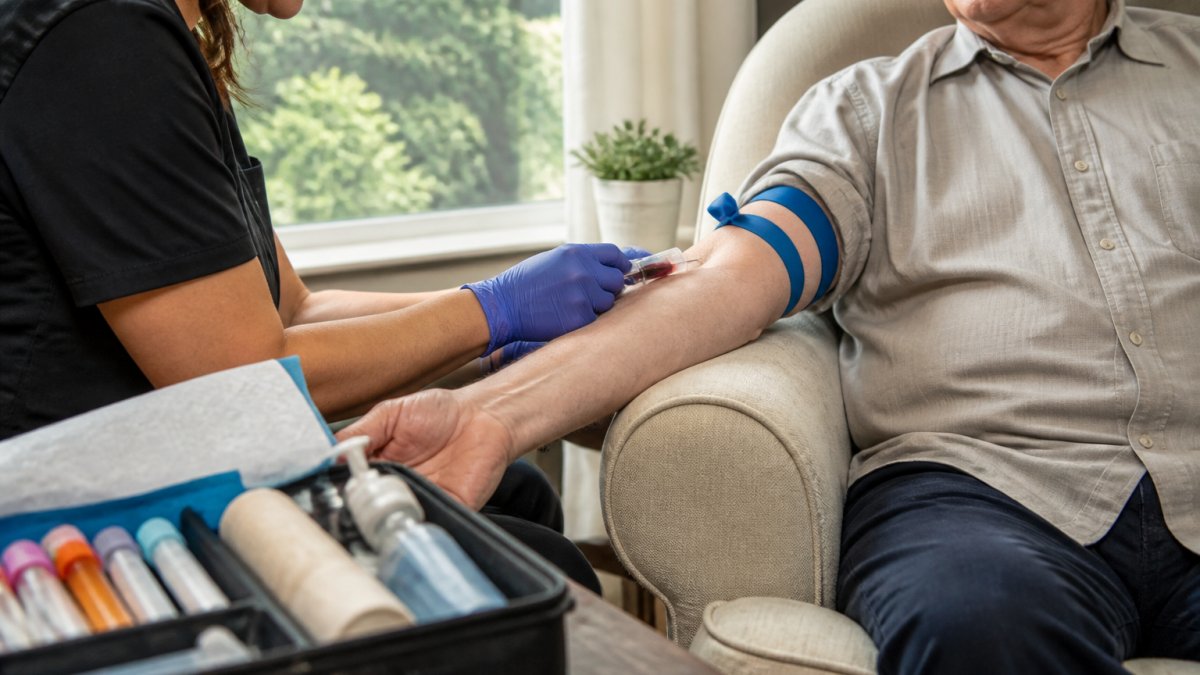
Most visits follow a standard sequence:
- Confirm the lab order and patient identifiers
- Assess the arm and select a suitable vein
- Draw the required tubes in the correct order
- Label specimens in the patient’s presence
- Package them for transport and leave a receipt
Confirm with your provider how specimens are labeled and handled before the visit.
Most visits follow a standard sequence from order confirmation to specimen transport.
| Step | What happens |
|---|---|
| 1 | Confirm the lab order and patient identifiers |
| 2 | Assess the arm and select a suitable vein |
| 3 | Draw the required tubes in the correct order |
| 4 | Label specimens in the patient’s presence |
| 5 | Package them for transport and leave a receipt |
At Home Blood Draw Services: What to Expect From a Licensed Visit
At home blood draw services vary widely in scope. Some providers send a technician for the draw only; others also coordinate the lab order, handle transport, and route results. Knowing which model you are booking prevents surprises.
Expect the phlebotomist to ask about medications, especially blood thinners, and about prior fainting or difficult veins. Expect a brief wait afterward to confirm the patient is stable before departure.
A common mistake is assuming every mobile provider works with every laboratory. Many do not. If your physician wants results sent to a specific lab, confirm that arrangement before the visit rather than after.
How to Prepare for a Mobile Blood Draw
Preparation for a mobile blood draw is mostly about following the ordering physician’s instructions, including any fasting requirement. Ask the physician’s office what applies to your test.
Practical preparation checklist:
- Confirm whether fasting is required and for how long
- Ask the physician about any medications to hold
- Have the patient drink water unless fluid-restricted
- Clear a well-lit space with a table for supplies
- Have the insurance card and lab requisition ready
- Note veins that have been difficult in the past
Watch out: fasting instructions are set by the ordering physician, not the phlebotomist. If you are unsure, call the physician’s office rather than guessing, because an unnecessary fast can be risky for frail patients. (Source: National Institute on Aging’s information on homebound individuals)
Mobile Phlebotomy Insurance Coverage: What Medicare and Plans Pay
Coverage for mobile phlebotomy depends on the service and the payer. Coverage for lab tests and for mobile draw fees varies by plan, payer, and the patient’s circumstances. Check with the payer and the official Medicare resources before booking.
The safe move is to verify before booking. Ask three questions: Is the draw billed separately from the lab test? Is the provider in network? Will the specimen go to a participating laboratory?
Many families find that a portion of the cost falls to them even when the test is covered.
Safety, Licensing, and Specimen Handling You Should Verify
Licensing requirements for phlebotomists are set at the state level and differ across states. Check the rules for your state with the relevant state health authority.
Verify these before the first visit:
- State licensure or certification status of the phlebotomist
- The provider’s infection control and needle handling practices
- Which laboratory receives the specimens and how transport is timed
- Whether the provider carries liability coverage
Specimen handling deserves scrutiny. Ask how transport is handled before booking. Ask how long transport takes and whether specimens are delivered directly or consolidated.
The CDC guidance on specimen collection and handling is a useful reference for what proper practice looks like. For questions about lab test coverage, the Medicare.gov resource on laboratory services explains the general framework.
Coordinating Regular Draws for Facility Residents and Caregivers
Facilities face a different problem than families: volume. A single phlebotomist visit that draws for one resident is inefficient; a standing schedule that covers several residents in one trip is not.
Administrators should ask whether the provider can handle recurring draws for multiple residents, how orders are tracked per patient, and how results reach each attending physician. Getting the paperwork right per resident matters more than speed.
A practical approach is to batch residents by ordering physician and schedule draws on the same day each month. That reduces transport delays and makes it easier to catch a missed or rejected specimen before it becomes a repeat visit.
For caregivers managing one patient at home, the priority shifts to consistency: same day, same time, same phlebotomist when possible. Familiarity helps with anxious patients and difficult veins alike.
Scheduling a Mobile Phlebotomy Visit for a Homebound Patient
Scheduling comes down to three inputs: a valid lab order, a confirmed address and access plan, and a payer check. Have all three before you call, and the booking takes minutes. This step-by-step scheduling guide shows how to book the visit.
When you call, state the patient’s mobility needs, whether the home has stairs or a secured entry, and any history of fainting or difficult draws. Those details shape who gets sent and how long the visit takes.
At Phlebotomy Experts, licensed phlebotomists provide in-home mobile blood draws and deliver specimens to the laboratory of the patient’s choice. For current services, availability, and pricing, contact Phlebotomy Experts directly.
Frequently Asked Questions
Is mobile phlebotomy covered by insurance or Medicare?
Coverage depends on the plan and the reason for the draw. Coverage depends on the payer, the plan, and the patient’s circumstances, and the official Medicare resources explain the current rules. Mobile phlebotomy insurance coverage varies widely, so ask the provider for a superbill and confirm with your insurer before scheduling. Keep the ordering physician’s requisition on hand, since most plans require it for reimbursement.
Can someone come to my house to take my blood?
Yes. Mobile phlebotomy services send a licensed phlebotomist to your home, office, or assisted living facility to collect specimens and deliver them to the lab your physician specified. You will need a lab order from your doctor for most tests. Confirm appointment and timing details with the provider when you book.
How do I prepare for an at-home blood draw appointment?
Confirm whether your tests require fasting, since a lipid panel or glucose test often does. Tell the phlebotomist about blood thinners, needle anxiety, or past difficult draws, and follow your physician’s instructions on fluids and fasting. Clear a well-lit space with a table and chair, have your insurance card and lab requisition ready, and arrange for someone to be present if the patient needs help with positioning. These steps make the visit faster and reduce repeat sticks.
Are mobile phlebotomists licensed and regulated?
Licensing rules differ by state. Ask the service to confirm its technicians’ current credentials under your state’s rules and whether the company carries liability insurance. A provider that answers these questions directly and can explain its specimen transport process is a better sign than one that avoids the topic.
Coordinating care for a homebound patient is demanding, and a missed draw should not be one more thing on your list. Phlebotomy Experts brings licensed phlebotomists to the home or facility, handles specimen delivery to your chosen laboratory, and supports regular draws for individual patients and facility residents. Get started with Phlebotomy Experts and keep your patient’s testing on schedule.

Related Posts