
Concierge lab services bring blood draws to your home or office. See how mobile phlebotomy works, what it costs, and how to prepare for a blood test.
What Happens to Your Blood Sample After It Leaves Home
Table of Contents
- From Your Arm to the First Label: What Happens Right After the Draw
- How Blood Samples Are Transported to the Lab
- What Happens to Blood Samples at the Lab: Accessioning and Processing
- How Long Blood Samples Last Before Testing (and What Shortens That Window)
- What Happens to Leftover Blood Samples After Testing
- When Something Goes Wrong: Delays, Hemolysis, Rejection, and Repeat Testing
- Timeline, Tracking, and How to Follow Up on Your Results
- Frequently Asked Questions
Last Updated: October 9, 2026
From Your Arm to the First Label: What Happens Right After the Draw
Once a blood sample leaves your arm, it begins a strict chain of handling designed to keep it safe, traceable, and usable. That chain starts before the needle ever comes out. At Phlebotomy Experts, our licensed phlebotomists treat those first few minutes as the most important part of the entire process, because mistakes here cannot be fixed later.
The moment your blood sample is drawn, it goes into a sealed collection tube. From there, it is labeled, packed, and handed off for transport to a laboratory.
Collection Tubes and Order of Draw
Each tube contains a specific additive that preserves the blood for a specific test. Some tubes prevent clotting. Others allow it. A common mistake is assuming all tubes are the same. They are not.
When more than one tube is needed, phlebotomists follow a set order of draw. This prevents additives from one tube contaminating another. Getting the order wrong can distort results, which means a repeat draw for you.
Patient Identification and Specimen Labeling at the Bedside
Every specimen label must carry your full name, date of birth, and collection time. This happens at your bedside, not later at the lab.
Labeling at the bedside is one of the strongest safeguards in the process. It links the blood specimen to you and only you. If a label is missing or mismatched, most labs will reject the sample outright rather than risk a wrong result.
Watch Out
Never let anyone draw blood without confirming your identity first. If a phlebotomist skips this step, speak up. An unlabeled or mislabeled sample is unusable and could lead to a wrong result if it slips through.
Never let anyone draw blood without confirming your identity first. If a phlebotomist skips this step, speak up. An unlabeled or mislabeled sample is unusable and could lead to a wrong result if it slips through.
How Blood Samples Are Transported to the Lab
Transport is where a good draw can still go wrong. How blood samples are transported to the lab depends on the test, the distance, and the time window.
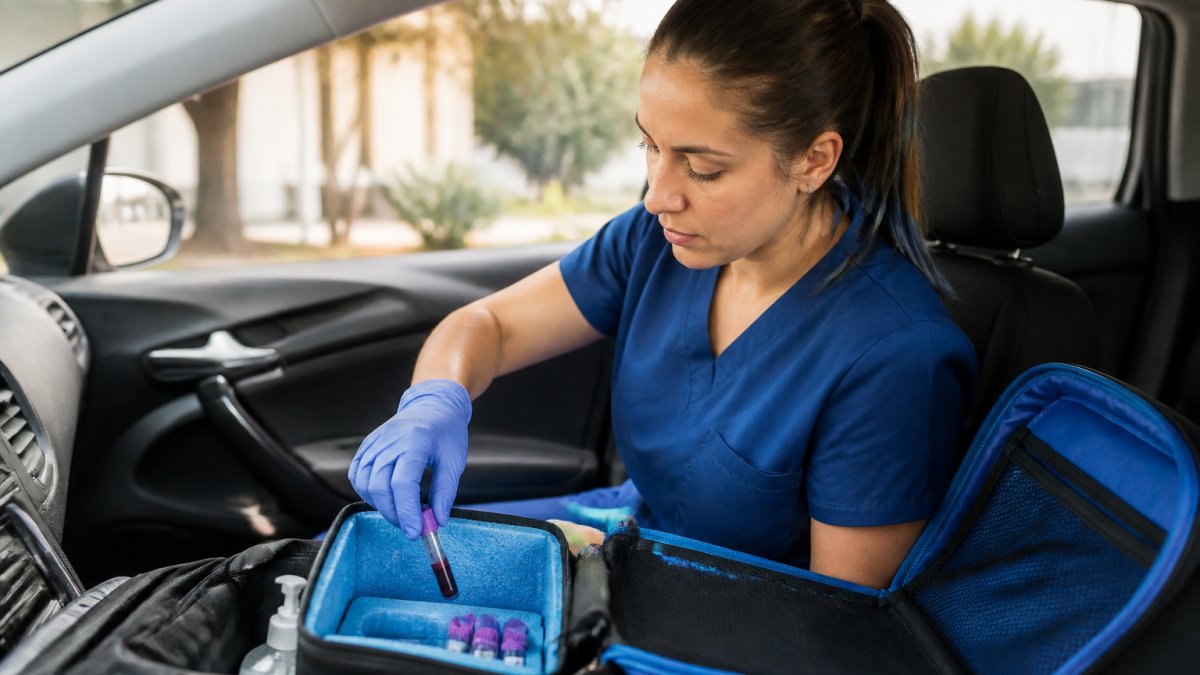
Packaging, Temperature Control, and Chain of Custody
Proper packaging does three jobs at once. It keeps tubes from breaking, holds the right temperature, and preserves a record of who handled the sample and when.
In practice, a transport container usually combines a rigid outer shell, absorbent material to contain any leak, and a secondary sealed bag around the tubes.
Temperature control is set by the test, not by convenience:
- Ambient (room temperature): many routine chemistry and hematology tests
- Refrigerated (roughly 2-8 °C): certain hormone, viral load, and specialized chemistry tests
- Frozen: a smaller set of tests that require it
- Protected from light: tests where light degrades the analyte, so the tube is wrapped or placed in an opaque sleeve
The wrong temperature can make a sample useless, and so can a delay.
That record of handling is the chain of custody.
Privacy, Identification, and Sample Security in Transit
A blood sample is confidential medical material, and it is handled that way from the moment it is sealed.
Identity is verified at two points: at collection, where the label is matched to you at the bedside, and at accessioning, where lab staff confirm the label matches the test request before the sample enters the system.
If you want to confirm how your provider handles this, ask two questions: how the sample is kept at the right temperature during pickup, and who has custody of it between your home and the lab.
Pro Tip
Ask your phlebotomy provider how they keep samples at the right temperature during pickup and who holds custody in transit. A provider who can explain their transport process clearly is usually a provider who handles specimens carefully.
Ask your phlebotomy provider how they keep samples at the right temperature during pickup and who holds custody in transit. A provider who can explain their transport process clearly is usually a provider who handles specimens carefully.
How Handling Differs by Test Type
Not every tube gets the same treatment, and the differences are worth knowing because they explain why one test comes back in a day and another takes longer:
- Routine chemistry and hematology: often ambient transport, processed the same day
- Coagulation tests: require precise fill volume and prompt processing, because the sample begins changing as soon as it is drawn
- Hormone and specialized chemistry tests: frequently refrigerated, sometimes light-protected
- Tests sensitive to time: may be couriered directly rather than batched with other pickups
If your test has special handling requirements, the collection tube, the transport temperature, and the processing timeline are all chosen to match it. That is why the same phlebotomist may pack two tubes from the same draw differently.
What Happens to Blood Samples at the Lab: Accessioning and Processing
When a blood specimen arrives at the laboratory, it is checked in through a step called accessioning. Staff confirm the label matches the test request, log the sample into the system, and assign it a tracking number.
If anything looks off, a damaged tube or a missing label, the sample is flagged. What happens to blood samples at the lab next depends on the test, but most follow a similar path. (Source: Department of Transportation (DOT) regulations for hazardous materials)
Centrifugation, Serum, Plasma, and Analyzer Testing
Many tests need blood separated into its parts before analysis. A machine called a centrifuge spins the tube at high speed. This separates the sample into serum or plasma on top and cells below.
- Serum: the liquid left after blood clots
- Plasma: the liquid portion when blood does not clot
- Whole blood: used as-is for some tests
Once separated, the liquid portion may be split into smaller portions called aliquots. Then it goes onto an analyzer, a machine that runs the actual test.
How Long Blood Samples Last Before Testing (and What Shortens That Window)
How long blood samples last before testing varies by test type. Some tests need to run within hours. Others stay stable for a day or more when stored correctly. This window is called sample viability.
Several things shorten that window:
- Delay in transport, which lets cells break down over time
- Wrong temperature, either too warm or too cold for the test
- Hemolysis, when red blood cells burst and release their contents
- Contamination from a dirty site or a mishandled tube
A common mistake is assuming a sample can sit indefinitely. It cannot. Once viability drops, results become unreliable, and the lab may ask for a repeat draw.
What Happens to Leftover Blood Samples After Testing
After testing, most of the blood sample is still there. Labs do not simply throw it away, and what happens next is one of the least-explained parts of the journey.
Retention: Why Leftovers Are Kept
Many labs keep leftover specimens in retention for a set period, commonly measured in days to weeks depending on the test and the lab’s policy.
Retention windows are not uniform. A lab may keep a routine chemistry sample for a shorter period than a specialized test, and some specimens are kept longer because the test itself is harder to repeat.
Disposal: How Leftover Specimens Are Handled
Once the retention period ends and no further testing is needed, the sample is treated as biohazard waste. It is disposed of through regulated channels, often by incineration, following the safety rules that govern medical waste. This is the same handling path used for other clinical specimens, and it is designed to prevent exposure and protect privacy.
Research Use and Consent
Some leftover specimens are used for medical research, but this is not automatic. It happens only under strict privacy and consent rules, and the rules differ by lab and by study.
This is also where a common confusion shows up: a diagnostic blood sample left over after testing is not the same thing as donated blood. Donated blood is collected specifically for transfusion or further processing, and it follows a separate set of rules and a separate consent process.
What You Can Ask
If you have questions about your own sample, you can ask the lab directly:
- How long is my specimen retained after testing?
- Is it ever used for research, and under what consent terms?
- When and how is it disposed of?
Under privacy rules that give you access to your own medical records, you can also request information about your results and, in many cases, about how your specimen was handled. The lab that processed your sample is the authoritative source for these answers, and asking is a reasonable part of understanding your own care.
Key Takeaway
Leftover diagnostic samples are retained for a set period in case add-on or repeat testing is needed, then disposed of as regulated medical waste. Research use requires consent and privacy safeguards, and a leftover clinical specimen is not the same as donated blood.
Leftover diagnostic samples are retained for a set period in case add-on or repeat testing is needed, then disposed of as regulated medical waste. Research use requires consent and privacy safeguards, and a leftover clinical specimen is not the same as donated blood.
When Something Goes Wrong: Delays, Hemolysis, Rejection, and Repeat Testing
Problems happen, and knowing what to expect helps. If a sample is delayed, damaged, or rejected, the lab does not guess. It flags the issue and requests a new specimen.
The most common reasons for rejection:
- Hemolysis, a pink or red tint in the serum from burst cells
- Clotting in a tube that should not have clotted
- Insufficient volume, not enough blood for the test
- Labeling errors, a missing or mismatched name
When this happens, your doctor is notified, and a repeat draw is scheduled. It is frustrating, but it protects you from a result built on a bad sample.
Timeline, Tracking, and How to Follow Up on Your Results
Most home-collected samples reach the lab within hours, and many results come back within a day or two, though this varies by test. Some specialized tests take longer.
You can follow up in a few simple ways:
- Ask your provider for the lab’s name and a tracking or accession number
- Call the lab and give them that number to check status
- Contact your doctor’s office if results are delayed
- Request a copy of your results under privacy rules that give you access to your own records
If a result looks abnormal, your doctor may order repeat testing or add-on tests. That is normal and not a sign anything is wrong with the process.
Frequently Asked Questions
How long does a blood sample stay fresh before it needs to be tested?
It depends on the test and the tube. Most routine chemistry and hematology samples are stable for several hours to a day when kept at the right temperature, while some specialized tests need processing within an hour or two. Your blood sample’s stability window is set by the test request and the collection tube used. A mobile phlebotomist who delivers your specimen to the lab promptly helps keep it within that window.
Can a blood sample be rejected or need to be recollected?
Yes. A specimen can be rejected if it is hemolyzed, clotted when it should not be, mislabeled, underfilled, or exposed to the wrong temperature. Contamination from an IV line or a missed patient identification step can also trigger rejection. When that happens, the lab notifies the ordering physician, and a repeat draw is usually needed. Using an experienced phlebotomist reduces the chance of these issues.
What happens to leftover blood samples after testing is complete?
Leftover blood specimens are typically kept in refrigerated or frozen storage for a set retention period so add-on tests or repeat testing can be run without a new draw. After that window closes, they are treated as biohazard waste and disposed of through regulated incineration or another approved method. Some patients consent to have de-identified leftover samples used in medical research.
How do I find out when my blood test results are ready?
Your results are reported to the physician who ordered the test, and many labs also release them through a patient portal. Routine panels often come back within a day or two, while specialized or send-out tests can take longer. If you have not heard anything after the expected turnaround time, call your doctor’s office or the mobile phlebotomy service that drew your sample and ask them to check on the specimen status.
Getting a blood sample from your home to the lab without errors takes trained hands and careful handling. At Phlebotomy Experts, our licensed phlebotomists bring that care to your door, with a gentle bedside manner and a focus on getting your specimen to your preferred lab quickly. We handle mobile blood draws for busy professionals, expectant mothers, and facility residents alike. Call now to schedule your in-home visit and let us take the stress out of your next blood draw.
