
Concierge lab services bring blood draws to your home or office. See how mobile phlebotomy works, what it costs, and how to prepare for a blood test.
Why IV Therapy Helps With Jet Lag: A 2026 Guide
Table of Contents
- Why IV Therapy Helps With Jet Lag: The Short Answer
- Jet Lag Symptoms and Duration: What You’re Actually Recovering From
- IV Therapy for Jet Lag: What’s in the Drip and What It Does
- How to Adjust to a New Time Zone: Circadian Strategies That Work
- Jet Lag Recovery Tips: What Helps, What Doesn’t, and Lower-Cost Options
- Safety, Side Effects, and Who Should Skip IV Therapy
- Conclusion: Using IV Therapy as One Part of a Smarter Travel Plan
- Frequently Asked Questions
Last Updated: October 14, 2026
Why IV Therapy Helps With Jet Lag: The Short Answer
Jet lag happens when your body clock falls out of sync with a new time zone, and an IV drip can help by restoring the fluids and nutrients you lose during long-haul flights. That is the honest short answer behind why IV therapy helps with jet lag.
At Phlebotomy Experts, we bring IV hydration and vitamin therapy to homes and offices.
Jet Lag Symptoms and Duration: What You’re Actually Recovering From
Jet lag is a temporary sleep disorder caused by crossing time zones faster than your body clock can adjust. Symptoms hit hardest in the first two to three days.
Common signs include:
- Trouble falling asleep at the local bedtime
- Waking up at 3 a.m. wide awake
- Daytime fatigue and low alertness
Most people improve within a few days. The more time zones you cross, the longer it tends to take.
How Air Travel and Time-Zone Changes Disrupt Your Body Clock
Your circadian rhythm is the internal 24-hour timer that runs sleep, hunger, hormones, and body temperature, and daylight is its main cue. Fly across time zones and that timer stays set to your home schedule, so you land at noon and your body thinks it is midnight. Cabin conditions make it worse: low humidity dries out your airways, cabin pressure adds mild stress, and you may drink less water or skip meals.
How Long Jet Lag Lasts and Why Dehydration Makes It Worse
A rough rule: it takes about one day per time zone crossed to fully adjust, so cross six zones and you may need most of a week.
Dehydration is the part most people brush off. Fluid loss during a flight can leave you with a dry mouth, headache, and fatigue that feels identical to jet lag, you cannot tell whether you are tired from the time change or from plain dehydration, so you treat neither well.
IV Therapy for Jet Lag: What’s in the Drip and What It Does
An IV drip delivers fluids and vitamins straight into your bloodstream, bypassing the digestive tract, rapid hydration without drinking liters of water. But “what’s in the bag” varies wildly between providers, and the evidence behind each ingredient is not equal.
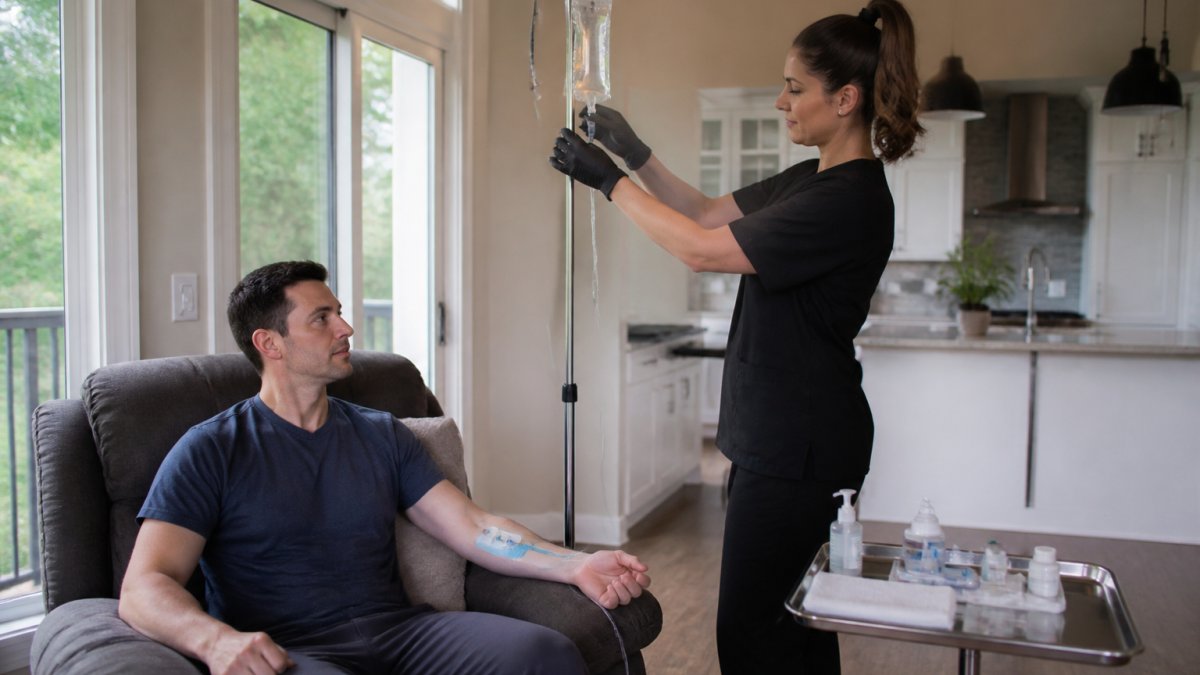
What’s Actually in a Travel Drip, and What the Evidence Says
A typical travel drip may include:
- Intravenous fluids, usually 500 mL to 1,000 mL of normal saline (0.9% sodium chloride) or lactated Ringer’s. This is the one component with a clear mechanism: it restores circulating fluid volume. If you are genuinely dehydrated, this is what makes you feel better.
- Electrolytes, sodium, potassium, magnesium, and sometimes calcium. These are already present in normal saline and lactated Ringer’s; added magnesium is common in wellness drips. Magnesium supports muscle and nerve function, but oral magnesium works for most people who are not deficient.
- B-complex vitamins, typically thiamine (B1), riboflavin (B2), niacin (B3), pyridoxine (B6), and cyanocobalamin (B12). These are water-soluble, so any excess is excreted in urine. B12 deficiency is common in vegans, older adults, and people on certain medications and can cause fatigue, but if your levels are normal, an IV B12 dose will not give you energy you did not already have.
The Evidence Gap You Should Know About
Here is the part most drip menus skip. The treatments with the strongest evidence for jet lag are not IV drips:
- Timed light exposure at your destination
- Melatonin taken at the right local time
- Sleep scheduling before and after travel
These are the interventions studied in sleep-medicine literature and recommended by clinicians who treat circadian rhythm disorders. IV hydration and vitamins have not been shown in controlled trials to shorten jet lag or reset the body clock; what they can plausibly do is correct a fluid or nutrient deficit making you feel worse on top of the time-zone shift.
That distinction matters. Land well-hydrated and well-fed and a drip is unlikely to do much; land with a headache, dry mouth, and no appetite and it may help you feel more like yourself while your clock catches up.
Doses Vary, and So Does Oversight
There is no single standard “jet lag drip.” Formulations differ by provider, and the same label (“Energy Boost,” “Recovery”) can mean very different contents at two clinics. Practical points:
- Ask for the ingredient list and doses before you book. A reputable provider will share them.
- Ask who reviews your history. A physician, nurse practitioner, or physician assistant should screen you, not just the person placing the IV.
- Ask what license the person placing the line holds. In most states, IV placement is performed by a registered nurse, licensed practical nurse, paramedic, or physician. Requirements vary by state.
What to Expect During an IV Therapy Session
A session usually takes 30 to 60 minutes, depending on the drip and how you feel:
- A licensed professional reviews your health history and medications
- They check your vitals and confirm the right formula for you
- They place a small IV line, usually in your arm
- Fluids and nutrients run in over 30 to 60 minutes
- They remove the line and you go about your day
Most people describe a cool sensation in the arm and little else. Some feel more alert within an hour; others notice nothing until the next morning.
Pro Tip
Book your drip for the morning after you land, not the night you arrive. Your body is still on the old clock, and an evening session can leave you wired when you need to sleep.
Book your drip for the morning after you land, not the night you arrive. Your body is still on the old clock, and an evening session can leave you wired when you need to sleep.
Key Takeaway
IV fluids can correct dehydration. B vitamins can correct a deficiency. Neither has been shown to reset your circadian rhythm, so treat the drip as symptom relief, not a clock fix.
IV fluids can correct dehydration. B vitamins can correct a deficiency. Neither has been shown to reset your circadian rhythm, so treat the drip as symptom relief, not a clock fix.
How to Adjust to a New Time Zone: Circadian Strategies That Work
The fastest way to adjust to a new time zone is to use light, timing, and consistency, not supplements alone:
- Get morning light. Step outside within an hour of waking local time.
- Avoid bright light at night. Dim screens and lamps two hours before bed.
- Shift your schedule before you fly. Move bedtime 30 to 60 minutes earlier or later for a few days.
If you are coming from a red-eye, a short nap is fine. Keep it under 30 minutes so you can still sleep at night. (Source: CDC’s recommendations for travel health)
This is where an IV fits into a smarter plan. Use it to fix the dehydration and nutrient gap, then let light and timing do the clock work.
Jet Lag Recovery Tips: What Helps, What Doesn’t, and Lower-Cost Options
Most jet lag recovery tips work best when you start before you land, and the advice only helps if it is specific, “get some sunlight” is not a plan. Here is what the timing actually looks like, plus a comparison of IV therapy against the cheaper options most travelers should try first.
Circadian Timing: The Part That Actually Resets Your Clock
The direction of the light shift depends on which way you flew:
- Traveling east (for example, from Los Angeles to New York, or the U.S. to Europe): your clock is behind. You want to advance it. Get bright morning light at your destination and avoid bright light in the evening.
- Traveling west (for example, New York to Los Angeles, or the U.S. to Asia): your clock is ahead. You want to delay it. Get bright evening light and avoid bright morning light for the first day or two.
A practical rule: for the first two to three days, aim for at least 30 minutes of outdoor light at the time that matches your direction of travel. Indoor light is far dimmer than daylight and does not substitute.
Melatonin: What the Evidence Supports
Melatonin is the most-studied supplement for jet lag. A common sleep-medicine approach:
- Timing: take it at the target local bedtime at your destination, not on the plane unless a clinician advises it.
- Dose: 0.5 mg to 5 mg is the range most often cited (Melatonin for the prevention and treatment of jet lag). Higher doses are not clearly more effective and can cause grogginess.
- Duration: usually the first two to four nights at the destination.
Melatonin is a timing signal, not a sedative, and works best combined with light exposure. Talk to a clinician first if you take blood thinners, have an autoimmune condition, are pregnant or breastfeeding, or take other sedating medications.
What Helps, What Doesn’t
What helps:
- Drinking water steadily before, during, and after the flight
- Eating light, protein-rich meals on local time
- Getting outside for daylight at the right time for your direction of travel
What does not help much:
- Alcohol as a sleep aid, it fragments sleep and worsens dehydration
- Heavy caffeine late in the day
- Long daytime naps that push your bedtime later
Lower-Cost Alternatives: What Oral Rehydration Actually Costs
If cost is the concern, oral hydration is your first line. A typical oral rehydration solution or electrolyte drink costs a few dollars per serving, and bottled water, a banana, and a normal meal cover most of the fluid and electrolyte gap for a fraction of a drip’s price.
IV therapy is typically not covered by insurance for jet lag because it is not medically necessary for most travelers. That cost difference matters when the evidence for IV therapy as a jet-lag fix is thin.
A reasonable order of operations for most healthy travelers:
- Hydrate and eat on local time.
- Use light and melatonin to shift your clock.
- Sleep on schedule at your destination.
- Consider a drip only if you are badly depleted, cannot keep fluids down, or are short on time and want faster rehydration.
Watch Out
Do not treat a drip as a substitute for sleep or light exposure. If you keep pushing through on caffeine and IVs without ever syncing to local time, you will stay foggy for days.
Do not treat a drip as a substitute for sleep or light exposure. If you keep pushing through on caffeine and IVs without ever syncing to local time, you will stay foggy for days.
Key Takeaway
For most travelers, water, food, timed light, and melatonin do the heavy lifting. IV therapy is a faster hydration option, not a clock reset, and it costs meaningfully more than the alternatives.
For most travelers, water, food, timed light, and melatonin do the heavy lifting. IV therapy is a faster hydration option, not a clock reset, and it costs meaningfully more than the alternatives.
Safety, Side Effects, and Who Should Skip IV Therapy
IV therapy is generally well tolerated when a licensed professional runs it, but it is not risk-free. Minor effects include bruising, a cool feeling in the arm, and mild soreness at the site.
More serious risks are rare but real:
- Infection at the insertion site
- Fluid overload, especially with heart or kidney conditions
- Allergic reactions to specific vitamins or additives
Who should skip it or check with a doctor first:
- People with heart failure, kidney disease, or fluid restrictions
- Anyone pregnant or breastfeeding
- People taking blood thinners or with bleeding disorders
Screening matters more than the drip itself. A qualified provider reviews your history, medications, and conditions before anything is placed, that review separates a safe session from a risky one.
Key Takeaway
The quality of the screening, not the size of the drip, is what keeps an IV session safe. Ask who reviews your history and what license they hold.
The quality of the screening, not the size of the drip, is what keeps an IV session safe. Ask who reviews your history and what license they hold.
Conclusion: Using IV Therapy as One Part of a Smarter Travel Plan
No single fix does the whole job. Your body clock needs light and timing, your body needs fluids and nutrients, and your schedule needs consistency. An IV drip handles the hydration and nutrient side quickly, freeing you to focus on the circadian side.
At Phlebotomy Experts, our licensed phlebotomists bring IV vitamin therapy and mobile blood draws to your home or office, with a gentle bedside manner and a focus on your comfort.
Frequently Asked Questions
Can IV fluids help with jet lag?
IV fluids can help with the dehydration and fatigue that make jet lag feel worse, but they do not reset your body clock. Air travel causes fluid loss through dry cabin air, and dehydration can add to headaches, low energy, and mental fog. An IV drip delivers fluids and electrolytes directly into the bloodstream for rapid hydration. Think of IV therapy as support for post-flight recovery, not a cure for the time-zone shift itself. Pair it with light exposure and sleep timing for the best results.
Does IV vitamin therapy reset your body clock?
No. Your body clock, or circadian rhythm, is set mainly by light exposure and sleep timing. IV vitamin therapy supports hydration, nutrient replenishment, and energy levels, which can make the adjustment period feel easier, but it does not shift your internal clock. To adjust to a new time zone, get morning sunlight at your destination, avoid late caffeine, and keep a consistent sleep schedule. Use IV therapy as a recovery aid alongside those habits, not as a replacement for them.
Is IV therapy safe for jet lag?
For most healthy adults, IV therapy is generally well tolerated when administered by a licensed professional after a health screening. Common side effects include bruising, mild soreness at the insertion site, and occasional coolness during the drip. People with kidney disease, heart failure, certain electrolyte disorders, or medication interactions should consult a physician first. Ask about ingredient doses and screening before booking, and seek medical attention if you develop swelling, shortness of breath, or chest pain after a session.
What helps with jet lag besides IV therapy?
Several low-cost habits do most of the work. Get daylight at your destination in the morning to shift your circadian rhythm, hydrate with water and electrolytes throughout the flight, and time your sleep to the local schedule as soon as you land. Short naps under 30 minutes can take the edge off without disrupting nighttime sleep. Melatonin timing and caffeine cutoff times also matter. IV therapy can complement these steps, but oral hydration and light exposure remain the foundation of jet lag recovery.
