Learn coping strategies for needle phobia in children: build a coping plan with your child, practice at home, and prepare for the appointment.
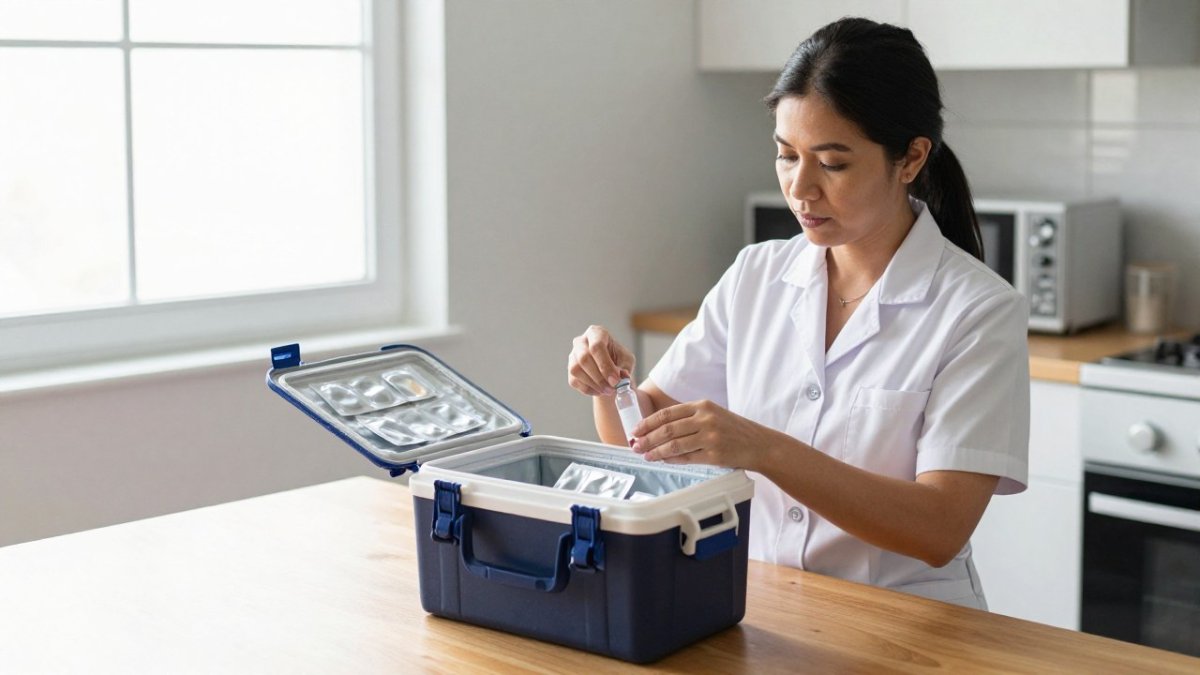
How Do You Keep Autologous Serum Eye Drops Cold?
Last Updated: November 18, 2026
Quick Summary
Keep autologous serum eye drops in the refrigerator as directed on your pharmacy label, store reserve bottles frozen, and never refreeze a bottle once thawed. Because the drops contain no preservative, maintaining the cold chain protects their stability and sterility.
- Store the in-use bottle on a refrigerator shelf, not in the door, with the cap closed tightly.
- Keep unopened or reserve bottles in the freezer in a labeled bag, as your label directs.
- Thaw frozen bottles slowly in the refrigerator the day before you need them.
- Do not refreeze a bottle after it has thawed, since this can damage the drops.
- Keep drops in your carry-on during air travel, never in checked luggage.
Need help with your at-home blood draw?Phlebotomy Experts brings licensed phlebotomists to your home or office.
Table of Contents
- What Autologous Serum Eye Drops Are and Why Cold Storage Matters
- Storing the Bottle You Are Using in the Refrigerator
- Freezing Unopened and Reserve Bottles Correctly
- Thawing, Handling and Daily Use Steps
- Traveling With Autologous Serum Eye Drops Without Breaking the Cold Chain
- Temperature Excursions: A Decision Guide for When Storage Goes Wrong
- Booking Your Next Step With Phlebotomy Experts
- Frequently Asked Questions
What Autologous Serum Eye Drops Are and Why Cold Storage Matters
Autologous serum eye drops are made from a patient’s own blood serum, diluted and used to treat dry eye disease. Because the product is biological and contains no preservatives, it must be kept cold to stay stable and sterile. Keeping the cold chain intact is an important part of using these drops safely. (Source: American Academy of Ophthalmology clinical guidelines)
Understanding why temperature matters can make the routine easier to follow. Heat and repeated warming can break down the proteins and growth factors that give the drops their value. Contamination is also a concern, since the drops have no preservative to stop bacteria from growing.
FDA guidance on compounded drug products and sterility
The safest approach is to follow the label directions from your dispensing pharmacy exactly. You can read more about Autologous Serum Eye Drops: Prescription Rules before you begin, and learn more about the product itself on the autologous serum eye drops service page.
Storing the Bottle You Are Using in the Refrigerator
The bottle you use each day should live in the refrigerator, as directed on your pharmacy label. Keep it on a shelf, not in the door, where temperatures swing more often.
- Store the in-use bottle in its original labeled container
- Keep the cap closed tightly between uses
- Do not store it next to food or drinks
- Check the use-by period printed on the label
Return the bottle to the refrigerator right after each dose.
The article lays out how to store the in-use bottle and the reserve bottles, so this summary is a quick reference for both.
| Bottle type | Where to keep it | Key instruction |
|---|---|---|
| In-use bottle | Refrigerator, on a shelf | Not in the door; keep cap closed |
| Unopened or reserve bottle | Freezer, labeled bag | Follow label; move to refrigerator only when needed |
| Thawed bottle | Refrigerator | Do not refreeze |
Freezing Unopened and Reserve Bottles Correctly
Unopened or reserve bottles are often kept frozen to extend their storage life, following the instructions on your label. Ask your dispensing pharmacy for the exact freezer temperature and storage period.
Place reserve bottles in a labeled freezer bag, and avoid stacking them so they cannot be crushed. Only move a reserve bottle to the refrigerator when you need it for the next few weeks of use.
For detailed handling steps, see the Serum Eye Drop Processing Guide before freezing any bottle.
Thawing, Handling and Daily Use Steps
Follow these steps each time you use a frozen bottle:
- Move the bottle from the freezer to the refrigerator the day before you need it.
- Let it thaw slowly in the refrigerator, as directed on your label.
- Once thawed, do not refreeze it.
- Wash your hands before touching the dropper tip.
- Avoid touching the dropper tip to your eye or any surface.
- Return the bottle to the refrigerator after each use.
Watch out: Refreezing a thawed bottle can damage the drops and raise the risk of contamination. If a bottle has thawed and you did not plan to use it, ask your pharmacy before refreezing.
Traveling With Autologous Serum Eye Drops Without Breaking the Cold Chain
Travel can be where cold chains are most easily interrupted. The approach below is general guidance for commuting, road trips, and air travel; your dispensing pharmacy’s transport instructions and your product label take precedence, and you should call the pharmacy before any trip longer than a day.
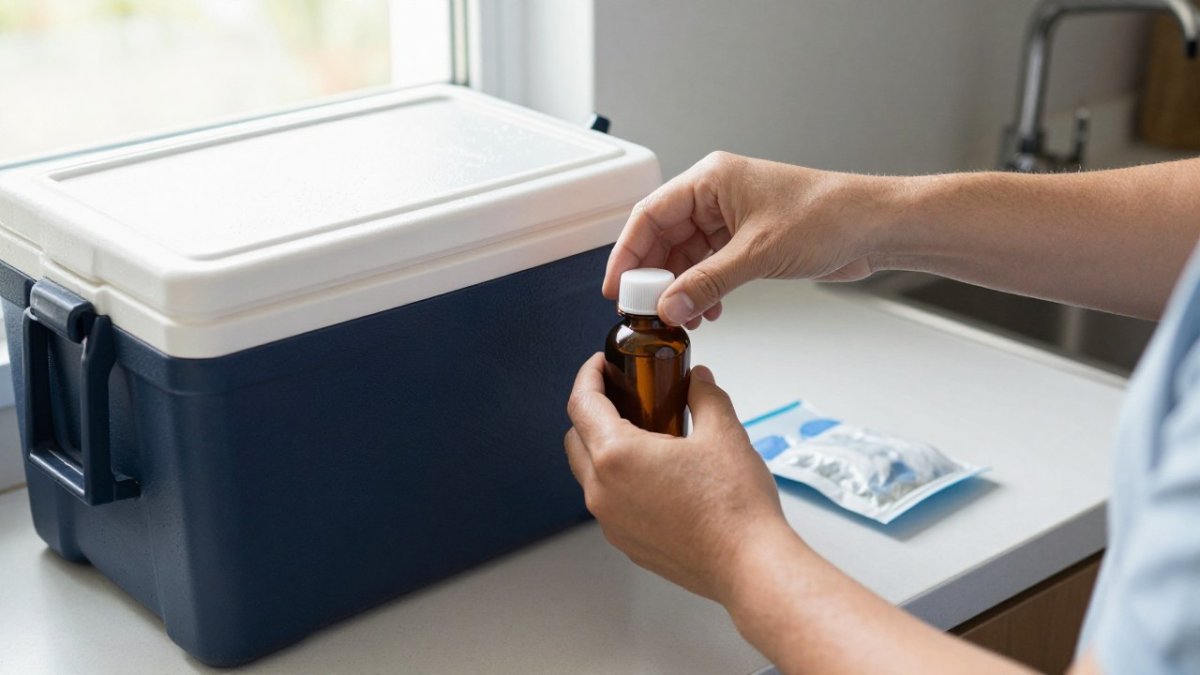
Build a transport kit. A workable kit is small: a hard-sided insulated container (a lunch cooler or a dedicated medication wallet), one or two gel cold packs, a folded paper towel or bubble wrap to separate the bottle from direct contact with the pack, a small thermometer if you want to log temperatures, and a printed copy of your label and prescription.
Separate the bottle from the cold pack. Direct contact with a frozen gel pack can chill the bottle below its intended range or freeze it. Wrap the pack in a cloth or place it on the opposite side of the container so the bottle sits in cooled air, not against ice.
Match the trip length to the packing method.
- Commute or day out (under a few hours): One cold pack in a small insulated pouch is usually enough. Keep the pouch out of a hot car trunk and away from direct sun.
- Full day or overnight drive: Use a rigid cooler with two packs, and plan a stop where you can refresh packs or access a refrigerator. Log the time the bottle left the refrigerator and any temperature reading.
- Air travel: Keep the drops in your carry-on, never in checked luggage, where cargo temperatures are uncontrolled and bags can be delayed. Tell the security officer that the container holds medically necessary liquid and cold packs before screening, and arrive early to allow time to explain. Ask the airline in advance about refrigerator access at layovers and at your destination.
- Extended trips or time away from home: Ask the pharmacy whether to travel with frozen reserve bottles in a separate insulated container, and how to arrange refrigeration at your destination (hotel front desk, family refrigerator, or a small medical cooler).
Document as you go. A short log, date, time out of refrigeration, time back in, and any thermometer reading, is useful if you later need to ask the pharmacy whether the drops are still usable. It also makes an excursion question answerable instead of a guess.
At the destination. Unpack the bottle into a refrigerator as soon as possible, on a shelf rather than in the door, and keep it in its labeled container. If you cannot confirm refrigerator access, call the pharmacy before the next dose rather than leaving the bottle at room temperature.
Watch out: A cold pack that has fully melted by the time you arrive tells you the container warmed more than planned. Treat that as a temperature excursion and follow the excursion steps above rather than assuming the drops are fine.
For longer or more complex trips, see the Safe Serum Eye Drop Transport Mobile Lab Guide and confirm the plan with your dispensing pharmacy before you leave.
Temperature Excursions: A Decision Guide for When Storage Goes Wrong
A temperature excursion is any period when your drops sit outside the range printed on your label, a power outage, a refrigerator door left ajar, a bottle forgotten on the counter, or a delivery that arrived warm. The steps below are a practical framework, not a safety guarantee: your dispensing pharmacy’s instructions always override anything here, because stability data is product-specific.
Step 1, Capture the facts before you act. Write down the approximate time the bottle left the refrigerator, the approximate time it returned (or was found), and the highest temperature you can reasonably estimate. A refrigerator thermometer reading, a room-temperature reading from a kitchen thermometer, or even a car’s outside-temperature display is more useful to your pharmacist than “it got warm.” Record the date and bottle label or lot number.
Step 2, Match the excursion to a category.
- Under about one hour at room temperature, bottle still cool to the touch: Return it to the refrigerator immediately and note the event. Confirm with your pharmacy before the next dose.
- One to several hours at room temperature, or unknown duration: Set the bottle aside, do not use it, and contact your dispensing pharmacy with the facts from Step 1. Follow the pharmacy’s instructions on whether to discard the bottle or shorten its in-use period; do not decide this yourself.
- Bottle became warm and was then returned to the refrigerator without being used: Treat this the same as the previous category. Repeated warming and cooling is not the same as one excursion.
- Bottle froze when it was supposed to stay refrigerated: Freezing an in-use bottle can damage the container and the drops. Ask the pharmacy whether to replace it rather than assuming it is fine.
- Visible change, cloudiness, particles, unusual color, or odor: Do not use the drops regardless of how short the excursion was. Contact the pharmacy for a replacement.
Step 3, Do not “rescue” the bottle. Do not put a warmed bottle in the freezer to cool it faster, do not immerse it in ice water, and do not microwave or warm it. Rapid temperature swings are their own stress on the product and the container.
Step 4, Document and follow up. Keep your written record with the bottle until it is finished or discarded. If your pharmacy asks you to discard it, ask whether the replacement should be counted against your current supply or requires a new draw, since that affects scheduling.
Watch out: Study conditions often differ from a home refrigerator, and the label and pharmacy instructions reflect the product you actually received.
Planning ahead for outages. A simple contingency kit can help: a refrigerator thermometer, a small insulated bag with a gel pack in the freezer, and the pharmacy’s phone number saved in the phone. During a forecast outage, move reserve frozen bottles together in the freezer and keep the door closed; a full freezer holds temperature longer than an empty one. If the outage is expected to be long, ask the pharmacy in advance which bottles to prioritize and how to document the event.
Booking Your Next Step With Phlebotomy Experts
Keeping autologous serum eye drops cold takes planning, and you do not have to manage it alone. You can compare reviews of serum eye drop services before you book. Phlebotomy Experts provides in-home mobile phlebotomy and concierge lab services, so you can get blood drawn and specimens delivered without leaving home. Visit the Phlebotomy Experts website or request a quote for current pricing, since costs depend on the services you need.
Frequently Asked Questions
Do serum eye drops need to be refrigerated?
Autologous serum eye drops are a biological product, and the bottle in daily use is normally kept refrigerated as directed on the label your dispensing pharmacy provides. Refrigeration slows changes in the serum that can reduce its effectiveness. Store the bottle in the refrigerator door only if the label allows it, since door shelves warm each time they open. If you are unsure of the required temperature for your specific preparation, confirm it with the pharmacy or clinician who prepared it before you assume any storage rule applies to you.
Can autologous serum eye drops be frozen?
Unopened or reserve bottles are often stored frozen to extend their usable life, but freezing and thawing must follow the instructions on your label. Freeze only bottles that are meant for long-term storage, and keep the bottle in use in the refrigerator. Do not refreeze a bottle once it has thawed unless your pharmacy has confirmed that is acceptable. Ask your dispensing pharmacy for the exact freezer temperature and the maximum storage period for your preparation.
What should I do if my serum eye drops thaw during travel?
If a bottle has warmed during travel, do not assume it is still safe. Note how long it was outside its required temperature range and how warm it became. Contact your dispensing pharmacy or prescribing clinician before using the drops, and ask whether the bottle should be replaced. Keeping a written log of temperatures and times during the trip makes that conversation much faster and more accurate.
How long do autologous serum eye drops last after thawing?
The usable period after thawing depends on how the preparation was made and what your label says, so there is no single number that applies to every bottle. Once a bottle has been thawed, follow the discard or use-by date printed by your pharmacy and avoid refreezing it unless they have approved it. Contact Phlebotomy Experts for guidance on your specific situation, or check current details with your dispensing pharmacy.

Related Posts