Looking for at-home blood tests for toddlers? Learn which tests suit home collection, how to calm a fussy child, and when a clinic is the better choice.

At-Home Blood Collection vs Lab Visits: Which Costs Less?
Last Updated: November 3, 2026
Quick Summary
At-home blood collection costs more upfront than a lab visit because the collection is a separate service fee on top of the lab’s charge, while a lab visit usually bundles collection into the test price or an office visit. A typical mobile phlebotomy visit runs $75 to $150, with laboratory testing billed separately.
- Self-pay lab tests can start as low as $5 per test, plus a single $18 order fee.
- One order fee covers multiple tests, so bundling tests costs less than ordering separately.
- Until your deductible is met, you may owe the negotiated cash-pay price even with insurance coverage.
- Ask each provider in writing what happens if your sample is rejected and who pays.
- Match the collection method to the test first, then compare total cost within methods that can run it.
Table of Contents
- The Real Cost of At-Home Blood Collection vs a Lab Visit
- Mobile Phlebotomy Cost: The Collection Fee Nobody Quotes Upfront
- Lab Work Cost Without Insurance: Cash-Pay Prices and Order Fees
- The Cost of Blood Work With Insurance: Deductibles, FSA, and HSA
- Labcorp Self-Pay Prices and How They Compare
- Hidden Costs: Failed Samples, Repeat Draws, and Travel Time
- Matching the Setting to the Patient: Who Each Option Fits
- Book a Mobile Blood Draw With Phlebotomy Experts
- Frequently Asked Questions
The Real Cost of At-Home Blood Collection vs a Lab Visit
The cost of at-home blood collection vs lab visits comes down to two separate bills: the collection itself and the laboratory testing. At-home blood collection is a paid convenience layered on top of a lab test, while a lab visit usually bundles collection into the test price or your office visit. (Source: a 2026 report by the U.S. Department of Health and Human Services)
Here is the part most cost guides skip: the collection fee is rarely the whole story. Travel, repeat draws, and order fees can change the math fast. Below, we break down each setting line by line so you can compare like for like.
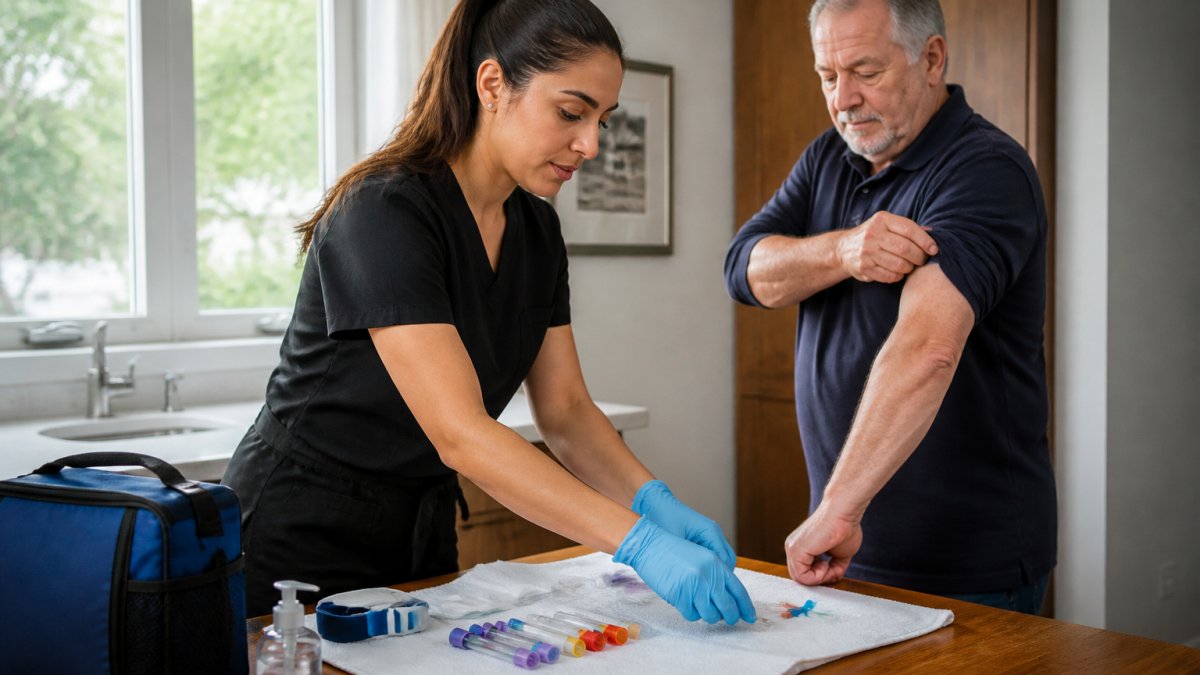
What You Actually Pay For in Each Setting
Every blood draw has two cost layers. The first is collection: who draws the sample and where. The second is laboratory processing: the analyzer time, reagents, and reporting behind each test panel.
In a lab visit, collection is often folded into the test price or covered as part of an office visit.
That structure explains why comparing a kit’s sticker price to a mobile visit feels confusing. You are comparing a bundled product to an unbundled service.
Mobile Phlebotomy Cost: The Collection Fee Nobody Quotes Upfront
Mobile phlebotomy cost is the number patients ask about last and should ask about first. According to MyOnsite Healthcare’s mobile phlebotomy cost guide, a typical mobile phlebotomy visit runs $75 to $150, with laboratory testing billed separately. That range reflects travel, scheduling, and the phlebotomist’s time.
What drives the number up or down:
- Distance and drive time to your address
- Same-day or after-hours scheduling
- Difficult draws requiring extra skill and supplies
- Multiple patients at one location, such as a facility visit
Watch out: a low quoted collection fee means little if the lab charge is separate and unmentioned. Ask for both numbers before you book. For a full breakdown of what mobile lab services include, see our cost of mobile lab services guide.
Self-Collection Kits vs a Mobile Blood Draw
Self-collection kits and mobile draws solve different problems. A finger-prick sample kit ships to your door, you collect at home, and you mail it back for laboratory processing. A mobile draw sends a trained phlebotomist to perform a venous blood draw in person.
The trade-off is sample quality: a finger-prick yields a small volume, and some panels, including many complete blood count requests, need a full venous sample a kit cannot provide.
Lab Work Cost Without Insurance: Cash-Pay Prices and Order Fees
Lab work cost without insurance splits into per-test charges and order fees, and the order fee is the one people forget. According to JustLabs’ guide to blood testing without insurance, self-pay tests can start as low as $5 per test, with a single $18 order fee added to the order.
That structure rewards bundling. One order fee covers multiple tests, so a panel ordered together costs less than the same tests ordered separately.
A common mistake is comparing one $5 test to a full panel price and assuming the panel is overpriced. It usually is not. You are paying for more analytes and a single order fee, not a markup.
The Cost of Blood Work With Insurance: Deductibles, FSA, and HSA
The cost of blood work with insurance depends on your plan year, not the draw setting. Insurance coverage applies to the lab test when it is physician-ordered testing for a covered reason. Until your deductible is met, you may owe the negotiated cash-pay price even with coverage in place.
Two payment accounts change the out-of-pocket picture:
- FSA: pre-tax funds for eligible medical expenses, including many lab tests
- HSA: pre-tax funds for qualified medical expenses when paired with a high-deductible plan
The collection fee is the wildcard. A mobile draw is a convenience service, and whether it counts as a covered expense depends on your plan and how it is billed. Our guide on whether mobile phlebotomy is covered by insurance walks through the questions to ask.
Labcorp Self-Pay Prices and How They Compare
Labcorp self-pay prices are set per test and vary widely by panel, so no single figure covers the catalog. The useful comparison is structural: a lab’s self-pay price is generally set per test, while a mobile draw is usually billed as a collection fee on top of the lab’s charge. (Source: the Centers for Medicare & Medicaid Services (CMS) fee schedule)
| Cost Layer | Lab Visit | Mobile Blood Draw | Self-Collection Kit |
|---|---|---|---|
| Collection | Included or office visit | Separate service fee | You collect |
| Lab processing | Per-test price | Lab’s charge, billed separately | Bundled in kit price |
| Travel | Your time and gas | Included in service fee | Shipping included |
| Repeat draw risk | Return trip needed | Phlebotomist on site | New kit may be needed |
The table makes the trade-off clear. A lab visit is cheapest on paper if your time is free and the draw is easy. A mobile draw costs more but removes travel. For current pricing, check Phlebotomy Experts’s website or request a quote.
Hidden Costs: Failed Samples, Repeat Draws, and Travel Time
The mechanism matters more than the label. Labs reject samples for hemolysis (red cells ruptured during collection or transport), insufficient volume, clotted specimens, and improper tube handling.
What a repeat actually costs depends on who is responsible:
- Self-collection kit: policies vary. Some vendors replace a rejected kit at no charge once; others charge for the replacement kit and may charge a second processing fee. Ask before you buy whether the kit price includes one recollection and who pays shipping on the return.
- Mobile blood draw: the collection fee is usually charged per visit, so a repeat draw can mean a second service fee on top of any lab re-processing charge. A written policy on repeat draws is the single best indicator of whether a low quoted fee is real.
- Lab visit: a rejected sample typically means a return trip to the patient service center, which is usually free of a collection charge but costs you another round of travel, parking, and waiting.
When comparing quotes, ask each provider what happens if a sample is rejected and whether that policy is provided in writing.
Travel time is the other quiet cost. A lab visit means driving, parking, and waiting, and that time has value even when it does not appear on a receipt.
Matching the Setting to the Patient: Who Each Option Fits
The cheapest setting is the one that fits your situation without a repeat, and fit is partly clinical, not just financial.
Here is how the three settings compare on the factors that decide that question:
| Factor | Lab Visit | Mobile Blood Draw | Self-Collection Kit |
|---|---|---|---|
| Who collects | Trained phlebotomist | Trained phlebotomist | You |
| Sample type | Venous | Venous | Usually finger-prick |
| Best for | Routine panels, flexible schedules | Difficult veins, mobility limits, children, busy schedules | Simple panels, privacy, low cost |
| Weak spot | Travel and wait time | Collection fee on top of lab charge | Small volume, handling risk, limited panels |
| Repeat-draw exposure | Return trip | Second service fee possible | Replacement kit or fee possible |
With a self-collection kit, the kit price bundles collection, shipping, and processing, but you should confirm the kit actually offers both panels, many finger-prick kits cover a narrower menu than a venous draw.
Clinical suitability is where price alone misleads:
- Test complexity: some panels, including many complete blood count requests, need a full venous sample that a finger-prick kit cannot provide. Paying less for a kit that cannot run your test is not a saving.
- Need for clinician interpretation: a result that needs a physician’s read and follow-up is worth more when the collection setting supports it. A cheap kit with no path to interpretation can cost more in the end.
- Vein access: patients with difficult veins, infants, and children do better with a trained hand on site, which is the case for paying a collection fee.
- Handling requirements: tests with tight transport or timing requirements are safer with a venous draw than with a mailed finger-prick sample.
A common pattern is that patients who choose the cheapest option for a complex test end up paying for a repeat anyway. If you are weighing whether the convenience is worth the fee, our guide on whether an at-home blood draw is worth it lays out the decision factors.
Book a Mobile Blood Draw With Phlebotomy Experts
Choosing a setting is half the decision. If you are still weighing the options, our mobile phlebotomy vs lab visits comparison can help you decide. The other half is who performs the draw.
Our team includes a licensed phlebotomist with 20 years of experience in the medical field, and we provide gentle, professional blood draws. We also offer on-site specimen collection for facilities.
Ready to compare for yourself? Call now to schedule your visit.
Frequently Asked Questions
Does insurance cover mobile phlebotomy?
Sometimes. Coverage depends on your plan, whether the draw is medically necessary, and whether the provider is in network. Call your insurer before booking and ask two questions: whether the mobile collection fee is a covered benefit, and whether the laboratory doing the processing is in network. If the collection fee is not covered, it becomes an out-of-pocket cost you pay directly.
Is the mobile blood draw fee separate from the lab test cost?
Yes. At-home blood collection usually involves two charges: a collection or visit fee for the phlebotomist who comes to you, and a separate laboratory processing fee for the tests themselves. Collection and laboratory charges are usually billed separately, and the amount depends on the provider and the tests ordered. Request a quote for current pricing. A standard lab visit folds collection into the lab’s own charge, which is why the two totals are rarely apples to apples.
Can I use my own lab order for a mobile blood draw?
Many mobile phlebotomy providers accept a requisition from your physician or a direct-to-consumer test order, then deliver the specimen to the laboratory you choose. Ask before booking: which labs the provider delivers to, whether the order needs to be physician-ordered, and whether the provider charges extra for a specific facility. Confirm the lab accepts the order form so your sample is not rejected after collection.
Are at-home blood tests worth the extra cost?
It depends on what the visit saves you. For someone with difficult veins, needle phobia, mobility limits, or a schedule that makes a lab trip costly, paying a collection fee can be cheaper than a repeat draw or a missed appointment. For a routine panel on a flexible schedule, a walk-in lab is usually the lower-cost route. Compare the total bill, including any repeat-sample risk, rather than the sticker price alone.
How much does LabCorp charge for at-home blood work?
LabCorp’s self-pay pricing varies by test and panel, and at-home collection is typically arranged through a separate mobile provider that charges its own visit fee on top of the lab’s test price. Because the two charges come from different parties, ask for both quotes in writing before you book. For current self-pay rates, check LabCorp’s published test menu or request a quote directly.
The cost question has a simple answer once you separate collection from testing: a lab visit is cheapest on paper, and a mobile draw is cheapest in practice when travel and repeat draws are counted. If convenience and a confident draw matter to you, get started with Phlebotomy Experts and schedule a licensed phlebotomist to come to you.

Related Posts