Looking for at-home blood tests for toddlers? Learn which tests suit home collection, how to calm a fussy child, and when a clinic is the better choice.
7 Common Lab Tests Performed by Mobile Phlebotomists
Last Updated: November 5, 2026
Quick Summary
The common lab tests performed by mobile phlebotomists include a complete blood count, basic and comprehensive metabolic panels, a lipid profile, hemoglobin A1c, thyroid function testing, and coagulation panels. These common lab tests follow the same preparation rules as a hospital draw, and the phlebotomist collects the specimen and delivers it to the laboratory or hospital of your choosing.
- A CBC requires no fasting, but mention any blood thinner at booking so the phlebotomist plans a longer pressure hold.
- The basic metabolic panel covers electrolytes, glucose, and kidney function markers such as creatinine.
- Hemoglobin A1c needs no fasting and reflects average blood sugar over roughly the prior two to three months.
- Many clinicians prefer a morning draw for thyroid testing because hormone levels shift through the day.
- A coagulation sample that sits too long or gets shaken during transport can be rejected outright.
Table of Contents
- What Mobile Phlebotomy Services Do and Which Tests They Collect
- 1. Complete Blood Count (CBC): The Most Ordered of All Common Blood Tests
- 2. Metabolic Panels: Basic and Comprehensive
- 3. Lipid Profile, Hemoglobin A1c, and Thyroid Function
- 4. Coagulation Panels and Specialized Genetic Draws
- Blood Test Preparation: What to Do Before Your At-Home Blood Draw Service
- How Mobile Phlebotomy Services Work: From Order to Results
- Schedule Your At-Home Blood Draw Service with Phlebotomy Experts
- Frequently Asked Questions
What Mobile Phlebotomy Services Do and Which Tests They Collect
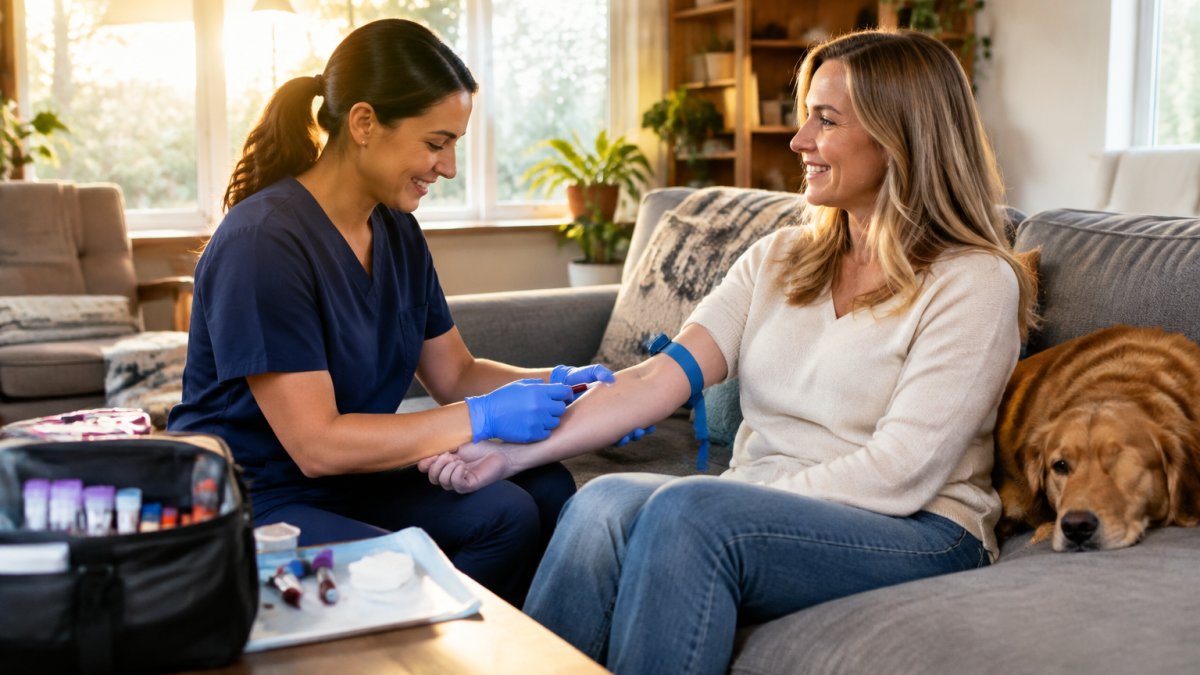
Mobile phlebotomy is the practice of sending a licensed phlebotomist to a patient’s home, office, or facility to collect blood and other specimens for laboratory testing. For a fuller explanation of mobile phlebotomy for routine blood work, see our dedicated article.
The job is narrower than it sounds. The phlebotomist performs the venipuncture, labels and handles the tubes, and manages specimen integrity from the moment blood leaves the vein. The clinical laboratory runs the analysis and reports results to the ordering physician.
Below, we break down the seven most requested tests, what each one measures, and how to prepare. First, a warning most guides skip: the test you receive is only as reliable as the pre-analytical variables you control before the needle goes in.
1. Complete Blood Count (CBC): The Most Ordered of All Common Blood Tests
The CBC is the workhorse of diagnostic testing. It measures red blood cells, white blood cells, and platelets in a single draw, which is why clinicians order it for everything from fatigue to infection to a routine physical.
What each component tells your doctor:
- Red blood cells and hemoglobin show whether you are anemic or carrying enough oxygen
- White blood cells flag infection, inflammation, or immune response
- Platelets matter for clotting and bleeding risk
A CBC requires no fasting. You can eat normally, drink water, and take regular medications unless your physician says otherwise. The one thing to mention at booking is any blood thinner, since it affects how long we apply pressure after the draw.
2. Metabolic Panels: Basic and Comprehensive
Metabolic panels split into two versions, and the difference matters when you book. The basic metabolic panel (BMP) covers electrolytes, glucose, and kidney function markers such as creatinine (Basic Metabolic Panel (BMP): MedlinePlus Medical Test). The comprehensive metabolic panel (CMP) adds liver enzymes and protein levels (Comprehensive Metabolic Panel (CMP): MedlinePlus Medical Test).
Both are common blood tests ordered for annual physicals, medication monitoring, and chronic condition management. Neither requires special preparation beyond your physician’s instructions, though some orders include a fasting glucose, so confirm that detail before your appointment.
If you take a diuretic or blood pressure medication, ask your physician whether to hold it the morning of the draw. That single question prevents a redo.
3. Lipid Profile, Hemoglobin A1c, and Thyroid Function
Three tests land in nearly every preventive screening order, and each has its own preparation rule.
The lipid profile measures cholesterol and triglycerides. The hemoglobin A1c reflects average blood sugar over roughly the prior two to three months and needs no fasting (the CDC).
Timing matters for thyroid testing. Thyroid hormone levels shift through the day, so many clinicians prefer a morning draw for consistency between visits. If you are monitoring glucose monitoring or diabetes management, the A1c gives a longer view than a single finger stick reading.
4. Coagulation Panels and Specialized Genetic Draws
A coagulation panel measures how long your blood takes to clot. Clinicians order it before surgery, while monitoring blood thinners, or when unexplained bleeding or bruising appears.
Then there is the category most people do not expect from a mobile service: specialized genetic draws.
Watch out: a coagulation sample that sits too long or gets shaken during transport can be rejected outright. Ask how your phlebotomist handles transport before the visit, not after.
Blood Test Preparation: What to Do Before Your At-Home Blood Draw Service
Preparation for an at-home blood draw service comes down to three things: fasting rules, hydration, and medication timing. Get those right and the draw is more likely to go smoothly. Most guides stop at that sentence. The useful version is a checklist by test type, because the rules are not the same across the panels a mobile phlebotomist draws.
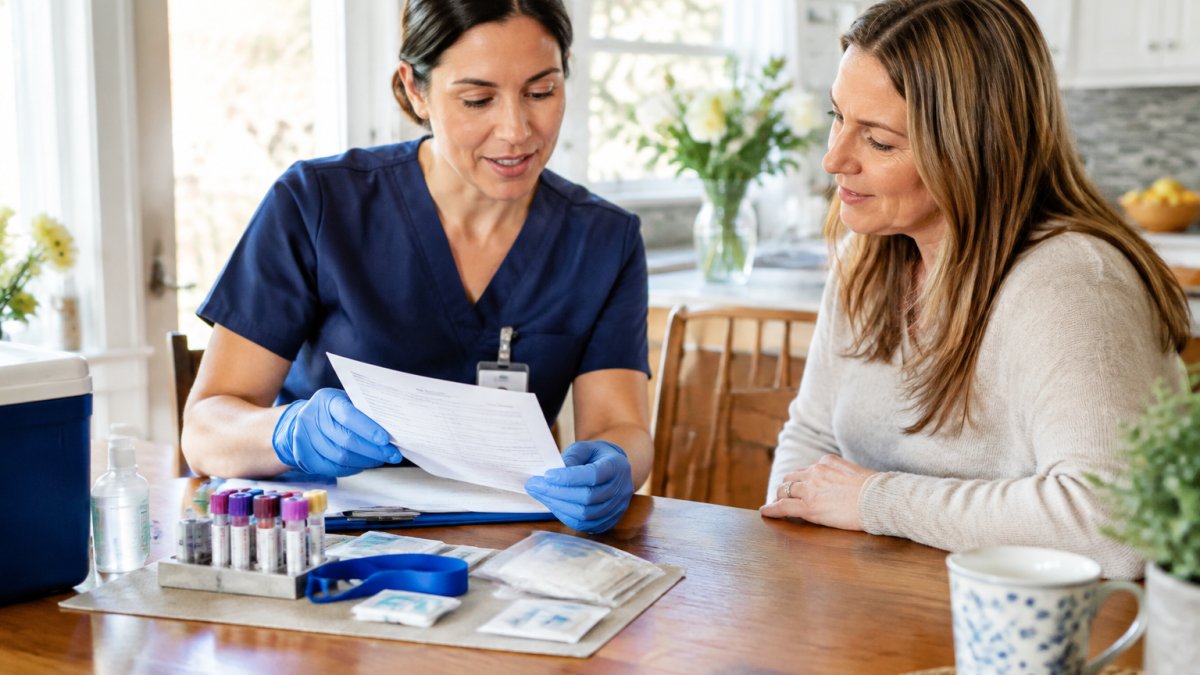
Start with the requisition. The ordering physician’s requisition is the controlling document, and it should state whether fasting is required and for how many hours.
Test-specific preparation at a glance:
- Complete blood count (CBC): No fasting. Eat and drink normally, take regular medications, and mention any blood thinner at booking so the phlebotomist plans for a longer pressure hold.
- Basic metabolic panel (BMP): Often no fasting, but orders that include a glucose draw may require 8 to 12 hours without food. Confirm on the requisition. Water is fine and encouraged.
- Comprehensive metabolic panel (CMP): Same fasting logic as the BMP. Ask the physician whether to hold diuretics or blood pressure medication the morning of the draw, since those drugs shift electrolyte and creatinine readings.
- Lipid profile: Fasting status depends on the order. Many clinicians now order non-fasting lipid panels, but if the requisition specifies fasting, the common window is 9 to 12 hours with water allowed.
- Hemoglobin A1c: No fasting. This test reflects average blood sugar over roughly the prior two to three months, so a single meal does not distort it.
- Thyroid function (TSH): No fasting required, but timing matters. Thyroid hormone levels shift through the day, so many clinicians prefer a morning draw for consistency between visits. If you take thyroid medication, ask whether to take it before or after the draw.
- Coagulation panel (PT/INR, aPTT): No fasting. Tell the phlebotomist about blood thinners and any recent dose, because the result is interpreted against that timing.
- Specialized genetic draws: Follow the ordering lab’s kit instructions exactly. Some kits require specific tube types, timing, or paperwork that must accompany the specimen.
Hydration deserves its own line. Drink water in the two hours before the draw to plump your veins, especially if you are prone to difficult draws.
Watch out: fasting rules are written per order, not per test name.
A practical checklist before your appointment:
-
Confirm on the requisition whether fasting is required, and for how many hours
-
Ask your physician about holding blood thinners or morning medications
-
Wear short or loose sleeves for easy access to the arm
-
Have your physician order and insurance card ready for the phlebotomist
-
Note any recent illness, fever, or strenuous exercise, since those can shift certain results
For fasting specifics, our guide on how to prepare for a fasting blood test at home walks through the timing rules. If you want the full picture beyond fasting, read our complete guide to preparing for a home blood draw.
Here is how preparation differs across the panels a mobile phlebotomist draws.
| Test | Fasting | Key preparation note |
|---|---|---|
| Complete blood count (CBC) | No fasting | Mention any blood thinner at booking |
| Basic metabolic panel (BMP) | Often none; glucose orders may need 8 to 12 hours | Confirm on the requisition; water is fine |
| Comprehensive metabolic panel (CMP) | Same fasting logic as the BMP | Ask physician about holding diuretics or blood pressure medication |
| Lipid profile | Depends on the order; fasting window 9 to 12 hours | Water allowed if fasting is specified |
| Hemoglobin A1c | No fasting | Reflects average blood sugar over prior two to three months |
| Thyroid function (TSH) | No fasting | Morning draw preferred for consistency |
| Coagulation panel (PT/INR, aPTT) | No fasting | Tell phlebotomist about blood thinners and recent dose |
| Specialized genetic draws | Follow ordering lab’s kit instructions | Some kits require specific tube types or paperwork |
How Mobile Phlebotomy Services Work: From Order to Results
Every mobile phlebotomy service follows the same basic sequence, and knowing it removes most of the anxiety.
- You obtain a physician order. The requisition names the tests and the laboratory. Without it, no draw happens. If your physician uses an electronic order, confirm the lab accepts it before the visit.
- You schedule the visit. You pick a time and place, home or office. Tell the scheduler about difficult veins, needle phobia, or mobility limits so the right phlebotomist is assigned.
- The phlebotomist arrives and verifies. Expect an ID check, requisition review, and a look at both arms for the best vein. Hand hygiene and fresh gloves should be visible before any supplies are opened.
- The draw happens. Standard venipuncture with aseptic technique, usually a few minutes. A capillary draw or finger stick may be used for certain tests, such as a rapid glucose check.
- Specimens are labeled and prepped. Tubes are labeled at the bedside, not later. Some samples need centrifugation within a set window, and some need to be kept chilled or protected from light. This is the step where a mobile service earns its keep.
- Samples go to the lab. We deliver to the laboratory or hospital you chose. Transport time and temperature matter for coagulation and other time-sensitive tests.
- Results reach your physician. Turnaround time depends on the test and the lab. Turnaround time depends on the test and the lab, and specialized tests can take longer than routine panels. Ask the ordering office what to expect for your specific tests rather than assuming a single timeline.
What happens if a specimen is rejected. A sample can be rejected for a short draw, a clotted tube, a missing label, or a transport delay.
Watch out: a coagulation sample that sits too long or gets shaken during transport can be rejected outright, and a rejected sample means a second visit.
Curious about the visit itself? Our walkthrough of what happens during a mobile blood draw covers each step in detail.
Schedule Your At-Home Blood Draw Service with Phlebotomy Experts
Booking a mobile draw takes less time than driving to a lab. Phlebotomy Experts sends licensed phlebotomists to homes, offices, and assisted living facilities, with specimens delivered to the laboratory of your choice.
Ready to skip the waiting room? Our step-by-step guide to scheduling a mobile blood draw shows exactly what to have ready. Then call to schedule and let us bring the draw to you.
Frequently Asked Questions
What are the 5 basic laboratory tests a mobile phlebotomist can collect?
The five most frequently collected are the complete blood count (CBC), basic metabolic panel (BMP), comprehensive metabolic panel (CMP), lipid profile, and hemoglobin A1c. Thyroid function tests and coagulation panels are also common. These common lab tests require only a blood specimen, which a licensed phlebotomist can draw at your home or office and deliver to the laboratory your physician ordered from.
Can a mobile phlebotomist collect any lab test?
Most standard blood tests can be collected at home, including CBC, metabolic panels, lipid profiles, A1c, thyroid tests, and coagulation studies. Some specialized tests require specific collection tubes, timing, or processing within a set window, so the laboratory’s instructions must be followed. Always confirm with the ordering physician and the laboratory that the test is approved for mobile collection before scheduling.
Do I need to fast before an at-home blood draw?
Fasting requirements depend on the test. Lipid profiles and some glucose tests often call for 8 to 12 hours of fasting, while a CBC or thyroid test usually does not. Your physician’s order should state whether fasting is required. If it is, water is generally fine, and you should schedule the draw early so you are not fasting longer than necessary. Never skip food or medication without your physician’s guidance.
How are blood samples transported to the laboratory after collection?
After the draw, tubes are labeled and sent to the lab your physician selected. Proper handling of samples helps reduce the chance of needing a repeat draw. Turnaround time for results varies by test and laboratory, and results go to the ordering physician, who reviews them with you.
The hardest part of lab testing is rarely the needle. It is the logistics: the drive, the wait, the rearranged morning. We built Phlebotomy Experts to remove that friction, with in-home mobile phlebotomy, specimen delivery to the lab or hospital of your choice, and specialized care for infants, children, and patients with difficult veins. Get started with Phlebotomy Experts and schedule a draw without leaving your home.

Related Posts