
Concierge lab services bring blood draws to your home or office. See how mobile phlebotomy works, what it costs, and how to prepare for a blood test.
How to Prepare for a Home Blood Draw: 2026 Guide
Table of Contents
- Why Home Blood Draw Preparation Matters
- Fasting Requirements for Blood Tests: What to Follow and When
- How to Hydrate Before Blood Work for Easier Vein Access
- What to Expect During a Mobile Blood Draw
- Preparing Your Home and Body for the Visit
- Managing Needle Anxiety, Difficult Veins, and Medical Conditions
- Appointment-Day Checklist and Common Mistakes to Avoid
- After the Draw: Post-Procedure Care and Recovery
- Frequently Asked Questions
Last Updated: September 12, 2026
Why Home Blood Draw Preparation Matters
Knowing how to prepare for home blood draw procedures can be the difference between a single, quick stick and a frustrating morning of missed veins. This guide from Phlebotomy Experts walks through exactly what to do before, during, and after your visit so your specimen arrives at the lab in good condition and your results come back accurate the first time. Preparation matters because most lab errors happen before the needle ever touches your skin. According to the Clinical and Laboratory Standards Institute, pre-analytical variables such as hydration, fasting timing, and medication use account for the majority of specimen rejection issues. Fasting windows, hydration, and vein accessibility are the three levers you actually control, and getting them right makes a home draw faster and more comfortable.
Key Takeaway
Preparation is not about doing more. It is about timing three things correctly: when you fast, when you drink water, and when you take your medications.
Preparation is not about doing more. It is about timing three things correctly: when you fast, when you drink water, and when you take your medications.
Fasting Requirements for Blood Tests: What to Follow and When
Fasting requirements for blood tests depend on which panel your physician ordered. A lipid panel or comprehensive metabolic panel typically requires 8 to 12 hours, while a complete blood count usually requires no fasting (medlineplus.gov).
Typical Fasting Windows for Common Panels
| Test Panel | Typical Fasting Window | Water Allowed? |
|---|---|---|
| Lipid panel | 8-12 hours | Yes |
| Comprehensive metabolic panel | 8-12 hours | Yes |
| Glucose test | 8-12 hours | Yes |
| Complete blood count | No fasting needed | Yes |
| Thyroid panel | No fasting needed | Yes |
Always confirm the exact window with your ordering physician, since individual instructions vary by lab test and medical history.
Medications, Supplements, and When to Pause
Do not stop any prescription medication before a blood draw without your doctor’s approval. Some medications, including diuretics, affect glucose levels and blood volume, and your physician may want them timed differently rather than skipped. Bring a complete medication and supplement list, and tell the phlebotomist about blood thinners in advance.
How to Hydrate Before Blood Work for Easier Vein Access
Hydration is the single most effective thing you can do to improve vein accessibility. When you know how to hydrate before blood work properly, your blood volume increases and your veins become easier to locate.
What to Drink, How Much, and When to Stop
Drink 16 to 24 ounces of plain water in the two hours before your appointment (my.clevelandclinic.org). Skip coffee, tea, and soda, since caffeine acts as a diuretic. Stop drinking about 30 minutes before the draw, and keep sipping small amounts if your appointment runs late.
Pro Tip
Warm your hands and arms before the draw. Wash them in warm water or hold a warm compress for a few minutes. Warmer skin brings veins closer to the surface, and phlebotomists notice the difference immediately.
Warm your hands and arms before the draw. Wash them in warm water or hold a warm compress for a few minutes. Warmer skin brings veins closer to the surface, and phlebotomists notice the difference immediately.
What to Expect During a Mobile Blood Draw
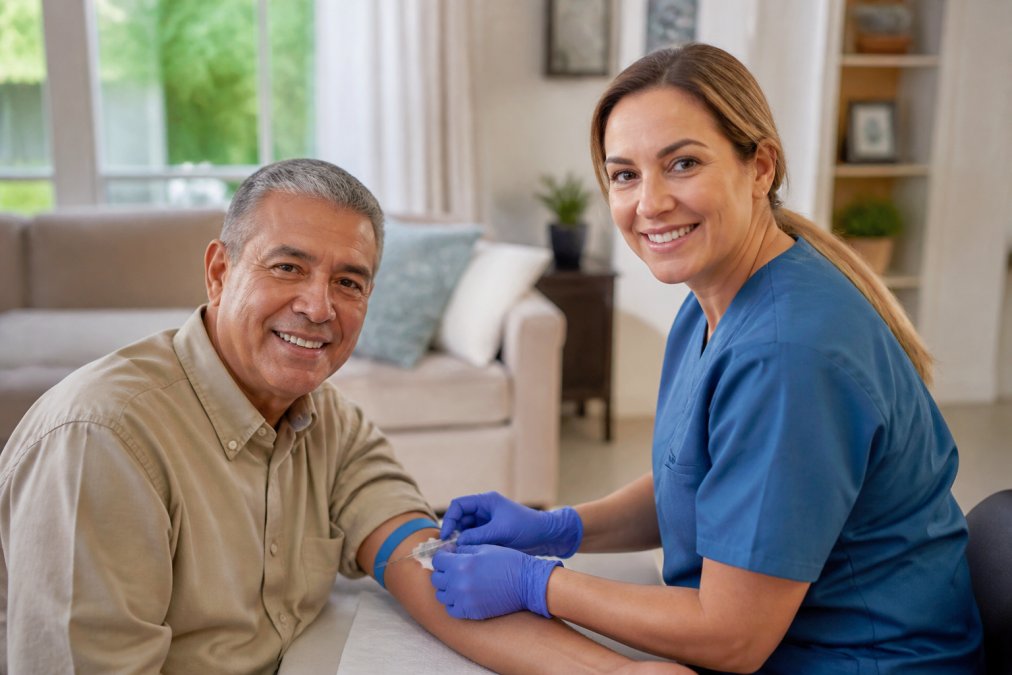
A mobile blood draw follows the same clinical sequence as a lab visit, just in your own space. What separates a good at-home experience from a bad one is the logistics: verifying who is coming to your door, how your specimen gets to the lab, and what to do if something goes sideways.
Verify the Phlebotomist Before the Visit
At-home collection is regulated differently than a hospital lab, so the burden of verification falls partly on you. Before you book, ask three questions:
- Licensure. Most states require phlebotomists to hold a certification such as PBT (ASCP), CPT (NHA), or RPT (AMT), and many require a state-issued license on top of that. Ask which credential the technician holds and confirm it is current.
- Ordering oversight. A legitimate mobile draw is tied to a physician’s lab order. If a service offers to run tests without an order from a provider who is treating you, treat that as a red flag.
- Specimen handling. Ask how the sample is transported, how long it sits before reaching the lab, and whether the service uses a temperature-controlled courier for time-sensitive panels. Pre-analytical delays are a common cause of rejected specimens.
You can also check your state health department’s practitioner lookup, and confirm the lab the service uses holds a CLIA certificate, every lab that performs testing on human specimens in the U.S. is required to have one.
The Step-by-Step Visit
- The phlebotomist arrives, shows identification, and confirms your identity and lab orders against the requisition.
- You review your medical history, medications, and any needle phobia concerns.
- The technician applies a tourniquet and selects a vein.
- The site is cleaned with an antiseptic wipe and the needle is inserted.
- Blood flows into sterile collection tubes, which are labeled at your side, watch that the label is applied before the tube leaves your sight.
- The needle is removed and pressure is applied to prevent bruising.
- Tubes are placed in a biohazard transport bag and secured for delivery to the laboratory named on your order.
The whole process usually takes under 15 minutes once the kit is set up. Ask for the tracking number or courier confirmation to follow the specimen to the lab.
When the Draw Does Not Go as Planned
Most home draws are uneventful, but a few situations are common enough to plan for:
- The technician cannot find a vein. This is the most frequent reason a home draw is rescheduled. If two attempts fail, stop and rebook rather than keep sticking. Ask whether a second visit is included or billed separately.
- You feel faint or dizzy. Tell the phlebotomist the moment you feel it coming on, sweating, ringing in the ears, or nausea. They will stop, lower your head, and apply a cold compress. Do not push through it.
- You actually faint. Stay reclined until you feel normal, drink something with sugar if you are not fasting, and do not drive yourself anywhere for at least 30 minutes.
- Bleeding will not stop. Apply firm pressure for a full five minutes without peeking. If it is still bleeding after ten minutes, or you are on a blood thinner, call your physician.
Pro Tip
Ask the service in advance what their policy is for a failed draw. Reputable mobile phlebotomy providers will tell you upfront whether a second attempt is free, discounted, or full price, and that answer tells you a lot about how they treat patients.
Ask the service in advance what their policy is for a failed draw. Reputable mobile phlebotomy providers will tell you upfront whether a second attempt is free, discounted, or full price, and that answer tells you a lot about how they treat patients.
What to Have Ready When They Arrive
Have your photo ID, insurance card, lab requisition, and a written medication list on the table before the doorbell rings. Point the technician to a well-lit spot with a chair that has armrests, and keep water nearby in case you feel lightheaded.
Preparing Your Home and Body for the Visit
Small choices at home make a measurable difference in how smoothly the draw goes. Pick a well-lit spot with a table or counter at a comfortable height, and clear space for the technician’s collection device and tubes.
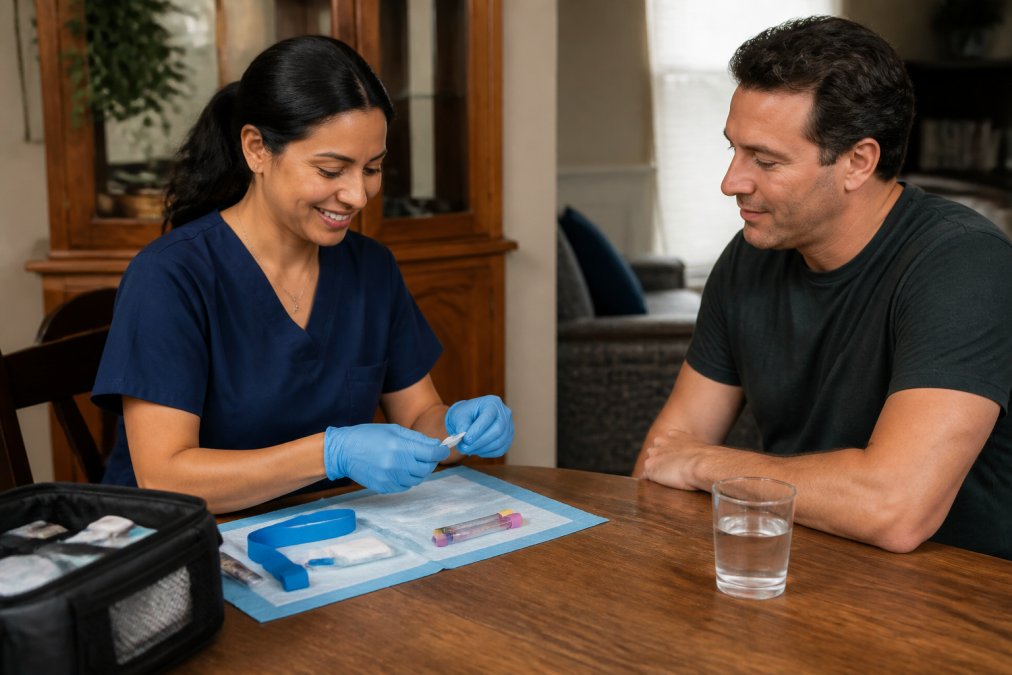
Wear short sleeves or a shirt with sleeves that roll above the elbow. A tight long-sleeved top forces the technician to work around fabric and slows everything down. Keep pets secured in another room, and have your insurance card and lab order within reach.
Managing Needle Anxiety, Difficult Veins, and Medical Conditions
Needle phobia, hard-to-find veins, and chronic conditions each require a different prep plan. Treating them as one problem is why so many home draws get rescheduled or produce unusable specimens.
Needle Anxiety and Vasovagal Response
Roughly one in four adults reports some degree of needle fear, and a smaller share have a true vasovagal response, a sudden drop in heart rate and blood pressure that causes fainting. If you have fainted during a past draw, tell the phlebotomist before they open the kit; they will position you reclined rather than seated upright, the single most effective prevention.
Techniques that actually help, in order of how well they tend to work:
- Applied tension. Tense your legs and abdomen for 10-15 seconds, release, and repeat. This counteracts the blood pressure drop that causes fainting.
- Distraction with a task. Counting backward from 100 by sevens, or naming objects in the room, works better than trying to relax on command.
- Cold pack on the back of the neck. Ask for one before the stick if you know you are prone to feeling faint.
Avoid holding your breath. It feels like it helps and it usually makes things worse.
Difficult Veins
If you have been told your veins are hard to find, say so when you book, not when the technician is already gloved up. Prep that helps:
- Hydrate aggressively the day before, not just the morning of. Steady intake over 24 hours beats a single glass two hours out.
- Keep the arm warm from the shoulder down. A warm shower, a heating pad on low for 10 minutes, or a warm compress right before the visit all help.
- Ask whether the service carries a vein finder or a butterfly needle. Not every mobile kit does, and a 23-gauge butterfly is often the difference between a successful draw and a second visit.
- Do not let anyone slap or tap the vein repeatedly. It is an old habit that causes bruising and does not improve access.
Condition-Specific Prep
This is where generic prep advice breaks down. If you manage any of the following, coordinate with your physician before the visit, not the morning of.
Diabetes. If you take insulin or a sulfonylurea, a fasting draw can trigger hypoglycemia. Ask your physician whether to adjust your dose, delay it until after the draw, or schedule early enough to eat immediately afterward. Bring a glucose source and tell the phlebotomist you are diabetic.
Blood thinners. Warfarin, apixaban, rivaroxaban, and clopidogrel all increase bleeding and bruising risk. Do not stop them on your own. Tell the phlebotomist in advance so they can apply pressure longer and use a smaller gauge needle where possible. Expect a bruise even with good technique.
Thyroid medication. Levothyroxine is typically taken on an empty stomach, and some thyroid panels are drawn before the dose. Confirm with your physician whether to take it before or after the draw, the answer depends on which test is ordered.
Blood pressure medications and diuretics. Diuretics can leave you dehydrated going into a fasting draw. Ask whether you can take them with a small amount of water, and hydrate more than usual the day before.
Bleeding disorders and anticoagulation for a mechanical valve. These require a conversation with your physician, not a general rule. Some patients are advised to have bloodwork done at a clinic with immediate access to treatment rather than at home.
Watch Out
Never skip a prescribed medication before a blood draw on your own. Stopping a blood thinner or diabetes medication without your physician’s direction can cause a serious health problem, and it is not required for most standard lab tests.
Never skip a prescribed medication before a blood draw on your own. Stopping a blood thinner or diabetes medication without your physician’s direction can cause a serious health problem, and it is not required for most standard lab tests.
If You Live in a Group Setting
Assisted living facilities and group homes scheduling multiple residents should share each person’s medical history, medication list, and any history of fainting or difficult veins with the phlebotomy team in advance. Batching draws without that information is the most common reason a mobile visit is repeated.
Appointment-Day Checklist and Common Mistakes to Avoid
A short checklist keeps the appointment moving and prevents the most frequent problems.
- Confirm your fasting window and stop eating at the right time
- Drink 16-24 ounces of water in the two hours before the visit
- Take medications as directed by your physician
- Wear a short-sleeved or loose-sleeved shirt
- Have your lab order, ID, and insurance card ready
- List all medications and supplements, including dosages
- Secure pets and clear a well-lit table or counter
- Tell the phlebotomist about needle anxiety or difficult veins
The most common mistakes are skipping water, wearing the wrong clothing, and hiding a fear of needles until the needle is already out.
After the Draw: Post-Procedure Care and Recovery
Post-procedure care is simple, but skipping it causes most bruising and hematoma complaints. Keep pressure on the site for several minutes after the needle is removed, then apply a bandage.
Avoid heavy lifting and strenuous activity with that arm for the rest of the day. If a bruise forms, ice it for short intervals during the first 24 hours. Contact your physician if you see worsening swelling, numbness, or bleeding that will not stop.
Preparing for a home blood draw does not have to be complicated, but the details protect both your comfort and your results. Phlebotomy Experts brings licensed, experienced phlebotomists to your home or office, with gentle handling for needle phobia, and prompt delivery of your specimen to the laboratory of your choice. Call now to schedule your visit and let our team handle the rest with the reliability and care you deserve.
Frequently Asked Questions
What should you never do before a blood test?
Avoid alcohol, strenuous exercise, and smoking in the hours before your draw, since all three can shift results for glucose, lipid, and liver panels. Don’t skip water, chew gum, or drink coffee if you’re fasting, and never stop a prescription medication without checking with your doctor first. If you’re unsure whether a specific food, drink, or supplement will interfere, call the lab or the ordering physician before your appointment.
Do I need to fast before an at-home blood draw?
Only if your provider ordered a fasting test. Fasting requirements for blood tests usually apply to glucose levels, lipid panels, and some metabolic panels, with a typical window of 8 to 12 hours. Many other tests, including most DNA gender testing and complete blood counts, do not require fasting. Confirm the exact fasting window with the lab or the phlebotomy team when you schedule your home blood draw.
How do I make my veins easier to draw blood?
Drink plain water in the two hours before your appointment, keep your arms warm with a light sweater or blanket, and gently open and close your fists a few times right before the draw. Avoid heavy caffeine and intense workouts that morning. Tell the phlebotomist if you’ve had difficult draws before, since a licensed technician can choose a smaller needle, a different vein, or a warming pack to improve vein accessibility.
How should I prepare my home environment for a phlebotomist?
Set up a well-lit area with a table or counter, two chairs, and enough space for the collection kit. Move pets to another room, clear clutter, and have your ID, insurance card, and lab order ready. Wear a short-sleeved shirt so the arm is easy to access, and let the technician know about any mobility issues or medical history that could affect the draw. A quiet, comfortable space helps the visit run smoothly.
