
Concierge lab services bring blood draws to your home or office. See how mobile phlebotomy works, what it costs, and how to prepare for a blood test.
How to Find Mobile Phlebotomists for Difficult Veins
Table of Contents
- Why Difficult Veins Make Finding the Right Mobile Phlebotomist Critical
- Mobile Phlebotomy Service Requirements: What to Verify Before Booking
- How to Prepare for a Difficult Blood Draw: A Step-by-Step Checklist
- Vein Finding Technology for Blood Draws: What to Ask Providers
- Pediatric vs. Geriatric Challenges: Matching the Phlebotomist to the Patient
- Safety and Verification Protocols for Home Visits
- Conclusion: Booking with Confidence
- Frequently Asked Questions
Last Updated: September 11, 2026
Why Difficult Veins Make Finding the Right Mobile Phlebotomist Critical
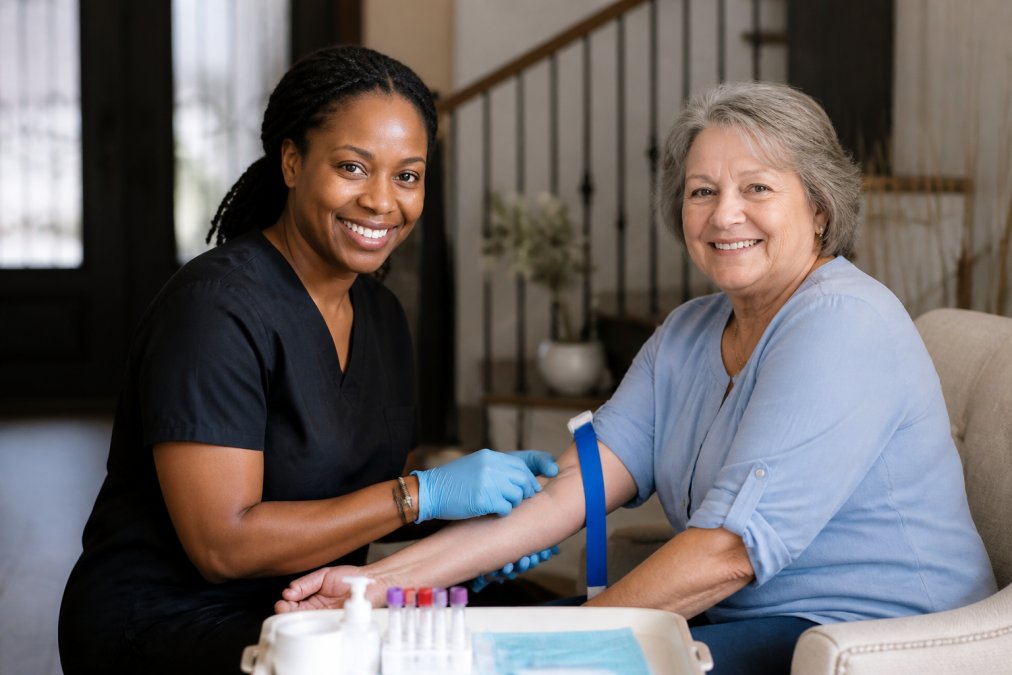
For patients with difficult veins, mobile phlebotomists can turn a routine blood draw from an ordeal of multiple needle sticks and rising anxiety into a single, successful visit. Finding mobile phlebotomists for difficult veins directly affects whether your blood collection succeeds on the first attempt. This guide from Phlebotomy Experts covers what to verify, how to prepare, and which questions separate a skilled practitioner from an average one.
A hard stick is a patient whose veins are difficult to locate, too fragile to hold a needle, or prone to collapsing during venipuncture. Causes range from dehydration and age to chronic conditions, cold temperatures, and anatomy. Without clinical expertise to manage these factors, the result is repeated punctures, bruising, and sometimes a failed draw that must be rescheduled.
The stakes are higher than most people realize. For patients on anticoagulants, those undergoing therapeutic phlebotomy, or anyone managing a chronic condition, a botched draw means delayed results and delayed care (peer-reviewed research).
CDC guidance on blood specimen collection
Mobile Phlebotomy Service Requirements: What to Verify Before Booking
Mobile phlebotomy service requirements come down to three things: verified credentials, clear billing terms, and a documented chain of custody. Ask about all three before confirming an appointment.
Licensing and Certification Checks
Phlebotomists in most states work under certification or licensure requirements, so ask directly which credential your technician holds. Common credentials come from national certifying bodies requiring documented training hours and continuing education. A legitimate mobile provider will answer without hesitation.
What most guides miss is that certification alone does not prove skill with difficult veins. Ask how many hard-stick patients the technician sees weekly. A phlebotomist who draws mostly healthy adults may hold the same certificate as one specializing in venous access challenges, but their hands-on experience is not comparable.
Pro Tip
Ask whether the technician carries a portable vein finder and a range of needle gauges, including butterfly needles for fragile veins. A provider who arrives with only standard equipment is not set up for hard sticks.
Ask whether the technician carries a portable vein finder and a range of needle gauges, including butterfly needles for fragile veins. A provider who arrives with only standard equipment is not set up for hard sticks.
Insurance and Billing for Mobile Visits
Insurance coverage for mobile phlebotomy varies widely. Many mobile services operate as a convenience layer separate from your ordering physician’s lab contract, so the draw fee may not be covered even when the lab work itself is.
Ask these questions before booking:
- Is the mobile draw fee billed to my insurance, or is it a self-pay service?
- Which laboratory do you deliver to, and is that lab in my insurance network?
- Will I receive an itemized receipt I can submit for reimbursement?
Get the answers in writing, ideally by email. Pricing depends on your location, the type of draw, and the laboratory you choose, so request a written quote rather than a phone estimate. For current service pricing, contact Phlebotomy Experts directly.
How to Prepare for a Difficult Blood Draw: A Step-by-Step Checklist
Preparing for a difficult blood draw starts the night before your appointment. Hydration, warmth, and calm are the three levers you control, and each improves vein visibility.
Follow this sequence:
- Drink water steadily for 24 hours before your appointment. Aim for consistent intake throughout the day rather than a single large glass an hour before.
- Avoid caffeine and alcohol on the day of the draw. Both contribute to vasoconstriction, which narrows veins and makes them harder to find.
- Apply a warm compress for 5 to 10 minutes to the intended draw site before the technician arrives.
- Wear short sleeves or loose layers so the arm can be exposed without a tourniquet-style sleeve roll.
- Eat normally unless your physician instructs fasting. Low blood sugar increases the chance of lightheadedness.
- Have your paperwork ready: photo ID, insurance card, and the lab order from your physician.
Hydration and Warm Compress Protocols
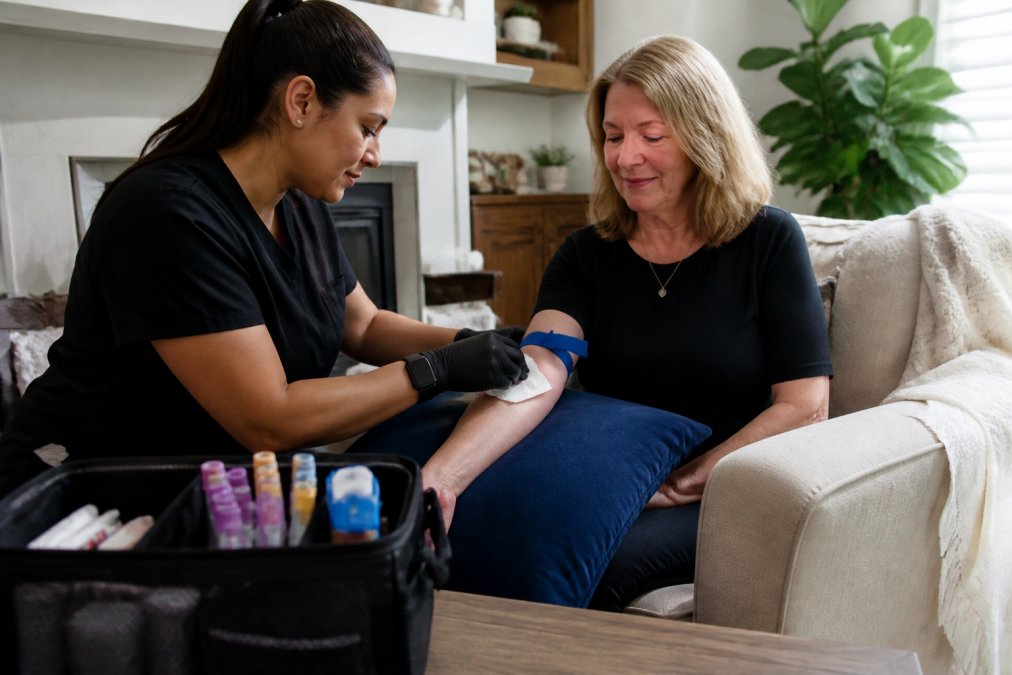
Dehydration is the most common and most fixable cause of a hard stick. When blood volume drops, veins flatten and become harder to palpate. Water restores volume; warmth dilates vessels near the skin’s surface.
A warm compress works because heat triggers localized vasodilation. Ten minutes of moist heat is usually enough to make a previously invisible vein palpable. If you have a history of difficult draws, mention it when booking so the technician can build in extra time.
Managing Anxiety Before the Appointment
Needle phobia is common and genuinely affects venous access. Anxiety triggers vasoconstriction, the opposite of what you want before a draw. Helpful techniques include slow breathing, tensing and releasing your muscles, and telling the technician upfront about your fear of needles.
A skilled phlebotomist will adjust: using a smaller needle gauge, keeping equipment out of sight until the last moment, and talking you through each step. Honesty here is useful clinical information, not weakness.
Watch Out
Do not skip food and water to “make the draw easier.” Fasting without hydration is the fastest route to a collapsed vein and a second attempt.
Do not skip food and water to “make the draw easier.” Fasting without hydration is the fastest route to a collapsed vein and a second attempt.
Vein Finding Technology for Blood Draws: What to Ask Providers
Vein finding technology for blood draws includes near-infrared vein visualization devices, ultrasound guidance, and transillumination tools. Each works differently and has limits that determine whether it helps on a hard stick. Knowing the mechanism lets you ask sharper questions when you book.
Near-infrared vein visualization. These devices shine infrared light into the tissue. Hemoglobin absorbs that light more than surrounding tissue, and the device projects the contrast back onto the skin as a vein map. The advantage is speed: a technician can survey the whole arm in seconds and spot a vessel palpation alone might miss. The limitation is depth. Most handheld units read only superficial vessels, so a deep or scarred vein may not appear. The map also shows location, not quality. A vein that lights up can still be fragile, rolling, or prone to collapsing, so the technician must still palpate before choosing a site.
Ultrasound guidance. Ultrasound uses high-frequency sound waves to build a real-time cross-sectional image of the vessel, including depth, diameter, and surrounding anatomy. It is the tool of choice for deep veins, patients with a history of IV drug use or vein scarring, and situations where a superficial attempt has failed. It requires formal training and a machine, so not every mobile phlebotomist offers it. When a provider does, ask who performed the training and how often the technician uses it, because the skill is perishable.
Transillumination. A transilluminator is a bright, focused light pressed against the skin. It works best on newborns, infants, and patients with very fair skin, where the vein casts a shadow through the tissue. It is inexpensive and portable but the least useful of the three on adults with deeper or thicker tissue.
Palpation remains the foundation of vein assessment. A good technician feels for the bounce and resilience of a vein, not just a blue line. A vein that feels springy and refills after being pressed is a better target than one that merely shows up on a screen. Technology supports that assessment; it does not replace it.
Ask specifically:
- Do you use a vein finder for hard sticks, or is site selection based on palpation alone?
- If you use near-infrared, do you still palpate before you stick?
- Do you carry butterfly needles in multiple gauges, and which sizes?
- Have you been trained on ultrasound-guided venous access, and how recently have you used it?
- What is your protocol when the first attempt fails?
Pro Tip
A provider who says “we use a vein finder” is not the same as one who can explain when the device fails. The follow-up question, “what do you do when the finder doesn’t show a usable vein?” tells you whether the technology is a tool or a crutch.
A provider who says “we use a vein finder” is not the same as one who can explain when the device fails. The follow-up question, “what do you do when the finder doesn’t show a usable vein?” tells you whether the technology is a tool or a crutch.
FDA information on medical device use and safety
Pediatric vs. Geriatric Challenges: Matching the Phlebotomist to the Patient
Pediatric and geriatric patients present opposite challenges, and a provider who excels with one may not suit the other. Children have small, mobile veins and limited cooperation; older adults often have fragile, rolling veins and thin skin that bruises easily.
For infants and young children, look for a technician with pediatric experience and a calm, unhurried approach. Butterfly needles and smaller gauges are standard, and keeping a child still and comfortable matters as much as technical skill. Phlebotomy Experts provides specialized care for infants and children, worth asking about directly when you book.
For older adults, priorities shift. Fragile veins require lower suction pressure, careful tourniquet application, and hematoma prevention. Patients on blood thinners need extra care at site selection and longer pressure after the needle is withdrawn.
| Patient Group | Primary Challenge | What to Ask For |
|---|---|---|
| Infants and children | Small, mobile veins; limited cooperation | Pediatric experience, butterfly needles, small gauge |
| Older adults | Fragile, rolling veins; thin skin | Low-pressure technique, hematoma prevention protocol |
| Chronic conditions | Frequent draws; vein scarring | Rotation of sites, vein mapping, experienced technician |
| Needle phobia | Vasoconstriction from anxiety | Slow-paced approach, smaller gauge, clear communication |
Safety and Verification Protocols for Home Visits
Safety and verification protocols for home visits protect both you and the technician, and a professional provider follows them without being asked. Inviting a stranger into your home to draw blood raises legitimate questions about identity, privacy, and what happens if something goes wrong.
Before the visit. A legitimate provider should confirm the appointment in writing, including the technician’s name, arrival window, and a phone number. Ask whether the technician carries photo identification and a copy of the lab order. You should also receive a clear description of what the visit includes and what it does not.
At the door. The technician should present identification and state the company name before entering. You are entitled to verify that the name matches your confirmation. If anything feels wrong, you can decline the visit; a professional will not pressure you.
During the draw. Watch for these standards:
- Single-use, sealed needles and tubes opened in front of you
- Gloves worn throughout the procedure
- Your name and date of birth confirmed against the requisition before any tube is labeled
- Specimens labeled at the point of collection, not later
- A sharps container used for needle disposal, not a household trash can
Privacy and documentation. The technician should handle your personal health information the way a clinic would: not discussing results with anyone else in the room, not leaving paperwork visible, and following the privacy practices required of health care providers under federal law. Ask how the provider safeguards your information.
Specimen transport and chain of custody. Ask how your sample is transported and how quickly it reaches the lab. Turnaround matters for time-sensitive tests, so a provider should describe their delivery process clearly, including temperature control and tracking from your home to the laboratory. At Phlebotomy Experts, specimens are delivered to the laboratory or hospital of your choice, and results go promptly to your ordering physician.
If something goes wrong. Ask in advance what the provider’s policy is for a failed draw, a hematoma, or a reaction such as fainting. A strong provider will have a written protocol, will not charge you twice for a failed attempt, and will tell you exactly who to contact afterward.
Watch Out
Never let a technician draw blood without first confirming your identity and your physician’s order. If the paperwork does not match, stop the visit and call the provider before proceeding.
Never let a technician draw blood without first confirming your identity and your physician’s order. If the paperwork does not match, stop the visit and call the provider before proceeding.
Key Takeaway
Home-visit safety is not just about clean needles. It is about verified identity, protected privacy, a documented chain of custody, and a clear plan for what happens if the draw fails.
Home-visit safety is not just about clean needles. It is about verified identity, protected privacy, a documented chain of custody, and a clear plan for what happens if the draw fails.
Conclusion: Booking with Confidence
Finding the right mobile phlebotomist for difficult veins takes a few pointed questions, not guesswork. Verify credentials, confirm billing terms in writing, prepare with hydration and warmth, and ask about hard-stick experience and equipment.
Phlebotomy Experts brings licensed phlebotomists to your home or office, with a gentle bedside manner, specialized care for infants and children, and specimen delivery to the laboratory of your choice. If repeated needle sticks have made blood draws something you dread, get started with Phlebotomy Experts and schedule a draw designed around your veins, not against them.
Frequently Asked Questions
How much does a mobile phlebotomist cost?
Pricing for mobile phlebotomy depends on your location, the number of patients, and the type of service. Insurance may cover the draw if it is medically necessary, but many mobile providers charge a convenience fee. Contact Phlebotomy Experts directly for a quote based on your specific needs.
What qualifications should I look for in a mobile phlebotomist for difficult veins?
Look for a current phlebotomy certification, state licensure where required, and hands-on experience with hard sticks. Ask about their training in palpation, butterfly needle use, and vein mapping. A provider who specializes in difficult veins will have a track record of successful draws and a calm, patient-centered approach.
How can I prepare for a mobile blood draw if I have a history of hard sticks?
Drink plenty of water in the 24 hours before your appointment to improve vein visibility. Apply a warm compress to your arms for 5-10 minutes before the draw. Wear short sleeves or loose clothing for easy access. Tell the phlebotomist about past difficult draws so they can plan accordingly.
Do mobile phlebotomy services use vein-finding technology?
Some mobile providers use vein-finding technology such as infrared or near-infrared devices to locate veins that are not visible to the naked eye. Ask ahead of time if the provider has this equipment. Even without technology, an experienced phlebotomist relies on palpation and clinical expertise to find the best site.
