
Find mobile lab services in Orange County using 7 proven steps. Learn how to verify providers and book convenient at-home blood draws.
Mobile Phlebotomy vs Lab Visits: Which to Choose
Last Updated: October 22, 2026
Quick Summary
Choose mobile phlebotomy when time, mobility, or comfort outweigh the collection fee, and choose a lab visit when speed, budget, or a specialized test menu matters more. Mobile phlebotomy trades a modest collection fee for saved time, less travel, and a calmer draw, while a lab visit costs less upfront but asks more of your day.
- A mobile visit usually takes 15 to 30 minutes and you never leave your chair.
- The collection fee is the line item insurance most often declines because it covers convenience.
- Lab patient service centers often accept walk-ins, which usually beats waiting for a mobile window.
- Don’t book a home draw before you have the requisition in hand with correct test codes.
- Result timelines depend on the test and the lab, not the draw location.
Table of Contents
- Mobile Phlebotomy vs Lab Visits: A Side-by-Side Comparison
- Convenience, Time Saved, and Reduced Travel
- Mobile Phlebotomy Cost and Insurance Coverage
- Who Benefits Most From Mobile Blood Draws
- How to Prepare for a Blood Draw at Home
- Booking, Doctor’s Orders, and Test Availability
- Specimen Handling, Safety, and Result Timelines
- Frequently Asked Questions
Mobile Phlebotomy vs Lab Visits: A Side-by-Side Comparison
Mobile phlebotomy is a licensed phlebotomist coming to your home, office, or facility to draw blood and deliver the specimen to the lab you choose. Below, we break down exactly when a home visit wins and when a traditional lab trip is still the smarter call. (Source: a 2023 survey by the National Health Interview Survey)
Here’s the short version: mobile phlebotomy trades a modest collection fee for saved time, less travel, and a calmer draw. A lab visit costs less upfront but asks more of your day.
| Factor | Mobile Phlebotomy | Traditional Lab Visit |
|---|---|---|
| Where the draw happens | Home, office, or facility | Lab patient service center |
| Travel and wait time | None to minimal | Often the biggest time cost |
| Collection fee | Usually charged per visit | Usually none beyond lab billing |
| Best for | Mobility limits, busy schedules, needle anxiety | Simple tests, tight budgets, walk-in speed |
| Test menu | Varies by provider | Broadest available |
| Results | Sent to ordering physician | Sent to ordering physician |
How Mobile Phlebotomy Works
A mobile phlebotomist arrives at your location with collection supplies, verifies your identity and lab requisition, draws the specimen, and transports it to the laboratory your doctor specified. The visit itself usually takes 15 to 30 minutes, and you never leave your chair. Most providers serve a defined service area, so availability depends on your address. Our team delivers specimens to the laboratory or hospital of the patient’s choice, which matters if your physician has a preferred lab.
How a Traditional Lab Visit Works
A traditional lab visit means traveling to a patient service center, checking in, and waiting for your turn before a phlebotomist draws the sample on site. Labs handle high volume, so the draw itself is quick, but parking, check-in lines, and waiting room time add up. The upside is scale: large labs run the widest test menus and typically process specimens on-site, which can shorten turnaround for routine panels.
Convenience, Time Saved, and Reduced Travel
Time is where mobile phlebotomy separates itself most clearly. A lab visit often consumes an hour or more once you count the drive, parking, check-in, and wait, and that estimate climbs for anyone relying on rideshare, public transit, or a caregiver’s schedule.
For busy professionals, the math is simple: a 20-minute draw at home beats a half-day carved out of the calendar. For caregivers coordinating a parent’s appointments, one less trip across town is one less logistics puzzle.
Pro Tip
Schedule your at-home draw for early morning if your doctor ordered a fasting test. You finish the draw before breakfast, then eat normally. Booking a mid-morning lab visit instead often means skipping breakfast and fighting traffic while hungry.
Schedule your at-home draw for early morning if your doctor ordered a fasting test. You finish the draw before breakfast, then eat normally. Booking a mid-morning lab visit instead often means skipping breakfast and fighting traffic while hungry.
Mobile Phlebotomy Cost and Insurance Coverage
Cost is where the two options diverge most, and where most guides stay vague. Here is the practical breakdown.
A mobile draw has two separate charges:
- Collection or visit fee. This pays the phlebotomist for travel, the draw, and specimen transport. It is a convenience charge, not a medical test charge.
- Laboratory analysis charge. This is the lab’s fee for running the ordered tests. It is billed the same way whether the sample was drawn at home or at a patient service center.
The collection fee is the line item insurance most often declines, because it covers convenience rather than diagnosis. The analysis charge is the line item insurance most often covers when the test is medically necessary and ordered by a physician.
What the collection fee typically looks like
Mobile collection fees vary widely by provider and service area. A common pattern is a flat per-visit fee, with an additional charge for travel beyond a defined radius or for after-hours and weekend appointments. Some providers bundle the visit fee into a single price; others itemize it. Ask for the all-in number before booking, including any travel surcharge, and confirm whether the fee is charged per draw or per visit when multiple patients at one address are drawn.
How insurance actually handles each line item
- Commercial plans. Most cover the laboratory analysis when the test is medically necessary and ordered by a physician. The collection fee is usually the patient’s responsibility unless the plan includes a home health or home visit benefit.
- Medicare. Part B generally covers medically necessary lab tests, and the specimen collection fee for a homebound patient is a recognized component in some circumstances. Coverage depends on the patient meeting homebound criteria and the test being ordered appropriately, so confirm with the plan before assuming.
- Medicaid. Coverage of mobile collection varies by state program; some cover it for homebound or medically fragile members, others do not.
When a lab visit costs less
A lab visit is usually cheaper upfront because there is no collection fee. If your test is simple, you can get to a patient service center easily, and your schedule is flexible, the lab visit wins on pure cost. The mobile premium buys time, comfort, and avoided travel, and it only pays off when those things matter to you.
Questions to ask before you book
- What is the total charge for the visit, including any travel or after-hours fee?
- Does the fee cover one draw or multiple patients at the same address?
- Will you bill my insurance directly, or will I pay upfront and submit a receipt?
Pro Tip
Ask for the collection fee and the lab’s self-pay price for your exact test codes in the same conversation. Comparing only the visit fee against a lab visit hides the analysis charge, which is often the larger number.
Ask for the collection fee and the lab’s self-pay price for your exact test codes in the same conversation. Comparing only the visit fee against a lab visit hides the analysis charge, which is often the larger number.
At Phlebotomy Experts, we confirm which lab will process your specimen before we schedule, so you can compare the full cost rather than just the draw.
Who Benefits Most From Mobile Blood Draws
Mobile blood draws help most when getting to a lab is the hard part. Four groups see the clearest benefit: (Source: the Centers for Medicare & Medicaid Services (CMS))
- Seniors and people with mobility limitations, who avoid transport, waiting rooms, and long walks from parking lots.
- Caregivers, who can coordinate a draw at home instead of escorting a parent across town.
- Busy professionals, who fit a draw into a lunch break without leaving the office.
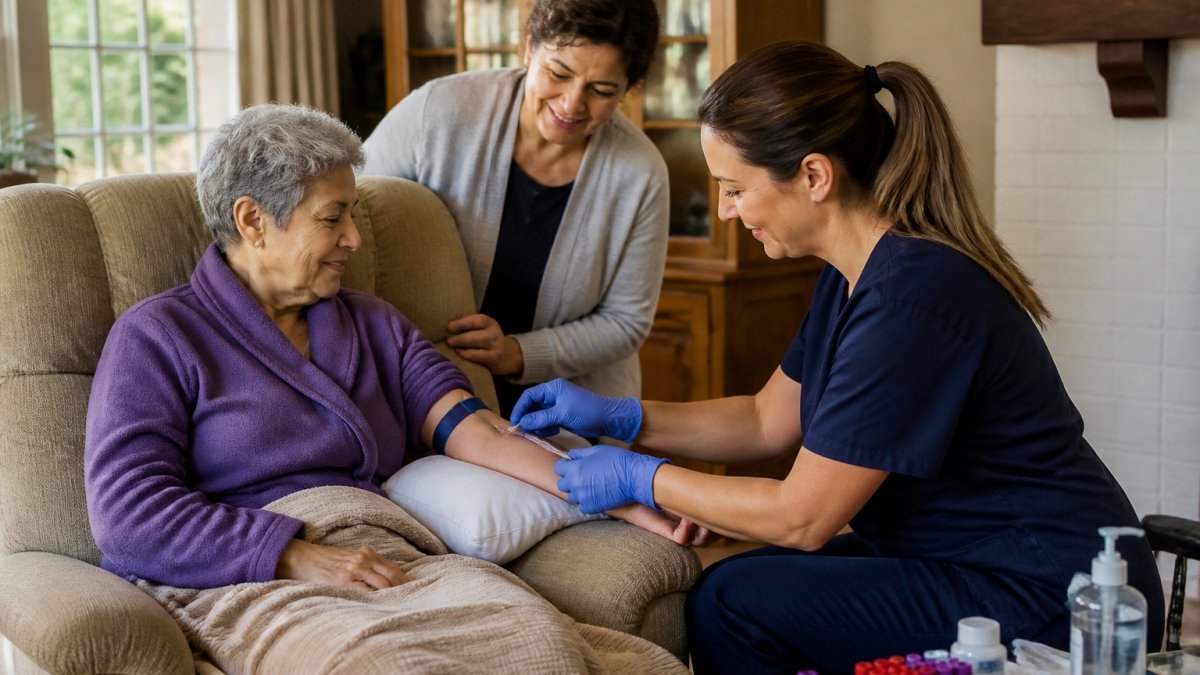
Residential facilities and assisted living communities also use on-site collection to handle multiple residents in one visit, which cuts disruption for staff and residents alike.
How to Prepare for a Blood Draw at Home
Preparing for a blood draw at home follows the same rules as a lab visit, with a few home-specific touches. Follow your doctor’s preparation instructions exactly, especially for fasting tests.
- Confirm whether your test requires fasting, and for how long.
- Drink water beforehand; hydration makes veins easier to find.
- Clear a well-lit space with a table and a chair with armrests.
A common mistake is skipping water to “save time” before a fasting test. Water is fine during a fast and helps the draw go smoothly. Another: handing over a requisition with missing test codes, which can delay processing.
Booking, Doctor’s Orders, and Test Availability
Most mobile services require a doctor’s order, also called a lab requisition, before they can draw. The requisition tells the phlebotomist exactly which tests to collect and which lab should process them.
Test availability is the biggest practical limit. A mobile phlebotomist can collect almost any blood sample, but the laboratory receiving it determines which tests actually run. Specialized or rare tests may need a specific lab, so confirm the destination before your appointment.
Decide by situation
Use this framework to choose quickly. It is the part most comparisons skip.
- Fasting test, early morning. A mobile draw scheduled before breakfast lets you finish the fast and eat normally afterward. A lab visit works too, but you may sit in traffic hungry. Mobile wins on comfort; lab wins on cost.
- Urgent or same-day testing. Lab patient service centers often accept walk-ins and process on-site, which usually beats waiting for a mobile window. Choose the lab when speed matters most.
- Multiple tests or a large panel. Either option works, but confirm the mobile provider can transport the full specimen set to the correct lab within the required handling time. If any test is time-sensitive, ask how transport is handled.
Quick checklist before you book
- Requisition in hand with correct test codes and the ordering physician’s information.
- Confirmed which laboratory will process the specimen and that it accepts the ordered tests.
- Confirmed the provider serves your address and the appointment window.
Watch Out
Don’t book a home draw before you have the requisition in hand. Arriving without a valid doctor’s order means the phlebotomist may have to reschedule, and you’ll have wasted the appointment slot.
Don’t book a home draw before you have the requisition in hand. Arriving without a valid doctor’s order means the phlebotomist may have to reschedule, and you’ll have wasted the appointment slot.
Key Takeaway
Choose mobile when time, mobility, or comfort outweigh the collection fee. Choose a lab visit when speed, budget, or a specialized test menu matters more. Confirm the lab destination and the all-in fee before either appointment.
Choose mobile when time, mobility, or comfort outweigh the collection fee. Choose a lab visit when speed, budget, or a specialized test menu matters more. Confirm the lab destination and the all-in fee before either appointment.
Specimen Handling, Safety, and Result Timelines
Specimen handling decides whether your test is accurate. Some samples need prompt processing or specific temperature conditions, which is why transport matters as much as the draw.
Safety standards apply at home just as they do in a lab.
Key Takeaway
The draw location doesn’t change your results, but specimen handling and transport time can. Ask how your sample gets to the lab before you book.
The draw location doesn’t change your results, but specimen handling and transport time can. Ask how your sample gets to the lab before you book.
Choosing between a home draw and a lab trip comes down to what your week can absorb: a convenience fee and a scheduled visit, or travel and waiting time on your own.
Frequently Asked Questions
Is mobile phlebotomy more convenient than visiting a lab?
For many people, yes. A mobile phlebotomist comes to your home, office, or facility, so you skip travel, parking, and waiting-room time. That matters most for busy professionals, seniors with mobility limitations, and caregivers managing multiple appointments. The trade-off is that you need to schedule in advance and confirm the service area covers your address. If your schedule is flexible and a lab is close by, a traditional visit can be just as quick.
Does insurance cover mobile phlebotomy?
Coverage varies by plan. Some insurance plans cover the lab analysis but not the mobile collection fee, which is often billed separately. Check with your insurer before booking to confirm whether a home visit is covered and whether you need a doctor’s order or lab requisition. Ask the mobile service how it bills collection versus processing so there are no surprise charges. Keep your receipts in case you need to submit a claim.
How should I prepare for an at-home blood draw?
Follow the fasting or preparation instructions your ordering provider gives you, since some tests require 8 to 12 hours without food. Drink water beforehand to make veins easier to find, and tell the phlebotomist about medications, needle phobia, or veins that have been hard to draw in the past. Clear a well-lit space with a table and chair, and have your ID, insurance card, and lab requisition ready when the phlebotomist arrives.
Can I choose which laboratory processes my blood sample?
Many mobile phlebotomy services let you specify the lab or hospital that processes your specimen, as long as it is within their delivery network. Confirm this when you book, and make sure your doctor’s order or requisition names the same lab. If your insurer requires a specific in-network laboratory, verify that before the visit so your sample is not sent to a facility that is out of network.
How quickly are results available after a mobile blood draw?
Timelines depend on the test and the laboratory, not just the draw. Routine panels often return within a few business days, while specialized testing can take longer. The phlebotomist delivers your specimen to the lab promptly, and results typically go to the ordering physician or lab portal. Ask the service about its delivery process and expected turnaround when you book so you know when to follow up.
