

Find mobile lab services in Orange County using 7 proven steps. Learn how to verify providers and book convenient at-home blood draws.
How to Hold a Baby During a Blood Draw
Last Updated: October 23, 2026
Quick Summary
How to hold a baby during a blood draw depends on their age and comfort level. Babies 6 months and older do well in a lap-sitting position with their draw arm at heart level, while newborns prefer a reclined position that mimics feeding. Keep your grip firm but gentle, stay calm, and use distraction techniques to help your baby feel secure and still.
- Position your baby’s draw arm at heart level or slightly below to improve blood flow and speed up the procedure.
- For babies 6 months and older, use the lap-sitting position with your baby facing away from you and their arm on an armrest.
- For newborns and infants under 6 months, use a reclined position that mimics feeding to keep them calm and provide heel access.
- Keep your grip secure but not tight, and use gentle pressure with your hands to prevent sudden movement without causing distress.
- Start distraction techniques before the needle appears, using singing, bubbles, toys, or gentle rocking to keep your baby’s attention.
Table of Contents
- Why Proper Positioning Matters When Holding a Baby During a Blood Draw
- Comfort Positions for Infant Blood Draws
- How to Prepare a Baby for a Blood Test
- How to Calm a Baby During a Blood Draw
- Blood Draw for a 1-Year-Old: Age-Specific Positioning
- Caregiver Positioning and Arm Placement: Step-by-Step
- Venous Blood Draws vs. Heel-Prick Sampling: What to Expect
- What to Do If Your Baby Cries, Moves, or the Draw Takes Longer
- Frequently Asked Questions
Why Proper Positioning Matters When Holding a Baby During a Blood Draw
How to hold a baby during a blood draw directly affects the outcome: a secure, calm baby means faster collection, fewer needle sticks, and less distress.
A secure baby stays still, letting the phlebotomist access veins easily and collect the sample quickly.
Understanding how to hold a baby during a blood draw depends on your baby’s age. Learn gentle blood draw techniques for infants that complement proper positioning guidance.
Pro Tip
Position your baby so their arm is at heart level or slightly below. This helps blood flow to the draw site and makes the procedure faster.
Position your baby so their arm is at heart level or slightly below. This helps blood flow to the draw site and makes the procedure faster.
Comfort Positions for Infant Blood Draws
The Lap-Sitting Position
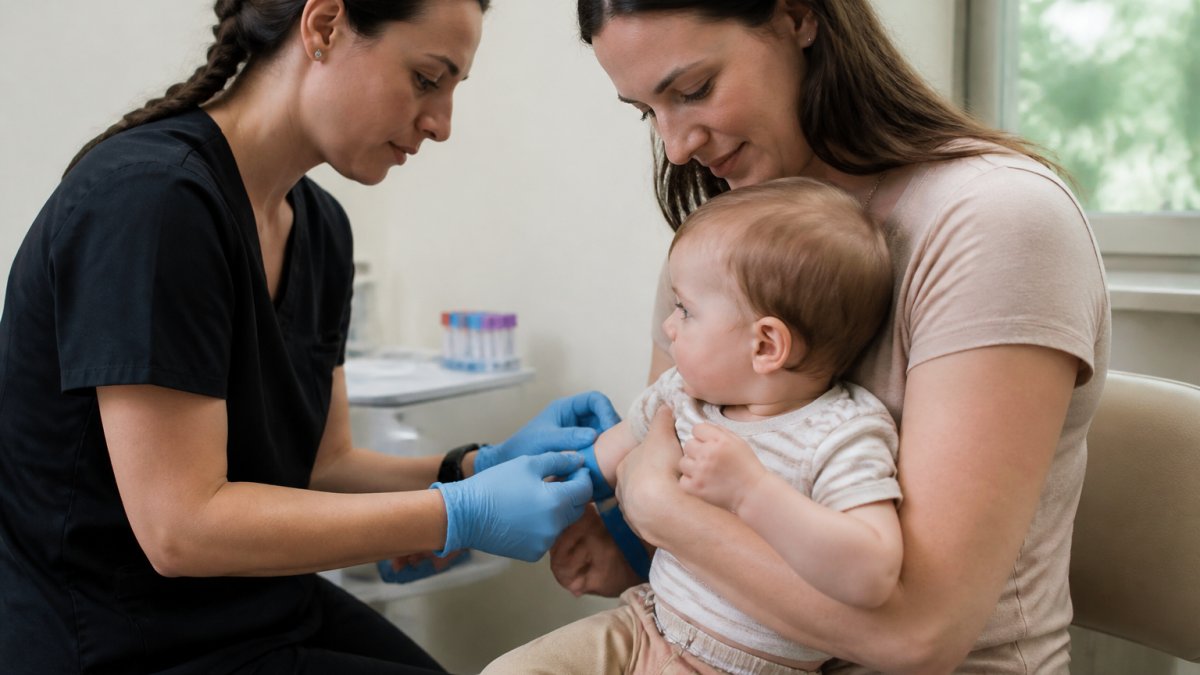
The lap-sitting position works well for babies 6 months and older. Sit with your back against the chair and place your baby on your lap facing away from you, back against your chest.
The draw arm should rest on the armrest or a small table at about heart level, with your other hand on your baby’s chest or stomach for gentle pressure and reassurance.
Keep your baby still without gripping too tightly: rest your hand gently but firmly, and breathe slowly, since your baby will sense if you’re nervous.
The Upright Facing-Forward Position
For active toddlers around 1 year old, the upright facing-forward position often works better. Sit upright and hold your baby on your lap facing the phlebotomist, supporting their back with one arm and gently holding their arm or hand with the other.
This lets your baby see what’s happening, reducing fear, while the phlebotomist accesses the inner arm easily and you keep your baby stable.
Keep your grip relaxed but secure, and stay calm, since your baby will pick up on tension.
The Reclined Position for Newborns and Young Infants
Newborns and babies under 6 months often do best reclined. Sit back in a comfortable chair with armrests and cradle your baby as if feeding them, head toward your left (if right-handed), body reclined against your chest.
The baby’s arm extends along their body, giving the phlebotomist access to the heel or inner arm. This mimics feeding, which most newborns find soothing, so keep your arms relaxed and breathing steady.
For very young infants, the phlebotomist may use a heel-prick sample instead of a venous draw. The reclined position keeps the baby’s foot accessible while they stay close to you.
Key Takeaway
The best position is the one where your baby feels most secure and the phlebotomist has clear access to the draw site. Every baby is different, what works for one may not work for another.
The best position is the one where your baby feels most secure and the phlebotomist has clear access to the draw site. Every baby is different, what works for one may not work for another.
How to Prepare a Baby for a Blood Test
What to Do the Day Before
Start preparing the day before. Review child-specific bloodwork preparation guidance to help your baby get ready for the test.
Make sure your baby is well-fed and hydrated, since a hungry or thirsty baby will be fussier.
Let your baby get a good night’s sleep, since a well-rested baby is calmer and less likely to move. Avoid evening overstimulation and keep the environment calm and quiet.
Morning-of Preparation Checklist
On the morning of the blood draw, follow these steps:
- Dress your baby in loose, comfortable clothing that allows easy access to the arm
- Offer a feeding or bottle an hour before the appointment if possible
- Keep your baby warm, a warm baby has better blood flow and easier-to-access veins
Keep your tone calm and reassuring. Avoid words like “shot” or “hurt.” Instead, say “We’re going to help the doctor learn about your body.”
Watch Out
Do NOT tell your baby “it won’t hurt” or “you won’t feel anything.” Babies pick up on this as a sign something uncomfortable is coming. Instead, be honest: “You might feel a quick pinch, and then it’s done.”
Do NOT tell your baby “it won’t hurt” or “you won’t feel anything.” Babies pick up on this as a sign something uncomfortable is coming. Instead, be honest: “You might feel a quick pinch, and then it’s done.”
How to Calm a Baby During a Blood Draw
Reassurance and Verbal Support
Your voice and presence are your baby’s biggest comfort during a blood draw. Discover additional comfort strategies for calming babies during the procedure.
Make eye contact if your baby is old enough; babies find comfort in a familiar face.
Avoid questions like “Are you okay?” or “Does it hurt?” They draw attention to discomfort. Instead, offer statements: “You’re so brave.
Keep your own body relaxed, since babies feel tension through your arms and chest.
Distraction Techniques That Work
Distraction is one of the most effective ways to keep a baby calm during a blood draw. The key is engaging your baby’s attention before the needle comes out.
Try these methods:
- Singing or humming: A familiar lullaby or simple song captures your baby’s attention and soothes anxiety
- Talking about something your baby loves: Describe their favorite toy, animal, or activity in detail
- Blowing bubbles: The rhythmic motion and visual interest of bubbles hold a baby’s focus
The best distraction is one your baby already enjoys. If your baby loves music, sing. If your baby loves movement, rock gently. Start the distraction before the phlebotomist approaches with the needle.
Pro Tip
Have a backup distraction ready. If one technique stops working, switch to another. Babies lose interest quickly, so variety helps.
Have a backup distraction ready. If one technique stops working, switch to another. Babies lose interest quickly, so variety helps.
Blood Draw for a 1-Year-Old: Age-Specific Positioning
At around 1 year old, babies are more mobile and aware.
For a 1-year-old, the upright facing-forward position usually works best.
Hold your baby firmly but gently, one arm across their chest or stomach and the other supporting their arm or holding their hand. At this age, babies want to touch and grab, so keeping their hands occupied helps them stay still. (Source: the impact of parental presence and comfort measures)
Talk to your 1-year-old before the draw starts: “The nurse needs to take a tiny sample of blood.
One-year-olds respond well to praise. After the draw, tell your baby “You did it!
Some 1-year-olds do better facing the phlebotomist rather than away, which lets them see what’s happening and feel more in control.
Caregiver Positioning and Arm Placement: Step-by-Step
Positioning Your Arms and Hands
Your arm placement makes the difference between a smooth draw and a difficult one. Position yourself correctly:
Step 1: Support your baby’s back and body. Use one arm to hold your baby against your chest or lap. Your arm should wrap around their back or torso, providing a sense of security and containment.
Step 3: Use your other hand for gentle pressure. Place your free hand on your baby’s chest, stomach, or the non-draw arm.
Step 4: Keep your grip firm but not tight. Your baby needs to feel secure, not trapped. A grip that’s too tight makes babies panic and struggle.
Step 5: Angle your baby’s head away from the draw site. Babies who watch the needle often become more anxious.
Keeping Your Baby Still Without Causing Distress
Keeping your baby still is essential, but forcing stillness causes distress.
Hold your baby close enough to feel your heartbeat.
Use gentle but consistent pressure with your hands.
Avoid restraining your baby’s head or face. This triggers panic.
If your baby tries to pull away, don’t fight it. Instead, redirect gently.
Talk to your baby throughout the process. Narrate what’s happening in a calm voice: “The nurse is cleaning your arm.
Venous Blood Draws vs. Heel-Prick Sampling: What to Expect
Two main methods exist for collecting blood from babies. Understanding the difference helps you know what to expect and how to position your baby.
Venous blood draws use a needle to collect blood from a vein in the arm or hand.
Heel-prick sampling is used for newborns and very young infants (the CDC).
For venous draws, use the lap-sitting or upright position.
Both methods are safe when performed by a trained phlebotomist.
Key Takeaway
Heel-prick sampling is faster but may feel sharper. Venous draws take longer but feel like steady pressure. Both are standard, safe methods for collecting baby blood samples.
Heel-prick sampling is faster but may feel sharper. Venous draws take longer but feel like steady pressure. Both are standard, safe methods for collecting baby blood samples.
Two main methods are used to collect blood from babies, each with different timing and sensations.
| Method | Age Group | Duration | Sensation |
|---|---|---|---|
| Venous blood draw | 6 months and older | 30-60 seconds | Quick pinch then mild pressure |
| Heel-prick sampling | Newborns and very young infants | 10-20 seconds | Sharp, quick sensation |
What to Do If Your Baby Cries, Moves, or the Draw Takes Longer
Babies cry during blood draws. This is normal and doesn’t mean something is wrong.
If your baby cries, stay calm. Your baby will sense panic in your voice or body.
If your baby moves suddenly, don’t panic.
After the draw, some babies bruise at the needle site. This is normal and usually fades within a few days. Why blood bruises after a blood draw explains what causes bruising and how to care for it.
Watch for signs of infection in the days after the draw: increasing redness, warmth, swelling, or pus.
Most babies recover quickly from a blood draw. Within minutes, they’re back to normal.
Frequently Asked Questions
How should I hold my baby during a blood draw?
The safest way to hold a baby during a blood draw is on your lap, facing forward or slightly reclined, with one arm supporting their back and your other hand gently holding their arm or leg still. Your body should be close to provide security and warmth. For infants under 6 months, a reclined position with head support is often preferred. Always keep your baby’s arm extended and relaxed on the phlebotomist’s work surface. Professional technicians will guide you on the exact position needed for your baby’s age and the collection site.
What’s the best way to calm a baby during a blood draw?
Comfort your baby by speaking in a calm, soothing voice and maintaining eye contact. Use distraction techniques like singing, showing a favorite toy, or letting them watch a video on a phone or tablet. For babies under 12 months, rhythmic movement or gentle swaying can help. Keep your own body relaxed, babies sense caregiver anxiety. Some babies respond well to a pacifier or comfort object.
How do phlebotomists draw blood from a 1-year-old?
For 1-year-olds, phlebotomists typically use a venous blood draw from the inner elbow (antecubital fossa) or the back of the hand. Your child will sit on your lap facing forward or slightly reclined, with their arm extended and supported. The phlebotomist will apply a tourniquet above the draw site to make veins easier to locate, then insert a needle to collect the sample. The entire process usually takes 1-2 minutes. Keeping your toddler still is important, so distraction and reassurance from you are key.
What should I do if my baby moves during a blood draw?
If your baby moves, alert the phlebotomist immediately. A sudden movement can cause the needle to slip, potentially requiring a second stick. Hold your baby’s arm or leg steady but not so tight that you cause pain or restrict blood flow. If your baby is very upset or moving frequently, ask the phlebotomist to pause and give your child a moment to calm down. Most phlebotomists are experienced with pediatric patients and expect some movement. If the draw becomes too difficult after one or two attempts, the phlebotomist may recommend trying again another day or using an alternative collection method.
At Phlebotomy Experts, we specialize in gentle blood draws for infants and children. Our licensed phlebotomists have extensive experience positioning babies safely and collecting samples with minimal distress. We bring professional phlebotomy directly to your home or office, so your baby stays in a familiar, calm environment. If you’re preparing for your baby’s blood test, call now to schedule a gentle, professional draw with a technician trained in pediatric care.
