Breaking down the cost of in home blood draws: collection fees, lab charges, insurance, and what you actually pay out-of-pocket.

Mobile Lab Tech Credentials Explained: What You Need
Table of Contents
- What Mobile Lab Tech Credentials Actually Cover
- Phlebotomy Certification Requirements by State
- Core Training and Clinical Competencies
- How to Verify Phlebotomy License and Credentials
- Mobile Phlebotomy Safety Standards and Equipment Calibration
- Mobile vs. Stationary Lab Credentials: Key Differences
- Frequently Asked Questions
Last Updated: September 27, 2026
What Mobile Lab Tech Credentials Actually Cover
Mobile lab tech credentials are the formal qualifications that allow a phlebotomist or laboratory technician to collect, handle, and process specimens outside a traditional clinical setting. At Phlebotomy Experts, we field questions about this constantly, because the rules are genuinely confusing: a credential that’s mandatory in one state may be entirely voluntary in another, and “certification” and “licensure” are not interchangeable terms.
Understanding mobile lab tech credentials starts with one distinction most people miss. The credential itself is rarely what authorizes you to work. What authorizes you is your state’s scope-of-practice rules, plus your employer’s verification process. The credential is the evidence.
CDC guidance on laboratory specimen collection and handling outlines the safety and handling expectations that apply regardless of where a draw takes place, and those expectations form the backbone of most credentialing exams.
Certificate vs. Certification: What’s the Difference?
A certificate is a document showing you completed a training program. A certification is a credential issued by a professional body after you pass an exam and meet eligibility requirements. They are not the same thing, and employers treat them differently.
- Certificate: Issued by a school, community college, or training provider. Proves coursework completion. No exam standard, no renewal cycle.
- Certification: Issued by a certifying organization. Requires an exam, documented clinical hours, and continuing education to maintain.
- Licensure: Issued by a state government. It is a legal requirement to practice, not a voluntary credential.
A common mistake is assuming a certificate alone qualifies someone for mobile work. It doesn’t. Most mobile operations want a certification from a recognized body, and in licensure states, they need the license.
Key Takeaway
The credential gets you considered. The state license, where one exists, gets you hired. Know which one your state requires before you invest in training.
The credential gets you considered. The state license, where one exists, gets you hired. Know which one your state requires before you invest in training.
Phlebotomy Certification Requirements by State
Phlebotomy certification requirements by state fall into three practical categories, and knowing which one you’re operating in determines everything about how you get credentialed and stay credentialed. There is no single national phlebotomy license, so the state layer is the one that actually governs whether you can legally draw.
Licensure states require a state-issued credential before you can perform venipuncture. California, Louisiana, Nevada, and Washington are the most commonly cited examples, though the specific credential type varies, California issues a Certified Phlebotomy Technician (CPT) certification through the Department of Public Health, while Louisiana and Nevada maintain their own registration or licensure frameworks. In these states, holding a national certification without the state credential does not authorize you to work.
Registration states require you to register with a state board but do not impose the full licensure apparatus. The requirements are lighter, but you still cannot practice without completing the registration.
Certification-only states leave the bar to employers and certifying bodies. The state does not issue a phlebotomy credential, so the employer sets the requirement, typically a national certification plus documented draws.
Clinical Laboratory Improvement Amendments program information governs laboratory testing standards nationally, but it does not license individual phlebotomists. That is why the state layer matters so much: CLIA sets the testing floor, and the state sets the practice ceiling.
States With Licensure vs. Certification-Only Rules
The split is not tidy, and it changes. A state that was certification-only five years ago may have added a registration requirement since. Before you invest in training or accept a mobile assignment, verify the current rule directly with the state board, not with a training provider’s marketing page, which may be years out of date.
Here’s the part that trips people up: even in certification-only states, individual employers and hospital systems often impose stricter requirements than the law does. A mobile lab operating across state lines has to satisfy the strictest jurisdiction it enters, not the loosest. If you draw in a certification-only state but your employer’s client hospital sits in a licensure state, you may still need that state’s credential to serve the account.
How Reciprocity Actually Works for Mobile Techs
There is no universal reciprocity for phlebotomy credentials. Some states recognize out-of-state credentials under specific conditions; others require a separate application, a fee, and sometimes additional coursework or a state-specific exam. A few require nothing beyond your existing national certification.
The practical implication for mobile work is that a technician planning to cross state lines needs to verify each state individually before accepting assignments.
Key Takeaway
Build a state-by-state credential matrix before you accept multi-state routes. The cost of a missed state requirement is not a fine, it is an invalidated specimen and a lost client.
Build a state-by-state credential matrix before you accept multi-state routes. The cost of a missed state requirement is not a fine, it is an invalidated specimen and a lost client.
Core Training and Clinical Competencies
Core competencies for mobile lab work split into two areas: getting a usable specimen, and knowing what happens to it afterward. Both are tested, and both matter more in the field than in a hospital draw station.
Specimen Collection and Handling
Specimen collection and handling is where mobile work diverges most from stationary work. In a clinic, a mislabeled tube gets caught in the same building. In the field, it gets driven across a metro area.
The competencies that matter most:
- Patient identification and verification before every draw, using two identifiers
- Order of draw for multiple tubes to prevent cross-contamination between additives
- Tube labeling at the bedside, never in advance and never in transit
- Temperature control for specimens requiring cold or ambient transport
- Chain-of-custody documentation for clinical trials, sports testing, and legal draws
Quality Control and Diagnostic Testing Basics
Quality control for a mobile phlebotomist centers on preventing pre-analytical errors, the mistakes that happen before a specimen ever reaches the analyzer. These include hemolysis from a rough draw, underfilled tubes that throw off additive-to-blood ratios, and delayed transport that degrades certain analytes.
Pro Tip
Ask your lab which of their common panels are most transport-sensitive. Prioritize those draws first on any multi-stop route. It’s a small scheduling change that prevents a lot of redraws.
Ask your lab which of their common panels are most transport-sensitive. Prioritize those draws first on any multi-stop route. It’s a small scheduling change that prevents a lot of redraws.
How to Verify Phlebotomy License and Credentials
Verifying a phlebotomy license takes three checks: the certifying body’s online registry, the state licensing board where applicable, and the employer’s own documentation. Patients and facility administrators can request all three.
Here’s how to verify credentials step by step:
- Ask for the certifying organization and certification number. A legitimate technician can produce this immediately.
- Look up the number in the certifying body’s public verification tool. Most national certifying organizations maintain one.
- Check the state licensing board if your state requires licensure. The board’s public lookup shows active status and any disciplinary action.
- Confirm expiration and renewal status. An expired certification is not a credential.
- Ask the agency how it verifies its own staff. A company that can describe its verification process clearly is a company that runs one.
Watch Out
Never accept a photocopy of a certificate as verification. Certificates are easy to reproduce. Registry lookups are not. Always check the source registry directly.
Never accept a photocopy of a certificate as verification. Certificates are easy to reproduce. Registry lookups are not. Always check the source registry directly.
Mobile Phlebotomy Safety Standards and Equipment Calibration
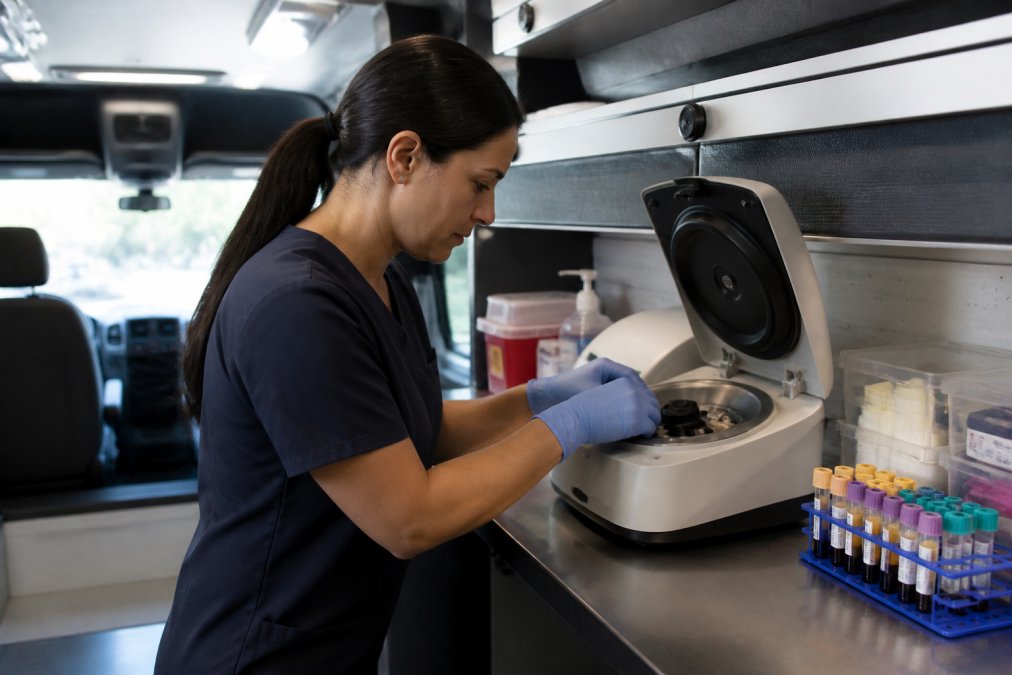
Mobile phlebotomy safety standards address the same hazards as stationary work, but with fewer environmental controls. Sharps handling, biohazard transport, hand hygiene, and PPE use all apply. What changes is that you’re managing them in a patient’s living room, an office, or a facility hallway rather than a dedicated draw station.
Calibrating Equipment for Mobile Environments
Equipment calibration for mobile environments is the gap topic most guides skip entirely. Portable centrifuges, temperature loggers, and refrigerated transport containers all need calibration and verification schedules, and movement affects them in ways a fixed lab never sees.
Watch Out
A calibration log with missing entries is a liability, not a record. If a result is challenged and your log has gaps, the assumption shifts against you. Log every check, including the ones that passed.
A calibration log with missing entries is a liability, not a record. If a result is challenged and your log has gaps, the assumption shifts against you. Log every check, including the ones that passed.
Mobile vs. Stationary Lab Credentials: Key Differences
Mobile credentials differ from stationary ones in two ways: transport competency and multi-jurisdiction compliance. A hospital phlebotomist works in one building under one set of rules. A mobile technician may cross three states in a week.
| Requirement | Stationary Lab | Mobile Lab |
|---|---|---|
| State licensure | Required in licensure states | Same, per state entered |
| Transport competency | Minimal | Core requirement |
| Equipment calibration | Fixed lab schedule | Route-adjusted schedule |
| Chain of custody | Facility-managed | Technician-managed |
| Multi-state compliance | Not applicable | Must satisfy strictest state |
| Continuing education | Standard renewal | Often includes transport modules |
Frequently Asked Questions
What certifications should a mobile phlebotomist have?
Most employers look for national certification from a recognized body, plus a current CPR card and proof of formal phlebotomy training. Some states also require a separate state license. Mobile lab tech credentials typically include a certificate or associate degree, national certification, and any state-specific licensure. Always check your state health department’s requirements, because rules vary and some states have no license requirement at all.
Do mobile phlebotomists need to be nationally certified?
National certification is not federally mandated, but many employers and mobile lab companies require it. It signals clinical competence, covers specimen handling and safety protocols, and often makes credential verification easier for patients and facilities. If you plan to work across state lines or with assisted living facilities, holding a national certification can simplify hiring and reciprocity discussions. Check each employer’s policy before you invest in an exam.
How do I verify a mobile lab technician’s credentials?
Ask for the technician’s certification number and the issuing organization. Most national certifying bodies offer an online verification tool where you can confirm active status. For state licensure, check your state health department or board of clinical laboratory personnel. You can also request a copy of the technician’s current CPR card and confirm the certification expiration date. A legitimate mobile lab tech will provide these details without hesitation.
Is state licensure required for phlebotomy technicians?
It depends on the state. Some states require a license or certification to practice, while others have no specific phlebotomy license and rely on employer verification. Because phlebotomy certification requirements by state differ, check your state health department or board of clinical laboratory science for the current rule. If you work in a mobile setting that crosses state lines, you may need to meet the requirements of each state where you draw specimens.
Navigating credential requirements across states, transport rules, and calibration schedules is genuinely complicated, and getting it wrong costs patients a second needle stick. Phlebotomy Experts handles that complexity for you: licensed phlebotomists, in-home and office visits, gentle technique for difficult veins and needle-phobic patients, and prompt specimen delivery to your chosen lab. Call now to schedule your mobile blood draw and skip the waiting room entirely.

Related Posts