Breaking down the cost of in home blood draws: collection fees, lab charges, insurance, and what you actually pay out-of-pocket.
Are Mobile Blood Draws Safe? 2026 Guide
Table of Contents
- Are Mobile Blood Draws Safe? What the Evidence Shows
- How At-Home Blood Draw Services Work
- Mobile Phlebotomy Safety Protocols That Protect You
- How to Verify a Mobile Phlebotomist Before You Book
- Pros and Cons of Mobile Blood Draws
- Who Mobile Blood Draws Are Best For
- What to Do in an Emergency During a Home Draw
- Conclusion
- Frequently Asked Questions
Last Updated: September 25, 2026
Are Mobile Blood Draws Safe? What the Evidence Shows
Mobile blood draws are safe when a licensed, trained phlebotomist follows standard precautions, uses sterile single-use equipment, and handles your sample correctly from collection to lab delivery. The risks match any clinic: a small bruise, brief soreness, or rarely fainting. What changes at home is who performs the draw and how well they follow protocol, and that’s what you can check before you book.
How Mobile Blood Draws Compare to Traditional Lab Visits
The clinical procedure is identical: the same venipuncture technique, sterile needles, and collection tubes as a lab visit. The difference is location and logistics.
Two things stay constant no matter where you are:
- The needle touches your skin once, then goes into a sharps container.
- Your tubes get labeled with your name and date before anything else happens.
How At-Home Blood Draw Services Work
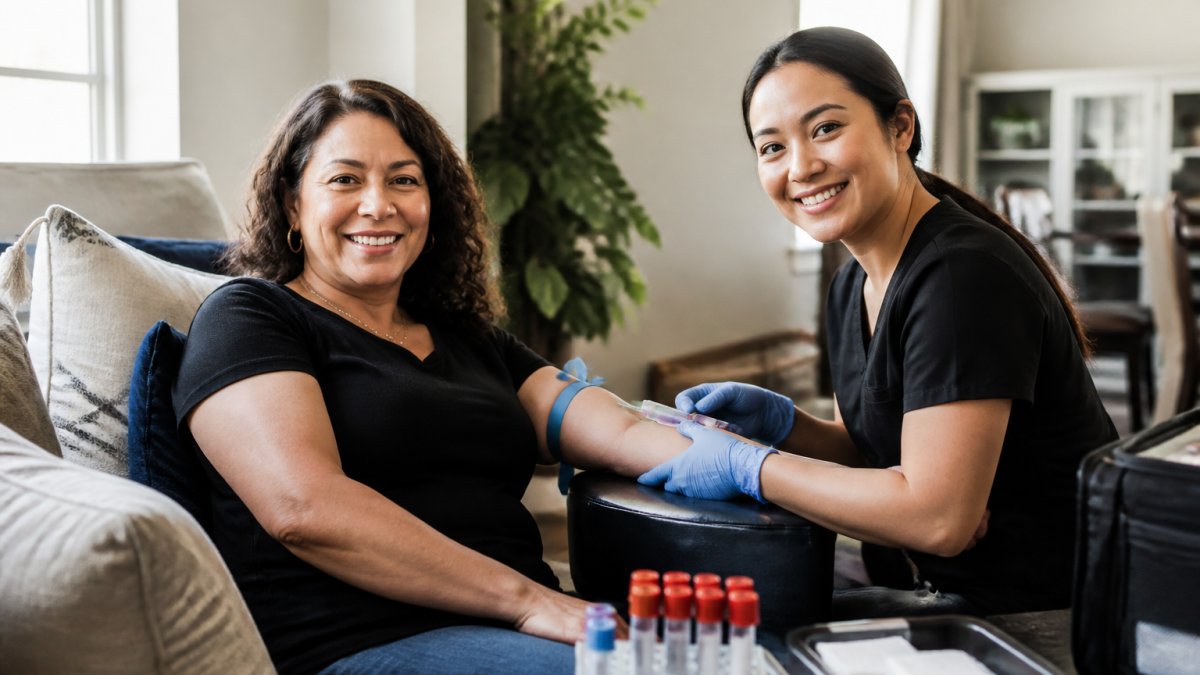
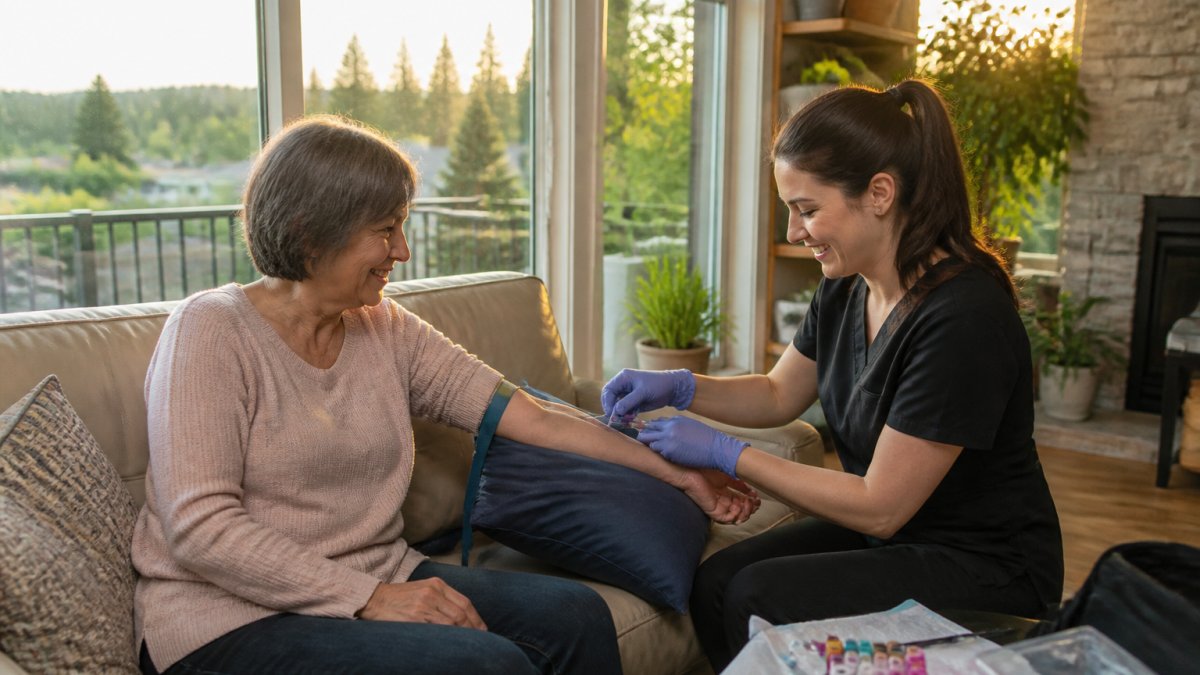
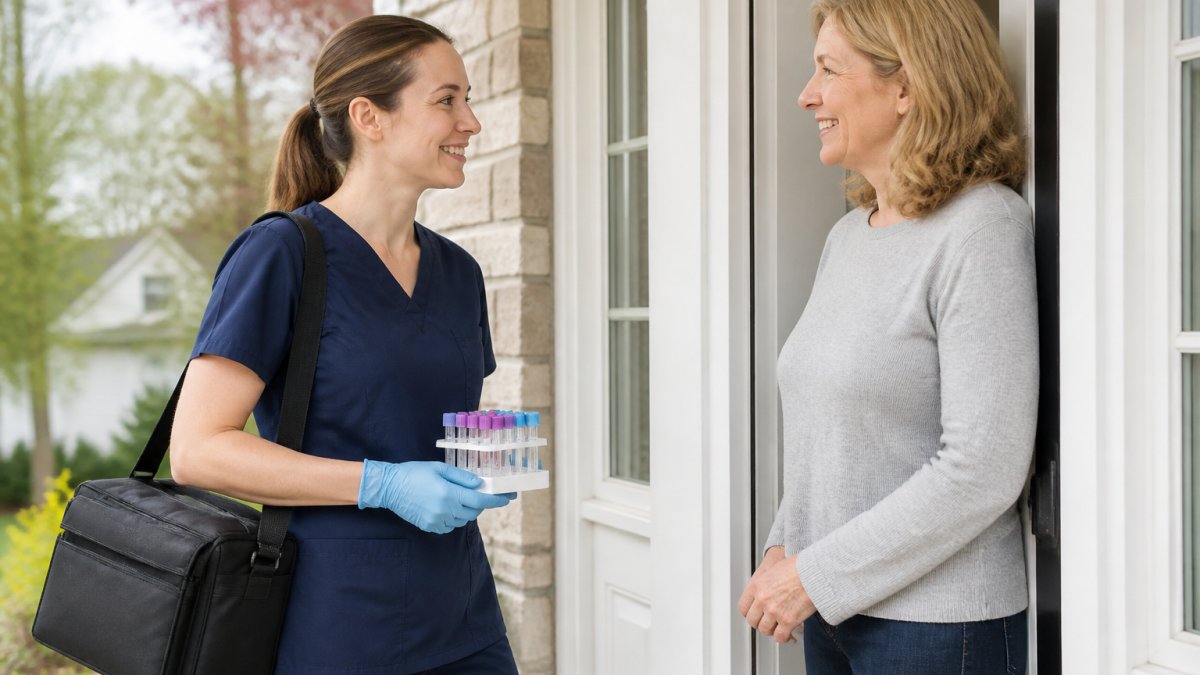
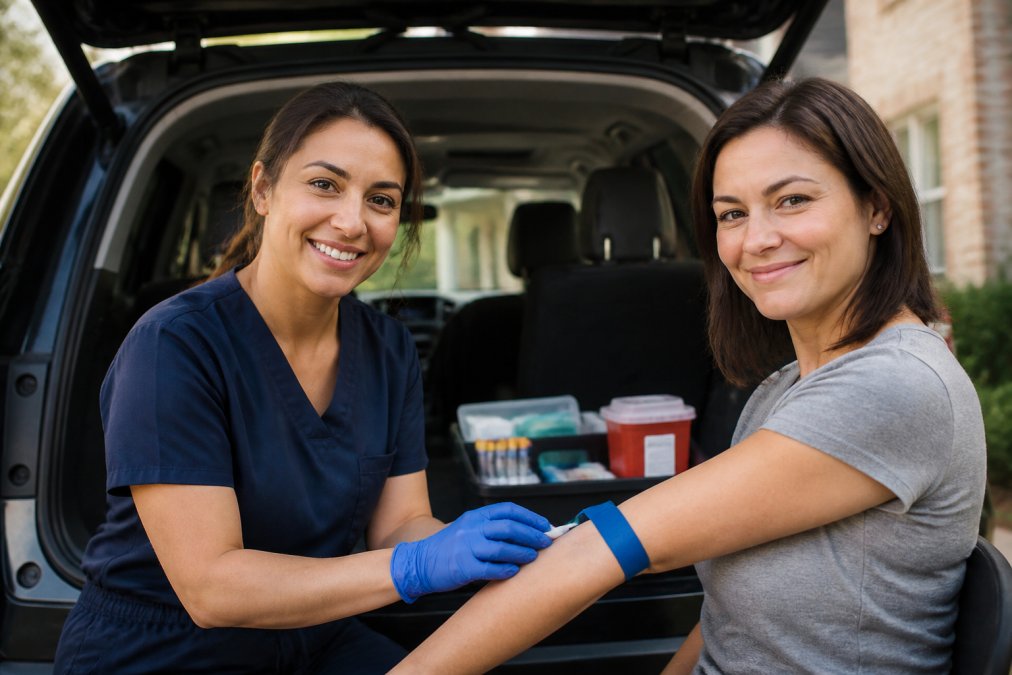
An at-home blood draw service sends a licensed phlebotomist to your home, office, or facility to collect your specimen and deliver it to the lab your doctor ordered from. You book online or by phone, confirm your lab order, and the technician arrives with all supplies.
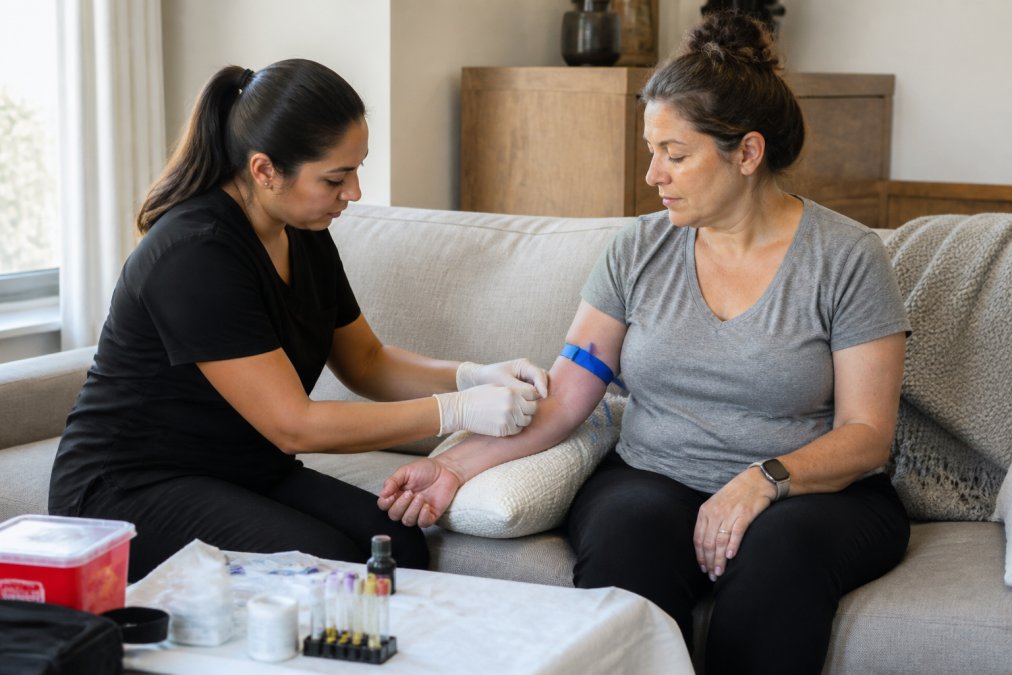
A Typical Home Visit, Step by Step
A standard visit, start to finish:
- Confirm your order. The phlebotomist verifies your name, date of birth, and the tests your provider ordered.
- Set up. They wash hands, put on gloves, and lay out sterile supplies.
- Find the vein. They apply a tourniquet and check your arm.
- Clean the site. An alcohol wipe sterilizes the puncture area.
- Draw the blood. Tubes fill in a set order based on the tests.
- Label at the bedside. Your name and date go on each tube immediately.
- Apply pressure and bandage. This lowers your risk of a hematoma.
- Package and go. Tubes go into a transport bag, then to the lab.
The whole visit usually takes 15 to 30 minutes. If you have needle phobia or hard-to-find veins, tell the phlebotomist when they arrive. Experienced technicians adjust their approach.
Mobile Phlebotomy Safety Protocols That Protect You
Mobile phlebotomy safety protocols are the written rules a provider follows to prevent infection, protect your sample, and respond to problems. A legitimate service has these in writing and trains staff on them.
Infection Control and Sterile Technique
Every needle and tube must be single-use and sealed until opened in front of you. The phlebotomist should wash hands or sanitize, then put on fresh gloves.
Specimen Integrity and Chain of Custody
Specimen integrity means your sample arrives at the lab unchanged. Heat, delay, or a tube filled to the wrong level can spoil it before testing.
Watch Out
A sample left too long at room temperature can give false results, forcing a repeat draw. Confirm the provider’s transport time to the lab before your appointment.
A sample left too long at room temperature can give false results, forcing a repeat draw. Confirm the provider’s transport time to the lab before your appointment.
How to Verify a Mobile Phlebotomist Before You Book
You’re about to let a stranger into your home and put a needle in your arm, so verification is reasonable. It takes about five minutes, and most of it can be done before the appointment.
Step 1: Confirm the Credential
Phlebotomy certification isn’t federally mandated, and state requirements vary, some require a license, others don’t. The credential may come from any of several recognized certifying bodies:
- ASCP (American Society for Clinical Pathology), the PBT (Phlebotomy Technician) credential
- NHA (National Healthcareer Association), the CPT (Certified Phlebotomy Technician) credential
- AMT (American Medical Technologists), the RPT (Registered Phlebotomy Technician) credential
- NCCT (National Center for Competency Testing), the NCPT credential
Step 2: Check the State Requirement
Some states require phlebotomists to hold a license or work under a specific scope of practice. If yours does, ask for the license number and confirm it with the state health department or licensing board. If not, certification still signals formal training and a passed exam.
Step 3: Confirm Insurance and Business Legitimacy
A legitimate mobile phlebotomy business carries professional liability insurance and usually general business liability coverage. Ask for a certificate of insurance to confirm the coverage exists and is current.
Also confirm:
- A business address and a working phone number (not just a form)
- A written service agreement or consent form
- A stated policy for failed draws and re-draws
- A clear answer on who owns and stores your sample data
Step 4: Ask About HIPAA
Any provider handling your lab order and results is a covered entity or business associate under HIPAA, so your health information must be protected in transit and at rest. Ask how they transmit orders and store results, unencrypted emails or paper requisitions left in a car don’t meet the standard.
Step 5: Ask the Process Questions
These questions separate a real operation from a side gig:
- Which lab do you deliver to, and what is your transport window?
- How do you maintain temperature control for tests that require it?
- What happens if the draw fails, is there a re-draw fee?
- How do you handle a vasovagal response or a bleeding complication?
- Do you bill my insurance directly, or do I pay upfront and seek reimbursement?
The Pre-Booking Checklist
Run through this before you confirm any appointment:
- Credential name and number provided, and verified on the issuing body’s site
- State license confirmed if your state requires one
- Certificate of insurance provided
- Business address and direct phone number confirmed
- Written consent and service agreement on file
- HIPAA handling of orders and results explained
- Transport window and temperature control described
- Failed-draw and re-draw policy stated in writing
- Emergency protocol described in plain language
- Reviews checked for repeated needle sticks or no-shows
A certified phlebotomist has completed formal training and passed an exam, not a guarantee of quality, but a verifiable floor. Phlebotomy Experts staffs licensed phlebotomists, including a Navy Veteran Medic with 20 years of experience in the medical field.
Pro Tip
If a provider resists any of these questions, treat that as your answer. A legitimate service expects to be verified and will hand you the numbers without hesitation.
If a provider resists any of these questions, treat that as your answer. A legitimate service expects to be verified and will hand you the numbers without hesitation.
Pros and Cons of Mobile Blood Draws
Mobile blood draws trade a little control for a lot of convenience.
| Factor | Pros | Cons |
|---|---|---|
| Convenience | No travel or waiting room | Must be home for the visit |
| Comfort | Familiar setting, less anxiety | Some people prefer clinical settings |
| Safety | Sterile technique, licensed staff | Depends on provider quality |
| Sample handling | Direct transport to lab | Transport window varies by provider |
| Access | Great for mobility issues | Not every area has coverage |
| Cost | Saves time and travel | May cost more than a lab visit |
Pros:
- You avoid crowded waiting rooms and travel time.
- Home settings calm many patients with needle anxiety.
- Home health care patients get care without leaving bed.
- Facilities can collect from multiple residents in one visit.
Cons:
- Quality depends on the individual provider, not a fixed lab.
- Transport adds a step that can go wrong if handled poorly.
- Not all insurance plans cover the convenience fee.
Pro Tip
Ask whether the provider bills your insurance directly or expects payment upfront. Getting this clear before the visit avoids surprise bills later.
Ask whether the provider bills your insurance directly or expects payment upfront. Getting this clear before the visit avoids surprise bills later.
Who Mobile Blood Draws Are Best For
Mobile blood draws suit people who struggle to get to a lab or need frequent testing, especially:
- Homebound patients and people with mobility issues
- Busy professionals who can’t spare a lab trip
- Expectant mothers needing early DNA gender testing
- Children and infants, who often do better at home
- Seniors in assisted living or nursing facilities
- Athletes and sports agencies needing routine panels
- Clinical trial participants with strict collection timing
What to Do in an Emergency During a Home Draw
Most home draws end with a bandage and a glass of water, but the home setting changes who responds first. In a lab, staff who see fainting weekly catch it; at home, the phlebotomist is the entire response team until help arrives. That’s not a reason to avoid mobile draws, it’s a reason to confirm the provider has a plan.
The Adverse Events That Actually Happen
Serious reactions are uncommon. The realistic ones, in rough order of frequency:
- Vasovagal response (fainting). The most common reaction. Triggered by the sight of blood, pain, dehydration, or anxiety. Onset is usually within seconds to a few minutes of the stick.
- Hematoma. Blood leaks under the skin when the vein is nicked through or pressure is released too early. It looks alarming, bruises for a week or two, and is rarely dangerous.
- Prolonged bleeding. More likely if you take anticoagulants such as warfarin or a direct oral anticoagulant, or if you have a bleeding disorder.
- Arterial puncture. Rare. The phlebotomist knows it happened when the tube fills with bright red, pulsing blood. It requires firm pressure for several minutes and a call to your provider.
- Nerve irritation. A sharp, electric shock sensation down the arm. Usually resolves, but it should be documented.
- Needle stick or equipment failure. Rare with single-use, safety-engineered devices, but it is the reason sharps containers and a spare kit matter.
If You Feel Faint During the Draw
- Say so immediately, do not wait to see if it passes.
- The phlebotomist should stop the draw, withdraw the needle, and apply pressure to the site.
- Lie down if you can, or recline in the chair with your legs elevated above heart level.
- Stay down until the dizziness fully passes, then sit up slowly and drink water.
- Do not drive yourself for at least 15 minutes after a fainting episode.
If you lose consciousness, the phlebotomist should keep you supine, monitor your breathing, and call 911 if you do not come around quickly or if you fell and struck your head.
If Bleeding Will Not Stop
Apply firm, direct pressure with a gauze pad for a full 5 to 10 minutes without lifting to check. If bleeding continues past that, or it’s spurting or the site is swelling rapidly, call your doctor or 911, don’t wait and see. Tell the phlebotomist about any blood thinners before the needle goes in.
What the Provider Should Have on Hand
Ask directly: what do you carry in your kit for a reaction? A prepared mobile phlebotomist typically has:
- A first-aid kit with gauze, tape, and antiseptic
- A sharps container and biohazard bag for safe disposal
- Gloves, alcohol wipes, and a spare tourniquet
- A charged phone and your emergency contact on file
- Cold packs for a developing hematoma
Watch Out
If you have a history of fainting during blood draws, a bleeding disorder, or you take anticoagulants, tell the provider when you book, not when they arrive. It changes how they prepare and whether they bring a second person.
If you have a history of fainting during blood draws, a bleeding disorder, or you take anticoagulants, tell the provider when you book, not when they arrive. It changes how they prepare and whether they bring a second person.
When to Call 911
Call 911 for chest pain, difficulty breathing, a seizure, loss of consciousness that doesn’t resolve within a minute, uncontrolled bleeding, or a fall with a head injury. For anything short of that, the phlebotomist should stabilize you, document what happened, and tell you to follow up with your provider.
Conclusion
The real question isn’t whether home draws are safe in theory. It’s whether the person at your door follows the protocols that make them safe in practice. Credentials, sterile technique, and sample handling decide the outcome, not the address.
Frequently Asked Questions
How do mobile phlebotomists ensure specimen integrity during transport?
Certified mobile phlebotomists follow established protocols that include proper tube labeling at the point of draw, temperature control using cold chain methods when required, and secure packaging to prevent breakage. Samples are typically transported directly to the laboratory or hospital of your choice, often within hours of collection. This minimizes pre-analytical variables that could affect diagnostic accuracy. If you are concerned about transport times, ask the service about their standard delivery windows before booking.
Are mobile phlebotomy technicians licensed and certified?
Licensing and certification requirements vary by state. Many mobile phlebotomists hold national certifications from organizations such as the American Society for Clinical Pathology (ASCP) or the National Center for Competency Testing (NCCT), and some states require additional licensure. When evaluating a mobile blood draw service, ask about credentials, training, and years of experience. A reputable provider will readily share this information. Phlebotomy Experts, for example, employs licensed phlebotomists with professional bedside manner.
What safety protocols are followed during an at-home blood draw?
At-home blood draws follow the same infection control standards as a clinic or hospital. Technicians use sterile, single-use equipment, including needles and vacutainers, and dispose of all biohazard waste in approved sharps containers. They perform hand hygiene before and after the procedure, wear gloves, and clean the venipuncture site with an antiseptic. Patient identification is verified before the draw. After collection, samples are labeled and prepared for transport according to standard operating procedures to maintain specimen integrity.
How does a mobile blood draw compare to a traditional lab visit in terms of safety?
Both settings follow the same clinical standards for venipuncture and infection control. Mobile draws reduce exposure to other patients and hospital environments, which can be a benefit for immunocompromised individuals or those with mobility issues. The main difference is the environment: a home setting may lack immediate emergency support, but reputable mobile phlebotomy services carry emergency protocols and are trained to handle adverse reactions like vasovagal response. For routine blood work, mobile draws are generally as safe as a lab visit when performed by a qualified professional.
What should I look for when choosing a mobile phlebotomy service?
Look for a service that verifies credentials upfront, including state licensure and national certification. Ask about their safety protocols, specimen handling, and chain of custody procedures. Check whether they provide clear billing information and accept insurance. Read reviews and ask about their experience with your specific needs, such as pediatric draws or difficult veins. A trustworthy provider will answer these questions transparently. Phlebotomy Experts, for instance, offers licensed phlebotomists with 20 years of experience in the medical field.

Related Posts