Looking for at-home blood tests for toddlers? Learn which tests suit home collection, how to calm a fussy child, and when a clinic is the better choice.
7 Essential Mobile Phlebotomy Equipment Checklist Items
Quick Summary
A mobile phlebotomy equipment checklist covers collection supplies, safety and infection control items, specimen transport supplies, and patient preparation steps. Because mobile draws have no supply room, the kit must carry everything the technician needs, packed sterile, organized, and ready to use.
- Check the kit at the start of each shift and again after each visit to restock.
- Expired tubes look identical to fresh ones, so check expiration dates at every restock.
- Never recap a used needle, and seal the sharps container before it reaches two-thirds full.
- Fill tubes in the laboratory’s order of draw to prevent additive carryover between tubes.
- Label tubes at the bedside, in front of the patient, using two identifiers.
Need a blood draw at home or work?Phlebotomy Experts brings licensed phlebotomists and a complete kit to your location.
Table of Contents
- Why a Standardized Mobile Phlebotomy Equipment Checklist Matters
- Core Phlebotomy Kit Checklist for Home and Office Draws
- Phlebotomy Safety Equipment and Infection Control Supplies
- Specimen Transport Supplies and Labeling Requirements
- Patient Preparation for Blood Draw: What to Set Up Before Arrival
- OSHA and Regulatory Compliance for Mobile Phlebotomy Kits
- Booking Your Next Mobile Blood Draw With Phlebotomy Experts
- Frequently Asked Questions
Why a Standardized Mobile Phlebotomy Equipment Checklist Matters
Last Updated: November 12, 2026
A mobile phlebotomy equipment checklist keeps every visit consistent, so nothing gets left in the car when a technician is at the patient’s door. (Source: OSHA Bloodborne Pathogens Standard)
A standardized list protects the patient, the specimen, and the technician.
Mobile draws differ from clinic draws: there is no supply room down the hall. Everything must travel with the technician, packed to stay sterile, organized, and ready to use.
Here is what a good checklist helps you avoid:
- Repeat sticks caused by a missing or expired collection tube
- Specimen rejections from wrong labels or missed order-of-draw steps
- Contamination from unsealed or improperly stored supplies
- Wasted trips when a forgotten item means rescheduling the visit
A printed checklist kept in the kit can be more reliable than memory. Check it at the start of each shift and again after each visit to restock.
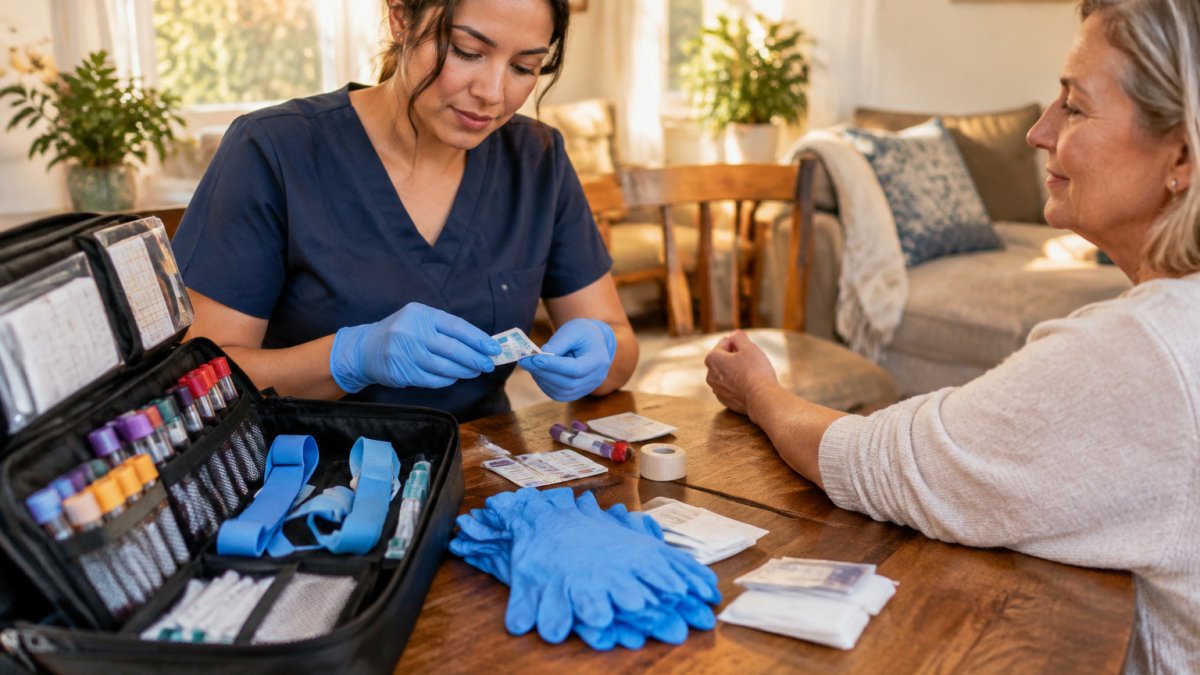
Core Phlebotomy Kit Checklist for Home and Office Draws
A mobile kit should handle a routine draw and a few surprises, organized by category so items are easy to find under pressure.
Collection supplies
- Vacutainer holders and needles in several gauges
- Evacuated blood collection tubes in the colors your lab requires
- Butterfly (winged) needles for small or difficult veins
- Tourniquet, single-use
- Alcohol prep pads and chlorhexidine swabs
- Gauze pads and adhesive bandages
Equipment and aids
- Portable light source for low-lit rooms
- Small sharps-safe work surface or tray
- Gloves in common sizes
- Padded cushion or armrest for patient comfort
Keep contents in clear, labeled compartments, and restock anything below a set minimum before the next visit.
Watch out: expired tubes look identical to fresh ones. Check expiration dates at every restock, not just when the kit feels low.
Phlebotomy Safety Equipment and Infection Control Supplies
Safety supplies protect both technician and patient. Standard precautions apply to every draw.
Keep these items in the kit at all times:
- Disposable gloves in multiple sizes
- Protective eyewear or face shield
- Impermeable gown or apron for splash-prone draws
- Puncture-resistant sharps container, sized for the number of draws in a day
- Biohazard bags for used supplies
- Hand sanitizer and a soap-and-water option
Sharps disposal is the step most often handled poorly in the field. Never recap a used needle, and seal the sharps container before it reaches two-thirds full.
Many practices also carry a small spill kit with absorbent material, disinfectant, and disposable towels.
Specimen Transport Supplies and Labeling Requirements
A perfect draw means little if the specimen arrives damaged, delayed, or mislabeled. Transport and labeling items deserve their own checklist section and pre-departure check.
Pack these items for every trip
- Leak-proof secondary containers or specimen bags, with absorbent material inside each bag
- Insulated transport cooler with cold packs or a temperature indicator, if the laboratory requires temperature control
- A thermometer or temperature strip for coolers that must stay within a range
- Requisition forms and order paperwork, kept in a locked bag, and the laboratory requisition guide for mobile blood draws explains what lab orders and paperwork must be in place before a home visit.
- Pre-printed labels, or a labeling method that stays legible on wet or refrigerated tubes, and the specimen transport checklist helps you verify each item and step.
- A permanent marker for backup labeling
- A specimen log or tracking sheet for chain-of-custody and time of collection
- The laboratory’s current collection manual or directory
Order of draw and tube additives
The order in which tubes are filled matters because additive from one tube can carry over on the needle and contaminate the next.
Labeling at the bedside
Label tubes at the bedside, in front of the patient, before they leave the room.
Patient identification before the draw
Use two identifiers and confirm them against the requisition, not the patient’s recollection alone. Ask the patient to state their full name and date of birth, then compare to the order. For patients who cannot identify themselves, follow the laboratory’s and facility’s protocol, which may require a caregiver or second staff member to confirm.
Temperature and stability windows
Most laboratories publish a stability window and a temperature range for each test. Common patterns include:
- Room-temperature transport for many routine chemistry and hematology tests, with a defined maximum time from collection to receipt
- Refrigerated transport for some tests, with a warning against freezing
- Protected from light for bilirubin and certain other analytes
- Immediate or rapid delivery for tests with short stability, such as some coagulation and blood gas tests
Record the collection time on the requisition and specimen log so the receiving laboratory can verify the window.
Chain of custody and tracking
For any specimen that may be used in a legal or employment context, use the laboratory’s chain-of-custody form and record each handoff with a time, name, and signature.
What triggers a rejection
Each laboratory sets its own transport rules.
The article’s transport and labeling guidance comes down to a few checkpoints, summarised below.
| Checkpoint | What to confirm | Common failure |
|---|---|---|
| Order of draw | Fill tubes in the laboratory’s sequence | Additive carryover contaminates the next tube |
| Fill volume | Tube filled to the line | Short draw in an additive tube |
| Patient identifiers | Two identifiers matched to the order | Misidentified specimen |
| Bedside labeling | Label written in front of the patient | Label applied after the collector left |
| Temperature | Within the laboratory’s stated range | Frozen gel pack causes hemolysis |
| Transit time | Delivered within the stability window | Arrival past the stability window |
| Specimen log | Collection, departure and delivery times recorded | No record to verify the window |
Patient Preparation for Blood Draw: What to Set Up Before Arrival
Good preparation shortens the visit. Ask the patient or their caregiver to set up a few things before the technician arrives.
Ask the patient to have ready:
- A valid photo ID and insurance card, if billing applies
- The lab order or requisition paperwork
- A list of current medications and any allergies
- Instructions on whether the patient fasted or needs to, as the test requires
- A clear, well-lit area with a chair or bed near an open surface
Some tests require specific timing, such as morning collection or fasting for several hours. Confirm these details when you book the appointment.
Patients often ask what to expect. A short explanation of the steps, including the tourniquet, the brief pinch, and the collection time, helps reduce anxiety, especially for patients with needle phobia.
A short phone call the day before a visit can help confirm missing paperwork. Use your own version of this call to confirm the details on your checklist.
OSHA and Regulatory Compliance for Mobile Phlebotomy Kits
Mobile phlebotomy is regulated the same way as clinic-based collection.
The federal baseline: OSHA’s Bloodborne Pathogens Standard
The Occupational Safety and Health Administration (OSHA) enforces the Bloodborne Pathogens Standard at 29 CFR 1910.1030. The standard applies to any employer whose workers can reasonably anticipate contact with blood or other potentially infectious materials, which includes mobile phlebotomists. The checklist should confirm the following are current and accessible:
- A written Exposure Control Plan, reviewed and updated at least annually and whenever tasks or procedures change
- A list of job classifications and tasks with exposure risk, kept with the plan
- Hepatitis B vaccination offered to employees as required by the standard, with a signed declination form on file if the employee declines
- Personal protective equipment provided at no cost, in the right sizes, and replaced when contaminated or torn
- Engineering controls, including safety-engineered sharps devices and a sharps container that is closable, puncture-resistant, leak-proof on the sides and bottom, and labeled or color-coded
- Handwashing facilities or, when not feasible in the field, an appropriate antiseptic hand cleanser with clean cloth or paper towels
- A post-exposure evaluation and follow-up procedure, including confidential medical evaluation and testing
- Labels and signs, including the biohazard symbol on containers of regulated waste and on refrigerators or freezers holding blood
- Information and training at initial assignment and at least annually, with a training record for each employee
- A Sharps Injury Log for employers required to maintain the OSHA 300 Log, recording the type and brand of device, the department or work area, and an explanation of how the incident occurred, while protecting the confidentiality of the exposed employee
- Medical and training records retained for the periods the standard requires
Sharps disposal in the field
OSHA does not itself dictate how a mobile phlebotomist disposes of a filled sharps container, but the container must meet the standard above and disposal must follow state medical waste rules and the receiving facility’s policy.
State rules layered on top of federal OSHA
Some states run their own occupational safety and health plans and may enforce standards that differ from federal OSHA, and some require separate medical waste registration or manifest forms.
HIPAA and patient information in the vehicle
The HIPAA Privacy and Security Rules apply to paper requisitions, printed labels, and any laptop or phone that stores patient information. Practical checklist items include:
- A locked bag or lockbox for paper requisitions and any printed labels in the vehicle
- A privacy screen or screen lock on any device used to view orders
- A policy for what happens if a device or paper record is lost or stolen, including the breach notification analysis
- A rule that labels and requisitions are never left visible on a seat or dashboard between visits
CLIA and the laboratory relationship
Mobile phlebotomists generally collect specimens for a laboratory that holds its own Clinical Laboratory Improvement Amendments (CLIA) certificate.
What to keep in the kit for an inspection or audit
- Current Exposure Control Plan summary and the full plan’s location
- Hepatitis B vaccination or declination records for the assigned technician
- Training records and the date of the last annual training
- Sharps Injury Log location and the post-exposure procedure
- Medical waste transporter permit and the current manifest
- Laboratory collection manual and the current requisition forms
This section is general information, not legal advice. Confirm current requirements with OSHA, the state occupational safety agency, the state health department, and the laboratory you collect for.
Booking Your Next Mobile Blood Draw With Phlebotomy Experts
A complete checklist makes every mobile visit smoother. Phlebotomy Experts provides licensed phlebotomists who deliver specimens to the laboratory you choose.
Frequently Asked Questions
What should a phlebotomy kit include?
A basic mobile phlebotomy kit typically includes single-use needles and holders, evacuated collection tubes matched to the test panel, a tourniquet, alcohol prep pads, gauze, adhesive bandages, nitrile gloves, a sharps container, and labels or a labeling system. Many technicians also carry a portable cooler or insulated transport bag for specimens. Confirm the exact tube types with the ordering laboratory before each visit, since requirements vary by test. Keep a restocking log so supplies are replaced before they run low.
What personal protective equipment does a phlebotomist need?
Phlebotomists working under standard precautions wear gloves for every draw, and add eye protection or a face shield and a gown when splashes are likely. Hand hygiene with soap and water or an alcohol-based sanitizer should happen before and after each patient. Under OSHA’s Bloodborne Pathogens Standard (29 CFR 1910.1030), employers must provide PPE at no cost to workers and maintain an exposure control plan. Check current OSHA guidance on the agency’s website for the full requirements.
How should blood samples be stored and transported after collection?
Each tube should be labeled at the bedside with at least two patient identifiers, the collection date and time, and the collector’s initials, before leaving the patient. Follow the laboratory’s stated temperature requirements, since some specimens need room temperature while others need refrigeration. Keep tubes upright in a leak-resistant secondary container during transport. Deliver specimens promptly within the stability window the laboratory specifies.
What should a patient prepare before a mobile blood draw?
Patients should confirm the test order, whether fasting is required, and which medications or supplements to discuss with the ordering provider. Drinking water before the draw usually helps veins stay visible, and patients should wear loose sleeves that roll above the elbow. Have a clear, flat space with good lighting and a chair available. Bring the requisition form and insurance or payment information so the visit runs smoothly.

Related Posts