
Concierge lab services bring blood draws to your home or office. See how mobile phlebotomy works, what it costs, and how to prepare for a blood test.

Orange County Labs Alternative for Professionals: 2026 Guide
Table of Contents
- Why Professionals Look Beyond Orange County Labs
- Top Alternatives at a Glance: Mobile Phlebotomy, National Labs, and Concierge Services
- Phlebotomy Experts: Concierge Lab Testing for Busy Professionals
- Labcorp and Quest Diagnostics: National Lab Networks as an Alternative
- Single Poke and Other Mobile Phlebotomy Services Near Me
- How to Choose a Mobile Phlebotomy Provider: Key Criteria for Professionals
- Insurance vs. Out-of-Pocket Costs and Turnaround Time Benchmarks
- Conclusion
- Frequently Asked Questions
Last Updated: September 17, 2026
Why Professionals Look Beyond Orange County Labs
Professionals searching for an Orange County Labs alternative for professionals usually are not chasing novelty. They are chasing time. A traditional lab visit can consume a half-day once you factor in travel, parking, waiting room time, and the draw itself, and that math gets worse for anyone billing hourly or juggling back-to-back meetings. (Source: a shift towards at-home healthcare services)
Top Alternatives at a Glance: Mobile Phlebotomy, National Labs, and Concierge Services
The best alternative depends on what you are optimizing for: speed, cost, or a specific testing menu. There is no single winner, and anyone who tells you otherwise is selling something.
| Option | Model | Best For | Main Trade-Off |
|---|---|---|---|
| Phlebotomy Experts | Concierge mobile phlebotomy | Home or office draws, comfort-focused care | Pricing requires a direct quote |
| Labcorp | National lab network | Broad test menu, insurance billing | Travel to a patient service center |
| Quest Diagnostics | National lab network | Provider-integrated testing | Site visit unless partnered |
| Single Poke | Regional mobile phlebotomy | Low-stress draws, fewer repeat sticks | Limited service area |
Phlebotomy Experts: Concierge Lab Testing for Busy Professionals
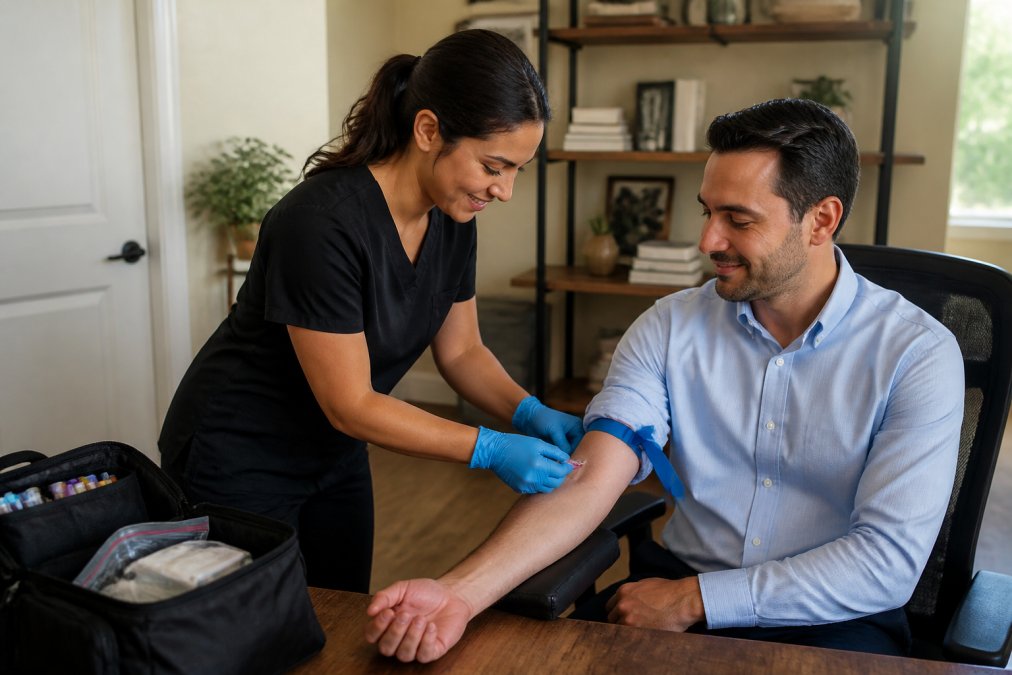
Phlebotomy Experts is a mobile phlebotomy and concierge lab service that sends a licensed phlebotomist to your home or office, then delivers your specimens to the laboratory or hospital of your choosing. That last detail is the one most people miss.
What Sets Phlebotomy Experts Apart
Concierge lab testing for busy professionals lives or dies on two things: whether the draw goes smoothly and whether the specimen arrives intact. Phlebotomy Experts addresses both with licensed phlebotomists, a bedside manner built for anxious patients, and prompt delivery of results to the ordering physician. Specialized care for infants and children is part of the service, which matters for parents booking pediatric draws.
Pro Tip
Ask upfront which laboratory your specimen will be delivered to. If your ordering physician already has a preferred lab, confirming that in advance prevents a redraw later.
Ask upfront which laboratory your specimen will be delivered to. If your ordering physician already has a preferred lab, confirming that in advance prevents a redraw later.
Labcorp and Quest Diagnostics: National Lab Networks as an Alternative
National lab networks are the default alternative for a reason: they run a comprehensive diagnostic testing menu and bill through insurance. Labcorp operates an extensive network of patient service centers with an integrated digital platform for provider result management, and it supports biopharma and clinical research work. Quest Diagnostics offers a large collection site network, in-office collection partnerships for medical practices, and deep electronic health record integration.
Accreditation and Certification Standards to Verify
Before you route specimens to any national network, confirm the credentials that make results defensible. Both Labcorp and Quest operate laboratories inspected under the Clinical Laboratory Improvement Amendments (CLIA), which is the baseline federal requirement for any facility reporting patient results in the United States. Beyond CLIA, look for College of American Pathologists (CAP) accreditation, which signals a voluntary, peer-reviewed standard above the federal floor, and ISO 15189 for laboratories that support international or research programs.
Data Security and HIPAA Compliance for Corporate Clients
This is the gap most comparison guides skip, and it is the first question a compliance officer asks. Both networks are covered entities or business associates under HIPAA and publish notices of privacy practices, but the operational details differ in ways that matter to an employer or clinic:
- Business Associate Agreements (BAAs). If you are an employer, benefits broker, or clinic sending employee or patient data to a lab, you need a signed BAA before any protected health information changes hands. Confirm the lab will execute one and understand who signs on your side.
- Result delivery channels. National networks typically push results through provider portals and EHR integrations. Ask whether results can be delivered directly to your ordering physician, whether you can restrict access to named administrators, and how long results are retained in the portal.
- Breach notification terms. HIPAA requires notification of a breach of unsecured protected health information, generally within 60 days of discovery. Ask how the lab defines and reports a breach and who is responsible for notifying affected individuals.
- State-level overlays. Some states impose stricter privacy rules than HIPAA, particularly for genetic, HIV, and mental health testing. If your workforce or patient base spans multiple states, confirm the lab can meet the strictest applicable standard.
For corporate accounts, the vetting checklist is: CLIA certificate, CAP accreditation, signed BAA, named result-delivery channel, and a written breach-notification process. A lab that cannot produce all five is a liability, not a convenience.
Corporate and Office Testing Solutions
National networks are built for volume, which makes them the practical choice for employer-sponsored wellness panels, pre-employment screening, and recurring occupational health testing. Labcorp and Quest both offer employer-facing programs with consolidated billing, on-site or near-site collection events for large groups, and results reporting to a designated company contact. The trade-off is scheduling rigidity: on-site events are typically booked in advance and staffed by the lab’s own phlebotomy team, so a small office with a handful of employees may not meet the minimum volume for an on-site visit and will be routed to a patient service center instead.
Single Poke and Other Mobile Phlebotomy Services Near Me
Searching for mobile phlebotomy services near me returns a mix of regional operators with very different quality levels. Single Poke is a reasonable reference point: the service focuses on technique and minimizing repeat sticks, coordinates with major national laboratories for processing, and offers flexible home or office scheduling. Availability is localized, which is the standard limitation for mobile-only providers.
How to Choose a Mobile Phlebotomy Provider: Key Criteria for Professionals
Choosing a mobile phlebotomy provider comes down to verification, not marketing. Any provider can promise convenience. Fewer can document licensing, transport protocols, and lab relationships.
- Confirm the phlebotomist is licensed and can describe their experience with difficult veins
- Ask which clinical laboratory receives the specimen and whether you can choose it
- Request the specimen transport window, from draw to delivery
- Verify HIPAA compliance and how your data is stored or shared
- Confirm whether the provider handles insurance or bills out-of-pocket
- Check whether follow-up testing and result questions are supported
- Ask about volume capacity if you are booking for a facility or group
Insurance vs. Out-of-Pocket Costs and Turnaround Time Benchmarks
Cost and speed are where the alternatives diverge most, and where most comparisons stay vague. Here is the mechanism behind each.
How Insurance Actually Follows the Specimen
Insurance coverage generally follows the laboratory that performs the test, not the person drawing your blood. That single fact explains most of the confusion professionals run into.
- National networks (Labcorp, Quest). These labs are in-network with most major commercial insurers and Medicare, and they bill the insurer directly. You typically owe only your copay, coinsurance, or a deductible balance. The draw itself is usually bundled into the claim.
- Mobile and concierge providers. Many operate fee-for-service. You pay the phlebotomist upfront for the draw, and the laboratory that runs the assay bills separately, sometimes to your insurance, sometimes to you. If the mobile provider is out-of-network, the collection fee is generally not reimbursable, even when the lab work is.
- Self-pay and cash pricing. National labs publish self-pay prices for common panels through their consumer portals, and those prices are often lower than the billed charge an uninsured patient would otherwise see. If you are paying out-of-pocket, ask for the self-pay rate before the draw, not after.
- HSA and FSA eligibility. Medically necessary lab testing ordered by a physician is generally an eligible expense for health savings and flexible spending accounts. Convenience add-ons like IV vitamin therapy usually are not, so keep the draw fee and the test fee on separate receipts.
The most common billing surprise is a specimen drawn by a mobile provider but processed by an out-of-network laboratory. Confirm both the collection fee and the receiving lab’s network status before you book, or you may receive two bills, one covered, one not.
Turnaround Time Benchmarks by Test Type
Turnaround time (TAT) is measured from specimen receipt at the laboratory to result release, not from the moment of your draw. Add transport time to get the realistic window. Benchmarks below reflect typical national-lab performance for routine testing; specialized assays run longer.
| Test Category | Typical TAT (from lab receipt) | Notes |
|---|---|---|
| Routine chemistry and lipid panels | Same day to 1 business day | Often reported within hours on automated analyzers |
| Complete blood count (CBC) | Same day | High-volume, fully automated |
| Thyroid and hormone panels | 1-2 business days | Some assays batched |
| HbA1c and diabetes monitoring | 1-2 business days | Widely automated |
| STD and infectious disease screening | 1-3 business days | Culture-based tests run longer than molecular |
| Genetic and molecular testing | 5-14 business days | Send-out to specialty reference labs |
| Anatomic pathology and biopsy | 3-7 business days | Requires pathologist review |
| Drug testing (screening) | 1-3 business days | Confirmation testing adds 2-4 days |
Matching the Model to Your Priority
If cost is the priority and you are insured, a national network with direct billing is almost always cheaper out-of-pocket. If speed and convenience are the priority, a same-day draw at your office before a morning of meetings, a concierge mobile provider earns its fee by eliminating travel and wait time, provided you confirm the receiving lab’s network status and TAT in advance.
Conclusion
The real challenge is not finding a mobile provider; it is finding one that handles the parts you cannot see, licensing, transport, and lab coordination. That is where most services quietly fail.
Frequently Asked Questions
Is there a way to get labs without a doctor?
In many states, you can order certain lab tests directly through consumer-initiated testing platforms, but for insurance coverage or specialized tests like DNA gender testing, a physician’s order is typically required. Mobile phlebotomy services like Phlebotomy Experts can coordinate with your primary care physician or help you connect with a telehealth provider to obtain the necessary orders before your blood draw.
Can a nurse come to your house to draw blood?
Yes, mobile phlebotomy services send licensed phlebotomists or nurses to your home or office for blood draws. Phlebotomy Experts, for example, provides in-home specimen collection and delivers samples to the lab of your choice. This service is ideal for busy professionals, individuals with mobility issues, or anyone who prefers to avoid a trip to a patient service center. Availability depends on your location.
What certifications should I look for in a mobile phlebotomy provider?
Look for licensed phlebotomists with certifications from recognized bodies such as ASCP or NHA. Verify that the provider follows HIPAA compliance for data security and uses proper specimen transport protocols to maintain specimen integrity. Phlebotomy Experts, for instance, employs licensed phlebotomists with years of experience, including a Navy Veteran Medic, ensuring professional and safe blood collection.
How does mobile phlebotomy ensure the safety and integrity of blood specimens?
Mobile phlebotomy providers use standardized collection tubes, temperature-controlled transport, and chain-of-custody documentation to protect specimen integrity. Samples are typically delivered to the lab within hours to meet turnaround time benchmarks. Phlebotomy Experts prioritizes prompt delivery to your preferred laboratory, reducing the risk of sample rejection or the need for a repeat draw.
What are the benefits of using a concierge mobile phlebotomy service?
Concierge mobile phlebotomy offers convenience, comfort, and time savings by bringing the blood draw to your home or office. You avoid waiting rooms and travel, and you receive personalized care from a licensed phlebotomist. Services like Phlebotomy Experts also provide specialized treatments such as IV vitamin therapy and DNA gender testing, making it a comprehensive option for busy professionals and individuals with needle phobia.
