
Concierge lab services bring blood draws to your home or office. See how mobile phlebotomy works, what it costs, and how to prepare for a blood test.
Benefits of Mobile Phlebotomy for Chronic Conditions
Table of Contents
- Why Mobile Phlebotomy Matters for Chronic Conditions
- Blood Tests for Chronic Disease Monitoring: What Gets Tracked and Why
- Convenience, Comfort, and Fewer Missed Tests
- Preparing for an In-Home Blood Draw: Practical Steps
- Mobile Phlebotomy Insurance Coverage and Out-of-Pocket Costs
- Therapeutic Phlebotomy vs. Diagnostic Blood Draw: Key Differences
- Safety, Sample Integrity, and When In-Person Care Is Needed
- Frequently Asked Questions
Last Updated: October 12, 2026
Why Mobile Phlebotomy Matters for Chronic Conditions
Mobile phlebotomy is a licensed professional drawing blood at your home, office, or care facility instead of a clinic or laboratory.
The benefits of mobile phlebotomy for chronic conditions start with closing the gap of missed appointments.
Chronic conditions rarely need one blood test. They need the same test, on schedule, month after month. When collection comes to you, missed appointments drop and monitoring stays on track.
How Home Blood Collection Works
The process is simpler than most people expect: you schedule a visit, a trained phlebotomist arrives with sterile supplies, performs the draw, and transports your specimen to the laboratory your physician ordered from.
Here is the typical flow:
- Your doctor orders the blood test and sends the requisition.
- You book a home visit at a time that fits your routine.
- A licensed phlebotomist arrives, confirms your identity, and reviews the order.
- The draw takes a few minutes, usually from a vein in the arm.
- Your specimen is labeled, packaged, and delivered to the lab for processing.
- Results go to your ordering physician.
Most visits take under half an hour. The CDC guidance on laboratory specimen handling outlines why proper labeling and transport matter for accurate results.
Blood Tests for Chronic Disease Monitoring: What Gets Tracked and Why
The tests drawn at home are the same tests drawn anywhere else. What changes is where the sample is collected, not what the laboratory measures. The real value of home collection shows up in the cadence, chronic conditions are managed by trend lines, not single readings, and a trend line only exists if the draws happen on schedule.
What Each Common Panel Actually Tells Your Care Team
Different conditions call for different panels. Here is what the most common ones measure and why the timing matters:
- A1C and glucose, A1C reflects average blood sugar over roughly the prior two to three months, so it is typically checked every three to six months for stable diabetes and more often when treatment is being adjusted. Fasting glucose captures a single point in time and is used to track day-to-day control.
- Basic metabolic panel (BMP), Measures creatinine, blood urea nitrogen (BUN), electrolytes, and glucose. For kidney disease, creatinine and estimated glomerular filtration rate (eGFR) are the numbers that drive staging and treatment decisions. Many nephrology practices recheck these every three to six months, and more frequently as kidney function declines.
- Lipid panel, Total cholesterol, LDL, HDL, and triglycerides. Used to gauge cardiovascular risk and to check whether a statin or other therapy is working. Guidelines commonly call for rechecking four to twelve weeks after a medication change, then every three to twelve months once stable.
- Thyroid panel (TSH, and free T3/T4 when indicated), TSH is the primary screening marker. After a dose change for hypothyroidism, TSH is often rechecked in about six to eight weeks, since the hormone takes time to reach a new steady state.
Why the Schedule Matters More Than Any Single Result
A single A1C or creatinine value is a snapshot. A series over months lets a physician see whether treatment is working, whether kidney function is drifting, or whether a thyroid dose needs adjusting.
For anyone on dialysis, medication management, or cancer treatment, the list often overlaps. A single home visit can cover multiple orders drawn into different tubes for different labs, avoiding three separate trips.
Key Takeaway
The value of home collection is not a different test. It is a test that happens on time, every time, so your physician is adjusting treatment based on current numbers rather than last quarter’s.
The value of home collection is not a different test. It is a test that happens on time, every time, so your physician is adjusting treatment based on current numbers rather than last quarter’s.
A Note on What Home Collection Does Not Replace
Mobile phlebotomy delivers the specimen. It does not interpret it, adjust medication, or substitute for a clinical evaluation. If a result comes back outside the expected range, the next step is a conversation with your physician, not another home draw on your own initiative. Home collection supports the monitoring plan your clinician sets; it does not set the plan.
Convenience, Comfort, and Fewer Missed Tests
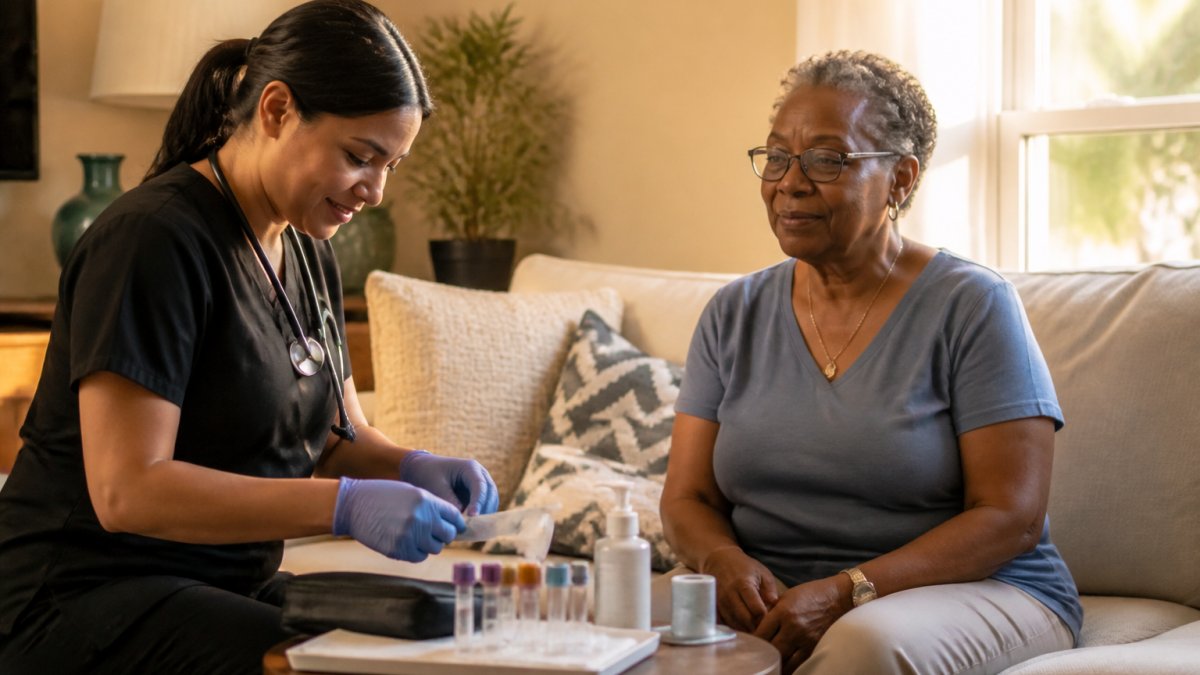
Missed lab appointments are one of the quiet problems in chronic care. When a draw happens at home, the barriers that cause those misses mostly disappear.
Reduced Travel Barriers and Waiting Room Time
Getting to a lab involves arranging transportation, navigating parking, and sitting in a crowded waiting room. For someone who tires easily or has a weakened immune system, that exposure and effort add up.
Home collection removes the trip entirely, no waiting room, no travel time, no rearranging your day around a lab’s hours. For patients who need routine labs every few weeks, that saved time compounds quickly.
Support for Older Adults, Caregivers, and People With Limited Mobility
Older adults, people with mobility issues, and their caregivers often carry the heaviest testing burden. A home visit means no wheelchair transfer into a car, no long walk from a parking lot, and no risk of a fall on unfamiliar ground.
Caregivers benefit too. Instead of coordinating a trip around work and transportation, they simply open the door. Assisted living facilities use mobile collection to handle multiple residents in one visit rather than arranging group transport.
Preparing for an In-Home Blood Draw: Practical Steps
A little preparation makes the visit faster and the draw easier. Most of it takes five minutes the day before.
What to Have Ready Before the Phlebotomist Arrives
Have these items within reach when your phlebotomist arrives:
- Your photo ID and insurance card
- The lab requisition or order from your physician
- A list of your current medications, including dosages
- A glass of water (hydration makes veins easier to find)
If you are fasting, confirm with your physician how long to hold off on food and drink, and ask whether any medications should be timed differently around the draw. For patients with needle phobia, tell the phlebotomist up front, a calm, unhurried approach makes a real difference.
Pro Tip
Drink water in the two hours before your appointment. Hydrated veins are fuller and easier to access, which often means a faster, more comfortable draw on the first attempt.
Drink water in the two hours before your appointment. Hydrated veins are fuller and easier to access, which often means a faster, more comfortable draw on the first attempt.
Mobile Phlebotomy Insurance Coverage and Out-of-Pocket Costs
Insurance coverage for mobile phlebotomy depends on your plan, your diagnosis, and whether the draw is medically necessary.
Some plans treat home collection as a covered home-health benefit. Others apply it to your deductible or consider it a convenience service.
Because coverage varies so much, check three things before you book:
- Whether your plan covers home specimen collection
- Whether a physician order is required for reimbursement
- What your out-of-pocket responsibility would be
Mobile phlebotomy pricing depends on your location, the number of draws, and your insurance situation. Call your insurer directly and ask for the specific billing code.
Therapeutic Phlebotomy vs. Diagnostic Blood Draw: Key Differences
These two procedures look similar but serve opposite purposes. Diagnostic blood draw means collecting blood to test it. Therapeutic phlebotomy means removing blood to treat a condition, such as hemochromatosis or polycythemia, where excess iron or red blood cells need to be reduced.
| Feature | Diagnostic Blood Draw | Therapeutic Phlebotomy |
|---|---|---|
| Purpose | Collect a sample for testing | Remove a set volume of blood |
| Volume | Small, a few tubes | Larger, prescribed amount |
| Frequency | Per testing schedule | Per treatment plan |
| Ordering | Physician requisition | Physician treatment order |
| Result | Lab values reported | Symptom and level management |
For patients who need therapeutic phlebotomy on a recurring schedule, home visits remove the burden of repeated clinic trips. Diagnostic draws follow your monitoring schedule. Both can be handled at home by a licensed phlebotomist.
Safety, Sample Integrity, and When In-Person Care Is Needed
Home collection is safe when done by a trained, licensed professional using sterile, single-use equipment. The same standards that apply in a clinic apply at your kitchen table, and “safe” is a set of specific practices you can ask about before you book.
What Protects Sample Integrity in the Home
A blood sample is only useful if it arrives at the lab in the same condition it left your arm. Several things have to go right between the draw and the analyzer:
- Identity confirmation. The phlebotomist verifies your name, date of birth, and the ordering physician against the requisition before the draw. This prevents the worst-case error in lab medicine: a result filed under the wrong patient.
- Correct tube order and additives. Different tests require different tubes, some with clot activators, some with anticoagulants like EDTA or citrate. Drawing into the wrong tube, or in the wrong order, can invalidate a result. This is a trained skill, not a formality.
- Labeling at the bedside. Tubes are labeled in your presence, not later. Most labs and accreditation standards require labeling at the point of collection to prevent mix-ups.
- Temperature and time limits. Some specimens are stable at room temperature for hours; others need refrigeration or special handling. A phlebotomist who understands transport logistics keeps the sample within the window the lab requires.
If any of these steps are skipped, the lab may reject the specimen and you may need a redraw. That is the outcome home collection is designed to prevent, so it is fair to ask a service how they handle labeling, transport, and turnaround.
Infection Control and Privacy in Your Home
Sterile, single-use needles and supplies are standard. The phlebotomist should arrive with sealed supplies, use gloves, and dispose of sharps in an approved container, not your household trash.
Privacy works differently at home than in a clinic: you control who is in the room. If you would rather a family member or caregiver not be present, say so; if you want them there, that is your call.
When In-Person Care Is the Better Choice
Home collection is not right for every situation. You may need in-person care if:
- You require urgent or stat labs with immediate physician review, the turnaround time from a home draw may not meet that need
- Your veins are extremely difficult and prior home attempts have failed
- You need imaging, a physical exam, or other services alongside the draw
- You are acutely ill and need clinical evaluation, not just a specimen
For everything else, a home visit is a practical option. If you are unsure which applies to you, your physician can tell you whether home collection fits your care plan.
Watch Out
Never skip a scheduled blood test because getting to the lab is inconvenient. Untracked chronic conditions can worsen quietly, and your physician can only adjust treatment based on the numbers in front of them.
Never skip a scheduled blood test because getting to the lab is inconvenient. Untracked chronic conditions can worsen quietly, and your physician can only adjust treatment based on the numbers in front of them.
Frequently Asked Questions
Is mobile phlebotomy covered by insurance?
Coverage varies by plan and by why the draw is ordered. Many insurance plans cover the laboratory test itself when it is medically necessary, but the mobile visit fee may be billed separately and is not always reimbursed. Medicare and most commercial plans handle the lab portion differently from the convenience fee. Check with your insurer before scheduling so you know what you will owe out of pocket. Phlebotomy Experts can share current service details when you call to book.
How often do people with chronic conditions need blood tests?
Frequency depends on the condition and how stable it is. Someone managing diabetes may check A1C every three to six months, while a patient on blood thinners or dialysis may need more frequent monitoring. Your doctor sets the schedule based on your treatment plan and recent results. Mobile phlebotomy makes recurring testing easier to keep up with because the draw comes to you instead of requiring a separate lab trip each time.
What should I do to prepare for an in-home blood draw?
Ask your ordering provider whether you need to fast and for how long, since some tests require 8 to 12 hours without food. Drink water beforehand to make veins easier to find, and wear a short-sleeved shirt or one with loose sleeves. Have your insurance card, photo ID, and the lab order ready. Clear a small table or counter near where you will sit, and let the phlebotomist know about any medications, needle anxiety, or past difficult draws.
What is the difference between mobile phlebotomy and therapeutic phlebotomy?
Mobile phlebotomy describes where and how blood is collected, meaning a licensed phlebotomist comes to your home or office instead of you traveling to a lab. Therapeutic phlebotomy describes why blood is removed, such as treating iron overload in hemochromatosis or certain blood disorders. A diagnostic blood draw is collected for testing. A single visit can involve either purpose, but the terms answer different questions: one is about location, the other about medical intent.
