Orange County Labs alternative for professionals: compare mobile phlebotomy, concierge lab testing, pricing, turnaround times and HIPAA compliance. Get.
Mobile Phlebotomy for Assisted Living: A 2026 Guide
Table of Contents
- Why Assisted Living Communities Rely on Mobile Phlebotomy
- The Mobile Blood Draw Process: From Scheduling to Results
- How to Properly Store Blood Samples Before Lab Transport
- CLIA Requirements for Mobile Phlebotomy in Senior Care
- Routine vs. Stat Draws: Scheduling for Your Facility
- Evaluating the Cost-Benefit for Facility Administrators
- Mobile Phlebotomy for Assisted Living: Key Considerations
- Frequently Asked Questions
Last Updated: September 9, 2026
Why Assisted Living Communities Rely on Mobile Phlebotomy
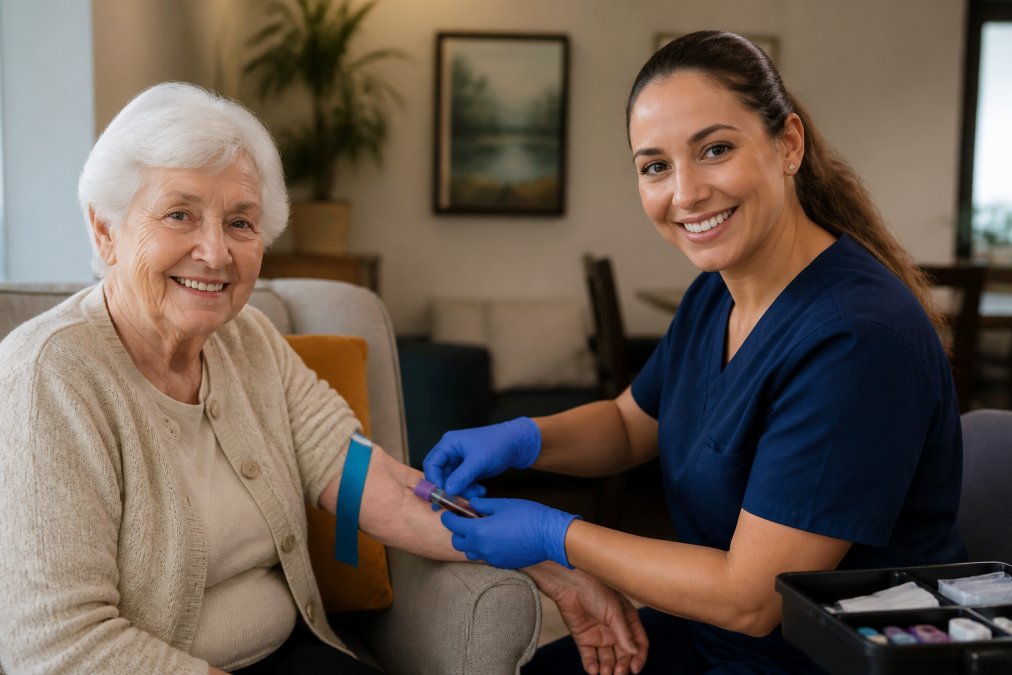
For residents of assisted living facilities, a routine blood draw often means a stressful, uncomfortable journey. Coordinating transportation, navigating waiting rooms, and managing mobility challenges turns a simple diagnostic test into an all-day ordeal. Mobile phlebotomy for assisted living solves this by bringing the laboratory to the resident, eliminating the logistical friction that often leads to missed or delayed diagnostic testing.
Mobile phlebotomy is the practice of a licensed phlebotomist traveling to a patient’s location to perform venipuncture and collect specimens for laboratory analysis. This approach directly supports geriatric care by prioritizing patient comfort, reducing fall risks associated with transport, and ensuring clinical accuracy through proper specimen handling in a calm, familiar environment.
The benefits extend beyond simple convenience. For administrators, mobile services reduce the staff hours spent on transportation logistics. For residents, the anxiety of a clinic visit disappears, which often leads to better cooperation and fewer repeat draws. This is preventative screening and chronic condition management delivered on-site, which supports resident wellness and improves the overall quality of life for those in skilled nursing and memory care environments.
The Mobile Blood Draw Process: From Scheduling to Results
A typical mobile blood draw follows a clear, coordinated sequence designed to protect patient safety and specimen integrity. The process begins with the facility sending physician orders to the mobile service, followed by insurance verification and scheduling. On the day of the visit, the phlebotomist arrives with all necessary equipment, confirms patient identity, and performs the draw in the resident’s room.
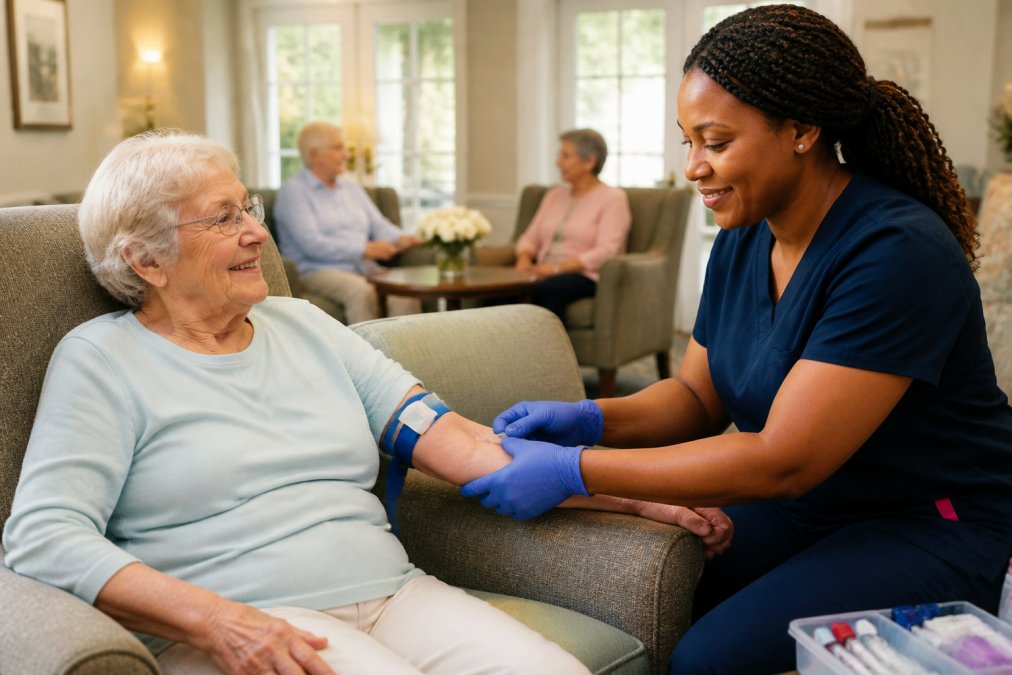
Here is how the standard workflow breaks down:
- Order Entry: The facility transmits physician orders, including the specific tests required, to the mobile service.
- Scheduling: A mutually convenient time is set, often coordinating with medication schedules or meal times.
- Insurance Verification: The service confirms coverage and obtains any necessary pre-authorizations before the visit.
- Specimen Collection: The phlebotomist performs the draw, labels the tubes at the bedside, and confirms chain of custody.
- Transport: Specimens are placed in proper transport bags and delivered to the designated laboratory by a lab courier.
- Results: The lab processes the samples and sends results directly to the ordering physician, who then updates the resident’s medical records.
What most guides miss is the importance of communication. A good service updates the facility on arrival times and flags any issues with difficult veins immediately, rather than after the courier has left. This reduces the need for repeat visits and keeps healthcare coordination seamless.
How to Properly Store Blood Samples Before Lab Transport
Proper specimen handling is the critical link between a successful blood draw and accurate lab results. The moment blood leaves the vein, a clock starts ticking. Improper storage can compromise specimen integrity, leading to hemolysis or degraded samples that force residents to undergo a second painful draw.
The storage requirements depend entirely on the type of test ordered. However, several universal rules apply. Whole blood samples for routine chemistry are typically kept at room temperature, away from direct sunlight and extreme heat (the CDC). Samples requiring serum separation often need to clot for a specific period before centrifugation. Tubes for tests like basic metabolic panels should never be refrigerated, as cold temperatures can cause potassium leakage from cells, skewing results.
A common mistake is placing all samples in a cooler, regardless of test type. This can ruin samples that need to remain at ambient temperature. The phlebotomist must follow the specific transport guidelines for each tube type. This attention to detail is why working with a service that employs trained, licensed phlebotomists matters; they understand the nuances of specimen processing and temperature requirements that laypeople might overlook.
CLIA Requirements for Mobile Phlebotomy in Senior Care
Facility administrators often ask about the regulatory standards governing mobile services. The primary oversight comes from the Clinical Laboratory Improvement Amendments (CLIA), which is administered by the Centers for Medicare & Medicaid Services (CMS). A common misconception is that CLIA certification applies to the phlebotomist or the mobile service itself. In reality, CLIA certification is issued to the laboratory that performs the testing. The mobile phlebotomy service is an extension of that lab’s collection network.
This distinction matters for compliance. When you contract with a mobile phlebotomy provider, you are effectively relying on the CLIA certificate of the laboratory they send specimens to. There are three main types of CLIA certificates, and the type dictates the level of oversight:
- Certificate of Waiver (CoW): For labs performing only waived tests, such as certain urine dipsticks or fecal occult blood tests. These have the least regulatory burden.
- Certificate for Provider-Performed Microscopy (PPM): For labs where a provider performs specific microscopic tests during a patient visit.
- Certificate of Compliance or Accreditation: For labs performing moderate- or high-complexity testing, which includes most routine chemistry panels, CBCs, and therapeutic drug monitoring. These labs undergo routine inspections and must participate in proficiency testing.
For an assisted living facility, the relevant question is not whether the phlebotomist has a CLIA certificate, but rather: What is the CLIA certificate type of the laboratory that will process our residents’ samples? A reputable mobile service will readily provide the CLIA number and certificate type of their partner lab. You can verify this number directly on the CMS CLIA database, which is publicly accessible.
Beyond the lab’s certification, the mobile service itself must comply with the OSHA Bloodborne Pathogens Standard (29 CFR 1910.1030). This standard mandates a written Exposure Control Plan, the use of engineering controls like safety needles, and the provision of hepatitis B vaccinations to employees (osha.gov). When evaluating a provider, ask for a copy of their Exposure Control Plan and their sharps disposal protocol. They should be using OSHA-compliant sharps containers that are puncture-resistant, leak-proof, and properly labeled.
State-level regulations also play a role. While CLIA is federal, phlebotomy certification requirements vary by state. Some states require phlebotomists to hold a state-issued license or certification, while others rely on national credentials like the CPT1 (Certified Phlebotomy Technician I) from the American Society for Clinical Pathology (ASCP) or the Phlebotomy Technician (PBT) credential from the American Medical Technologists (AMT). A best practice is to request documentation of each technician’s current certification and verify that it has not lapsed. Most national certifications require continuing education credits for renewal, which ensures the phlebotomist stays current on best practices for geriatric care.
A final compliance point that is often overlooked is the chain of custody for specimens. While this is critical for forensic testing, it is also relevant for routine clinical draws. The phlebotomist must document the time of collection, the initials of the collector, and the time the specimen was handed off to the courier. This documentation protects the facility if a result is questioned. A robust mobile service will have a digital chain-of-custody log that you can audit. Ask to see a sample log during your vendor evaluation.
Watch Out
Do not assume that a mobile phlebotomy service is ‘CLIA certified’ just because they claim to be. Always request the specific CLIA certificate number of the processing laboratory and verify it on the CMS public database.
Do not assume that a mobile phlebotomy service is ‘CLIA certified’ just because they claim to be. Always request the specific CLIA certificate number of the processing laboratory and verify it on the CMS public database.
By understanding the distinction between the lab’s CLIA status and the phlebotomist’s certification, you can make an informed decision that protects your residents and your facility from regulatory liability.
Routine vs. Stat Draws: Scheduling for Your Facility
Efficient scheduling is the backbone of a successful mobile phlebotomy program. Facilities typically need two types of service: routine draws and stat (urgent) draws. Understanding the difference is crucial for managing both resident care and staff expectations. However, the real-world execution requires more nuance than a simple two-column table.
Routine Draws: The Rhythm of Chronic Care
Routine draws are scheduled in advance, often on a weekly or bi-weekly basis. These are for chronic condition management, such as monitoring INR levels for warfarin (Coumadin) therapy, HbA1c for diabetes, or basic metabolic panels for renal function. The key to efficient routine scheduling is batching. Most mobile services offer a discounted per-draw rate for a minimum of 5-10 draws per visit. For a facility with 50 residents, this means coordinating a single morning visit where the phlebotomist sees 8-10 residents consecutively.
The critical operational detail for routine draws is fasting status. Many common tests, such as lipid panels and fasting glucose, require an 8-12 hour fast. Scheduling a morning visit means residents must fast overnight, which can be disruptive for diabetic residents or those on scheduled meals. A best practice is to coordinate the phlebotomy visit with the facility’s breakfast service. The phlebotomist draws the fasting residents first, and the dietary team holds their breakfast trays until the draw is complete. This requires clear communication between the mobile service, the nursing staff, and the dietary department.
Another scheduling consideration is medication timing. For residents on diuretics, a morning draw might be preferred before their medication is administered to get a baseline reading. For those on insulin, the draw should be coordinated with their blood glucose monitoring schedule. The facility’s medication pass schedule should be shared with the mobile service so they can avoid interrupting medication administration.
Stat Draws: The Urgent Diagnostic Pathway
Stat draws are for urgent clinical situations where results are needed immediately to make a treatment decision. Common triggers include:
- Acute change in mental status: Sudden confusion or lethargy may indicate an infection, electrolyte imbalance, or adverse drug reaction.
- Suspected infection: A sudden fever, especially in a resident with a urinary catheter, warrants an immediate CBC and urinalysis.
- Cardiac events: Chest pain or new-onset shortness of breath requires a troponin level and basic metabolic panel.
- Medication toxicity: A resident showing signs of digoxin toxicity or a supratherapeutic INR with bleeding requires an immediate level.
The clinical reality is that a stat draw is not just about speed; it is about result interpretation. A typical stat turnaround is 2-6 hours from draw to result (peer-reviewed research). However, the phlebotomist must also flag the specimen for the lab to prioritize processing. This is a distinct workflow from routine draws. The mobile service must have a protocol for dispatching a phlebotomist within 60-90 minutes of the request, and the courier must be on standby for immediate transport.
| Draw Type | Typical Turnaround | Best Use Case | Scheduling | Key Operational Detail |
|---|---|---|---|---|
| Routine | 24-72 hours | Monthly labs, medication monitoring | Scheduled days in advance | Coordinate with fasting and medication schedules |
| Stat | 2-6 hours | Acute illness, critical value checks | Same-day, immediate dispatch | Requires dedicated courier and lab priority flagging |
For administrators, the strategy is to batch routine draws to maximize efficiency, minimizing the number of visits per week. Reserve stat requests for genuine emergencies. A mobile service that offers both options provides flexibility, but overusing stat services can increase costs.
A practical framework for your nursing staff is to use the ‘could this wait until tomorrow morning?’ test. If the answer is yes, it is not a stat draw. If the answer is no, and the resident is clinically unstable, then a stat draw is appropriate. For borderline cases, a ‘same-day’ or ‘urgent routine’ draw with a 6-12 hour turnaround can be a cost-effective middle ground. Many mobile services offer this tier, which is faster than routine but less expensive than a true stat dispatch.
Planning ahead for routine blood work is the most effective way to manage the facility’s budget while ensuring residents receive timely diagnostic testing. By establishing clear clinical triggers for stat draws and a structured batching schedule for routine draws, you can reduce costs, minimize resident disruption, and ensure that urgent diagnostic needs are met without delay.
Evaluating the Cost-Benefit for Facility Administrators
The decision to adopt mobile phlebotomy often comes down to a cost-benefit analysis. On the surface, a per-draw mobile fee may seem higher than the cost of a resident taking a group transport van to a central lab. However, the full accounting tells a different story.
The hidden costs of off-site draws include staff time for transportation logistics, the risk of resident injury during transfers, and the administrative burden of missed appointments. When a resident misses a draw, the consequence is often a delayed diagnosis or an unnecessary emergency room visit, both of which carry significant financial and clinical costs. Mobile services reduce these risks by bringing on-site services directly to the resident.
For a facility administrator, the value proposition is clear. Mobile phlebotomy reduces transportation burdens, freeing up staff to focus on direct care rather than acting as escorts. It also improves resident satisfaction, a key metric for family communication and facility reputation. The pricing for mobile services depends on the volume of draws, the frequency of visits, and the specific tests required. To get an accurate picture, request a custom quote based on your facility’s census and typical testing patterns, rather than comparing a single published price.
Mobile Phlebotomy for Assisted Living: Key Considerations
Choosing the right mobile phlebotomy partner requires looking beyond the convenience factor to examine operational competence. The ideal provider acts as an extension of your clinical team, not just a vendor that shows up for a stick.
First, verify that the service employs licensed phlebotomists with specific experience in geriatric care. Difficult veins and fragile skin are common in the elderly population, requiring a gentle touch and advanced venipuncture skills. Second, inquire about their integration with Electronic Health Records (EHR). A provider that can seamlessly transmit orders and results reduces the risk of transcription errors and saves your nursing staff valuable time. Finally, ask about their quality assurance process for handling issues like specimen rejection or the need for a redraw. A clear, accountable process is a sign of a mature organization.
Facilities that successfully implement mobile blood draw programs report fewer missed labs and higher satisfaction among residents and families. It is a practical solution that addresses the realities of transportation logistics while upholding the dignity of the residents. When you find a partner that combines clinical accuracy with genuine patient comfort, the decision becomes less about cost and more about the standard of care you can offer.
Choosing the right partner for on-site lab work is a decision that affects resident wellness and operational efficiency. The challenge is finding a team that treats every resident with patience and skill while maintaining rigorous clinical standards. Phlebotomy Experts offers licensed technicians with a professional bedside manner, specializing in gentle draws for elderly patients. We handle the scheduling, the specimen collection, and the prompt delivery to the laboratory of your choice, ensuring your medical records are updated without delay. Get started with Phlebotomy Experts and bring reliable, compassionate diagnostic services directly to your residents. Call now to schedule a consultation.
Frequently Asked Questions
Does Medicare pay for mobile phlebotomy services for seniors?
Medicare Part B typically covers diagnostic lab tests ordered by a physician, and the associated blood draw is covered when performed by a participating provider. However, coverage for the travel or convenience component of a mobile visit is not guaranteed. The best approach is to verify coverage before the appointment. The service can perform insurance verification, but you should also confirm with your Medicare plan that the specific mobile service and the ordered tests are covered to avoid unexpected out-of-pocket costs.
How does mobile phlebotomy benefit residents in assisted living?
The main benefit is removing the stress and physical strain of travel. Residents with mobility issues, dementia, or chronic conditions avoid the discomfort of a van ride, long waits in a clinic, and the disruption to their daily routine. On-site draws happen in a familiar, calm environment, which often makes the process easier for residents and reduces anxiety. For staff, it means fewer off-site appointments to coordinate and less time spent on transportation logistics, improving overall resident wellness and operational efficiency.
What safety protocols must mobile phlebotomists follow in clinical settings?
Mobile phlebotomists must follow the same standard precautions as clinic staff, including hand hygiene, wearing fresh gloves for each draw, and proper disposal of sharps in a biohazard container. They should also follow HIPAA guidelines to protect resident privacy, which includes not discussing results in common areas. For facilities, it is important to confirm the service has liability insurance and that technicians follow OSHA standards for bloodborne pathogens. Ask about their specific infection control procedures for visiting a multi-resident facility.
How are blood samples stored and transported from assisted living facilities?
Proper storage and transport are critical for accurate test results. Samples are typically placed in a labeled biohazard bag and stored in a secure, temperature-controlled transport cooler immediately after the draw. The phlebotomist must follow specific handling requirements based on the test, such as protecting light-sensitive specimens or keeping certain tubes at a specific temperature. The goal is to deliver the specimens to the laboratory for processing within a set timeframe to ensure the integrity of the sample and the reliability of the lab results.

Related Posts