Breaking down the cost of in home blood draws: collection fees, lab charges, insurance, and what you actually pay out-of-pocket.
Is Mobile Phlebotomy Safe? Safety, Credentials & What to Expect
Table of Contents
- What Mobile Phlebotomy Is and Why Safety Comes Down to the Provider
- Mobile Phlebotomy Requirements: Licensing, Credentialing, and Background Screening
- Mobile Phlebotomy Specimen Transport Standards and Chain of Custody
- Infection Control, Sterile Collection, and Sharps Disposal at Home
- How to Find a Reputable Mobile Phlebotomy Service
- When to Choose a Lab Visit or Clinic Instead
- Conclusion
- Frequently Asked Questions
Last Updated: September 30, 2026
What Mobile Phlebotomy Is and Why Safety Comes Down to the Provider
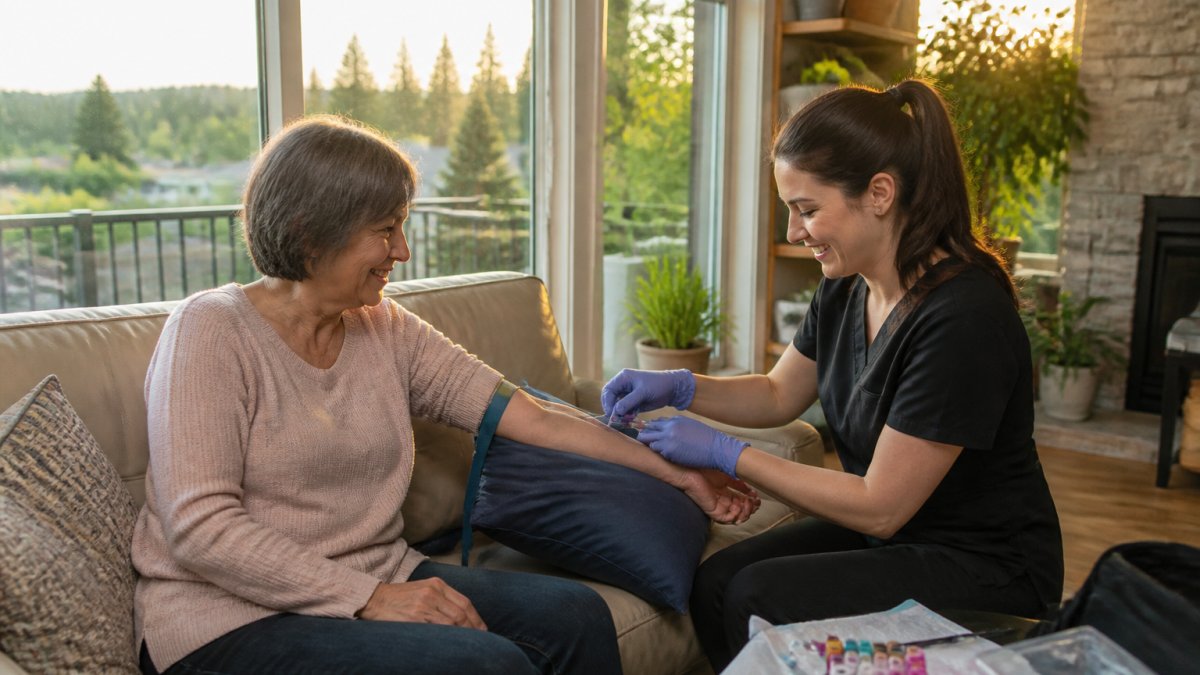
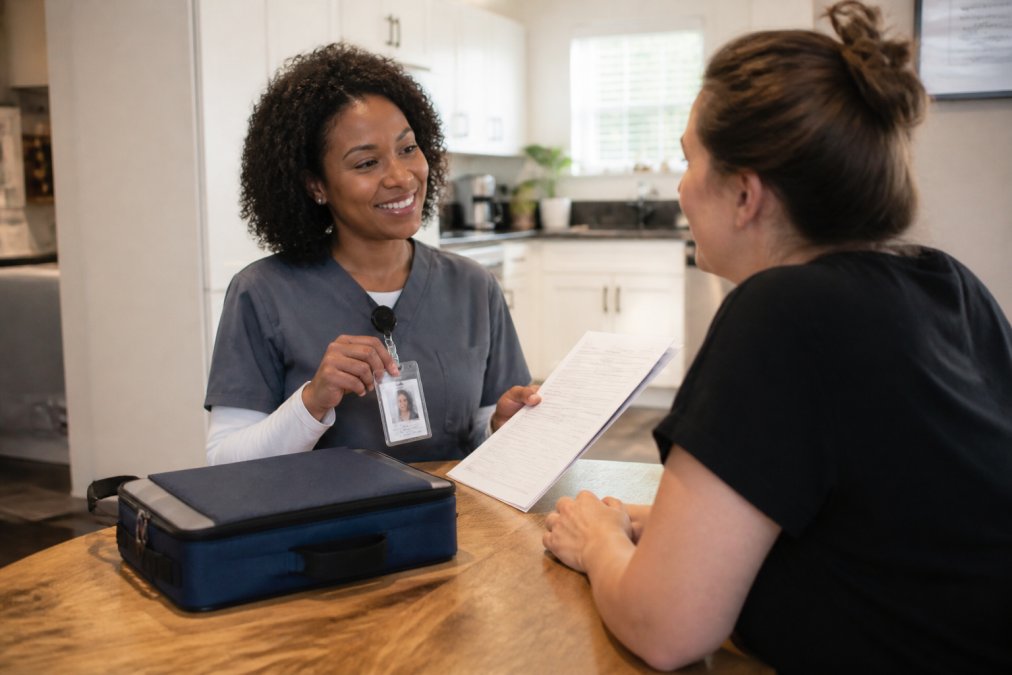
Mobile phlebotomy is the practice of drawing blood at a patient’s home, office, or care facility instead of a clinic or standalone lab. The question of is mobile phlebotomy safe has a direct answer: the draw itself is as safe as any clinical blood draw when a licensed, credentialed phlebotomist follows standard precautions. Safety depends almost entirely on who shows up at your door, not where the draw happens.
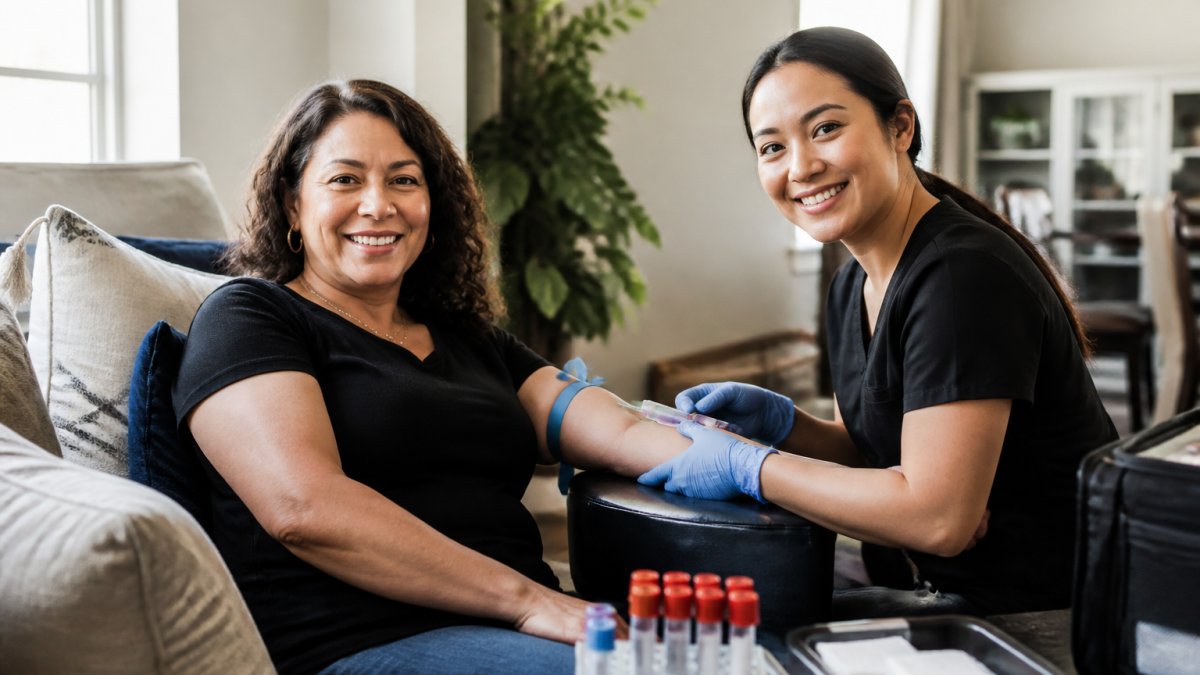
The In-Home Blood Draw, Step by Step
- Identity verification. The phlebotomist confirms your name, date of birth, and the test order against a photo identification.
- Hand hygiene and glove change. Clean hands and fresh gloves before any contact with your skin.
- Site selection and antisepsis. The draw site is cleaned with an approved antiseptic and allowed to dry.
- Venipuncture. A single-use needle collects the specimen into labeled tubes.
- Specimen labeling at the bedside. Tubes are labeled in your presence, not later.
- Hemostasis. Pressure and a bandage stop bleeding; the needle goes straight into a sharps container.
- Transport. The sealed specimen leaves with the phlebotomist for delivery to the lab you or your physician selected.
Mobile Phlebotomy Requirements: Licensing, Credentialing, and Background Screening
Licensing rules vary by state, and no single national license covers every market. Most states require certification through an accredited body, and many employers add background screening and drug testing. Ask which certification your technician holds and which state agency oversees it.
Mobile Phlebotomy Specimen Transport Standards and Chain of Custody
Specimen integrity depends on time, temperature, and handling: blood samples degrade if they sit too long or are stored at the wrong temperature, which is why transport standards exist. A reputable service delivers specimens to the laboratory or hospital of the patient’s choice and can tell you how long delivery typically takes.
What Chain of Custody Actually Documents
A complete chain of custody record is a sequence of handoffs, each capturing the same core fields:
- Collector identity. Name, certification number, and the service that dispatched them.
- Patient identity match. Name and date of birth confirmed against the test order and photo ID.
- Collection timestamp. Date and clock time the specimen was drawn, not the time the visit was scheduled.
- Specimen description. Tube type, additive (for example, lavender-top EDTA or gold-top serum separator), and the number of tubes drawn.
- Condition at handoff. Whether the specimen was intact, sealed, and within the required temperature range.
- Each subsequent transfer. Every person who takes possession signs and timestamps, from the phlebotomist to the courier to the receiving lab accessioning desk.
Temperature and Time: The Two Variables That Break Samples
Different tests tolerate different handling. A common pattern in lab requirements:
- Refrigerated specimens (typically 2°C to 8°C) for many chemistry and hormone panels that degrade at room temperature.
- Room temperature (roughly 20°C to 25°C) for certain coagulation and hematology tests that cold can distort.
- Protected from light for bilirubin and some vitamin assays, which is why you may see tubes wrapped in foil or placed in an amber sleeve.
- On ice for specific ammonia and blood gas collections.
How to Verify Custody Yourself
You do not need to be a lab auditor to confirm the basics. At collection:
- Watch the phlebotomist label each tube at your bedside, in your presence.
- Confirm the label shows your name, date of birth, and collection time.
- Watch the tubes go into the sealed transport container.
- Ask the phlebotomist to state the destination lab out loud.
- If chain of custody applies to your draw, ask to see the form and confirm your name is on it before it leaves.
Pro Tip
Ask the phlebotomist to show you the sealed transport container before it leaves your home, and confirm the label matches your name and date of birth. If a sample is ever questioned, that moment is your proof it left you correctly.
Ask the phlebotomist to show you the sealed transport container before it leaves your home, and confirm the label matches your name and date of birth. If a sample is ever questioned, that moment is your proof it left you correctly.
When Chain of Custody Is Legally Required
For workplace drug testing governed by federal rules, forensic draws, and clinical trial specimens, chain of custody is a regulatory requirement, not a courtesy. The collection site, collector, and courier are all documented, and the specimen may be split into an A and B sample for confirmatory testing if the first is challenged. If your draw falls into these categories, ask in advance whether the service supports documented custody, because not every mobile provider does.
What to Ask Before You Book
- What is the typical time from draw to lab accession?
- How is temperature maintained in transit, cooler, ambient, or temperature-controlled case?
- Is the transport container sealed and tamper-evident?
- Who signs the specimen over to the lab, and can I get a copy of the custody record?
- What happens if the lab rejects the specimen, who pays for the redraw?
Infection Control, Sterile Collection, and Sharps Disposal at Home
Infection control at home follows the same clinical standards as a hospital draw: single-use needles, sterile collection tubes, antiseptic skin prep, and gloves changed between patients. Nothing about a home setting lowers the standard.
Watch Out
Never let anyone recap a used needle by hand or drop it loose into a trash can. A loose needle in household waste is a biohazard exposure risk for whoever handles that bag, and it is a clear sign the technician is not following standard operating procedures.
Never let anyone recap a used needle by hand or drop it loose into a trash can. A loose needle in household waste is a biohazard exposure risk for whoever handles that bag, and it is a clear sign the technician is not following standard operating procedures.
How to Find a Reputable Mobile Phlebotomy Service
Finding a reputable mobile phlebotomy service comes down to verification, not marketing. Any provider can claim to be licensed; fewer can show the paperwork on request. The best services welcome the question, because it separates them from the ones that do not.
Start with these three questions:
- Who is coming, and what are their credentials? Ask for the technician’s certification and state oversight.
- Where does my sample go, and how fast? Confirm the destination lab and the typical transport window.
- What happens if something goes wrong? Ask about emergency protocols, including how a vasovagal response (fainting) is handled on site.
What a Real Emergency Protocol Looks Like at Home
A clinic has a code team down the hall; a home draw does not, which is why the protocol matters more, not less. A prepared mobile phlebotomist follows a defined response sequence:
- Recognize the early signs. Warmth, clamminess, pallor, sweating, nausea, a sudden feeling of lightheadedness, or a drop in responsiveness. The technician should be watching your face and asking how you feel, not just watching the needle.
- Stop the draw and reposition. Needle withdrawn, pressure applied, and the patient laid flat with legs elevated to restore blood flow to the brain. This is the single most effective intervention for a simple faint.
- Protect the airway and prevent a fall. If the patient is seated, the technician supports them to the floor rather than letting them slump out of a chair. Head injury from a fall is the most common serious complication of a fainting episode.
- Assess and monitor. Check responsiveness, breathing, and pulse. Most vasovagal episodes resolve within a minute or two once the patient is flat.
- Escalate when it does not resolve. If the patient does not recover quickly, has chest pain, difficulty breathing, seizure activity, or a prolonged loss of consciousness, the technician calls 911. A prepared provider has the patient’s address and a phone ready before the draw starts.
- Document the event. The incident should be recorded and reported to the ordering provider, because it may affect future draws and the patient’s care plan.
Watch Out
A phlebotomist who has no answer for “what do you do if I faint?” is telling you something. The correct answer is a sequence, not a shrug. If the response is vague, reschedule with a different provider.
A phlebotomist who has no answer for “what do you do if I faint?” is telling you something. The correct answer is a sequence, not a shrug. If the response is vague, reschedule with a different provider.
Other Situations the Protocol Should Cover
Fainting is the most common adverse event, but not the only one. Ask how the provider handles:
- Prolonged bleeding at the puncture site, especially for patients on blood thinners.
- Hematoma, a bruise that swells under the skin when the vein is missed or leaks.
- Needle stick or blood exposure to the technician, which triggers a post-exposure protocol.
- Allergic reaction to antiseptic or adhesive, which is uncommon but possible.
- A patient who becomes unresponsive with no prior warning.
A Quick Credential Verification Checklist
- Technician’s phlebotomy certification name and number provided on request
- State licensing or oversight body confirmed
- Background screening completed by the employer
- Photo identification presented at the door
- Sealed, single-use collection kit opened in front of you
- Tubes labeled at your bedside, in your presence
- Sharps container present and used for the needle
- Transport container sealed and destination lab named
- Chain of custody documentation available for trial, sports, or legal draws
- HIPAA compliance confirmed for any paperwork or digital records
- Written emergency protocol available on request
- Technician carries a phone and can reach emergency services from your address
HHS information on HIPAA privacy protections explains what patient privacy protections apply to your health information once a specimen is collected and a result is generated.
Red Flags That Should End the Visit
Even after you book, watch for signs the technician is not following standard procedure. Any of these is reason to stop the draw:
- The collection kit is already open when they arrive.
- Tubes are pre-labeled before your identity is confirmed.
- The technician attempts to recap a used needle by hand.
- No sharps container is present.
- They cannot name the destination lab.
- They dismiss your questions about credentials or emergency response.
When to Choose a Lab Visit or Clinic Instead
Home draws are not right for every situation. If you need imaging, an exam, or an immediate result, a clinic or hospital is the correct setting, mobile phlebotomy handles specimen collection, not diagnosis.
| Situation | Better Choice | Why |
|---|---|---|
| Routine blood panel, stable patient | Mobile draw | Convenience, no waiting room |
| Needle phobia or difficult veins | Mobile draw with an experienced technician | Calmer setting, focused attention |
| Mobility limitations or chronic conditions | Mobile draw | No travel or transfer required |
| Assisted living, multiple residents | On-site mobile draw | One visit covers several patients |
| Imaging, exam, or urgent symptoms | Clinic or hospital | Requires equipment or immediate care |
| Suspected emergency | Call 911 | Home collection cannot address it |
Conclusion
Verifying credentials, transport standards, and sharps handling takes ten minutes and removes most of the uncertainty from a home blood draw. The safest option is a provider that answers every question without hesitation and shows its documentation on request. Phlebotomy Experts sends licensed phlebotomists to homes and offices, delivers specimens to the laboratory or hospital of your choice, and brings a bedside manner built for anxious patients, difficult veins, and children.
Frequently Asked Questions
What are the risks of mobile phlebotomy?
The risks mirror those of any blood draw: bruising, soreness at the puncture site, and a possible vasovagal response such as lightheadedness. In a home setting, two extra considerations matter: infection control and specimen handling. A credentialed phlebotomist follows standard operating procedures for sterile collection, uses single-use needles, and seals biohazard materials for proper medical waste disposal. Ask any provider how they handle a fainting episode, since response planning is a mark of a safe mobile phlebotomy service.
Are mobile phlebotomists required to be licensed or certified?
Requirements vary by state, so mobile phlebotomy requirements are not uniform nationwide. Many states do not issue a standalone phlebotomy license, but employers and laboratories frequently require national certification and documented training in venipuncture. Some states do regulate the practice directly. Because rules differ, ask the provider which credential their technicians hold and which state requirements apply where you live. A reputable service answers this without hesitation and can show documentation.
How do mobile phlebotomists ensure specimen integrity during transport?
Mobile phlebotomy specimen transport standards center on temperature, timing, and chain of custody. Tubes are labeled at the point of care, placed in sealed transport bags, and kept at the temperature the test requires, with some samples needing a portable centrifuge or cold pack. The phlebotomist logs the handoff to the clinical laboratory so the specimen’s path is documented. If a sample is compromised, the lab rejects it and the test must be repeated, so ask how the provider tracks delivery.
Is mobile phlebotomy covered by insurance?
Coverage depends on your plan and the reason for the draw. Medically necessary lab work ordered by a physician is often covered, but the mobile convenience fee may be billed separately and is frequently an out-of-pocket cost. Before booking, ask the service for an itemized breakdown and check with your insurer whether home collection is a covered benefit. Pricing varies by provider, location, and test type, so request a quote in writing rather than assuming the cost matches a walk-in lab.

Related Posts